Why 26% of restaurants are turning to AI agents
Learn why 26% of operators turn to an AI agent for restaurant management. Automate inventory, marketing, and scheduling via text to reclaim manager time.
Your managers are stretched to their limits. Between persistent labor shortages – with hospitality job openings routinely exceeding one million according to National Restaurant Association data – and chronic turnover, operators are constantly on the defensive. Many are forced to sacrifice their work-life balance and work excessively long hours just to cover basic floor shifts and administrative gaps.
Faced with this exhaustion, the industry is shifting. The latest State of the Restaurant Industry report highlights that 26% of operators now use AI-related tools to streamline their businesses.
But the next competitive frontier is not another static dashboard or complex back-office portal. The real transformation lies in conversational AI agents that allow you to manage your entire storefront through natural language.
What is an AI agent for restaurants?
Traditional software requires manual data entry, endless clicking, and tedious employee training. An AI agent is fundamentally different. It acts as an autonomous virtual assistant that understands natural language, reasons through multi-step operational tasks, and executes those decisions directly across your tech stack.
Instead of logging into five different dashboards to adjust menu pricing, check stock, or pull sales reports, you can run your restaurant by texting it. The AI agent acts as a conversational control layer. It translates simple messages sent via Slack, Claude, or ChatGPT into immediate, accurate changes within your point-of-sale (POS) and back-office databases.
Streamlining operations and inventory
Managing daily back-of-house logistics is notoriously complex, which explains why 52% of operators prioritize back-office and inventory tech investments. By connecting AI agents to your POS and supply databases, you can automate manual monitoring and improve your margins.
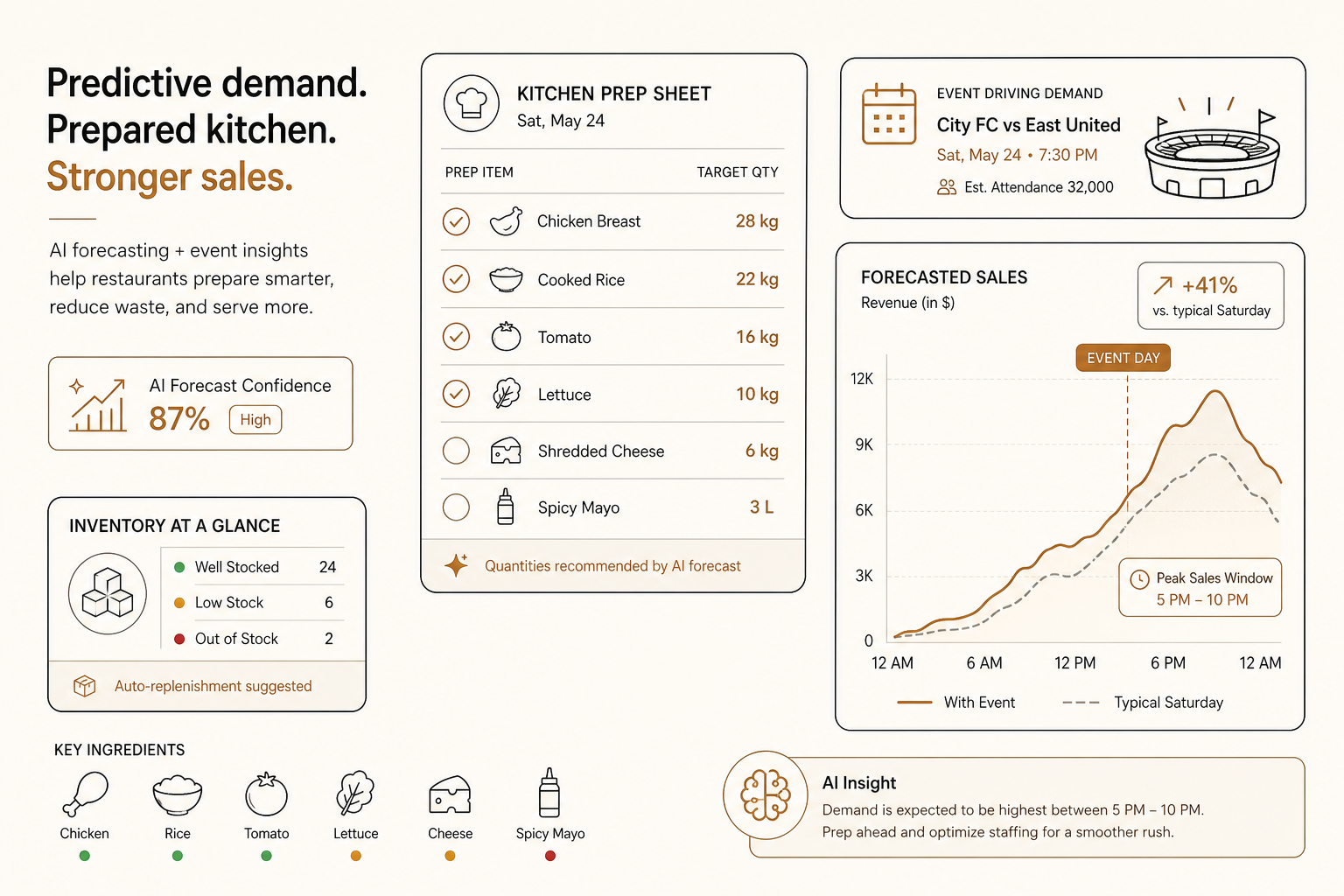
These agents use predictive analytics to forecast demand based on past patterns. For instance, if a major local sporting event is scheduled, the agent can analyze historical sales and automatically adjust your kitchen prep sheets to minimize waste.
When it comes to inventory control, the agent proactively flags supply shortages and automates the reordering process. If you manage multiple locations, you no longer have to log in and out of individual store profiles to update menus. A single text command can update pricing or toggle delivery channel availability across your entire footprint simultaneously.
Driving revenue with autonomous marketing
Marketing is another area where operators are losing valuable hours. Although 19% of full-service restaurants leverage AI for marketing tasks, many still struggle to find the time to build and target promotional campaigns.
Instead of manually segmenting email lists, you can delegate the heavy lifting to an AI agent. By analyzing historical loyalty program data, the agent identifies lapsed customers and designs highly targeted promotions to win them back.
You can text your agent: "Launch a 10% discount on wood-fired pizzas for guests who haven't ordered in the last 30 days." The agent will instantly analyze customer behavior, draft the promotional message, segment the target list, and schedule the SMS or email campaign.
Reclaiming manager productivity
Administrative bottlenecks keep managers trapped in the back office when they should be on the floor supporting staff and welcoming guests. This compounding workload is a primary driver of restaurant manager burnout.
AI agents help managers reclaim their shift hours by bypassing administrative friction. For example, employee scheduling is a notorious time-sink. Yet, research shows that 67% of multi-location operators use technology specifically to streamline employee shifts. An AI agent can analyze your sales forecasts, historical staffing levels, and employee availability to generate an optimized shift schedule in seconds.
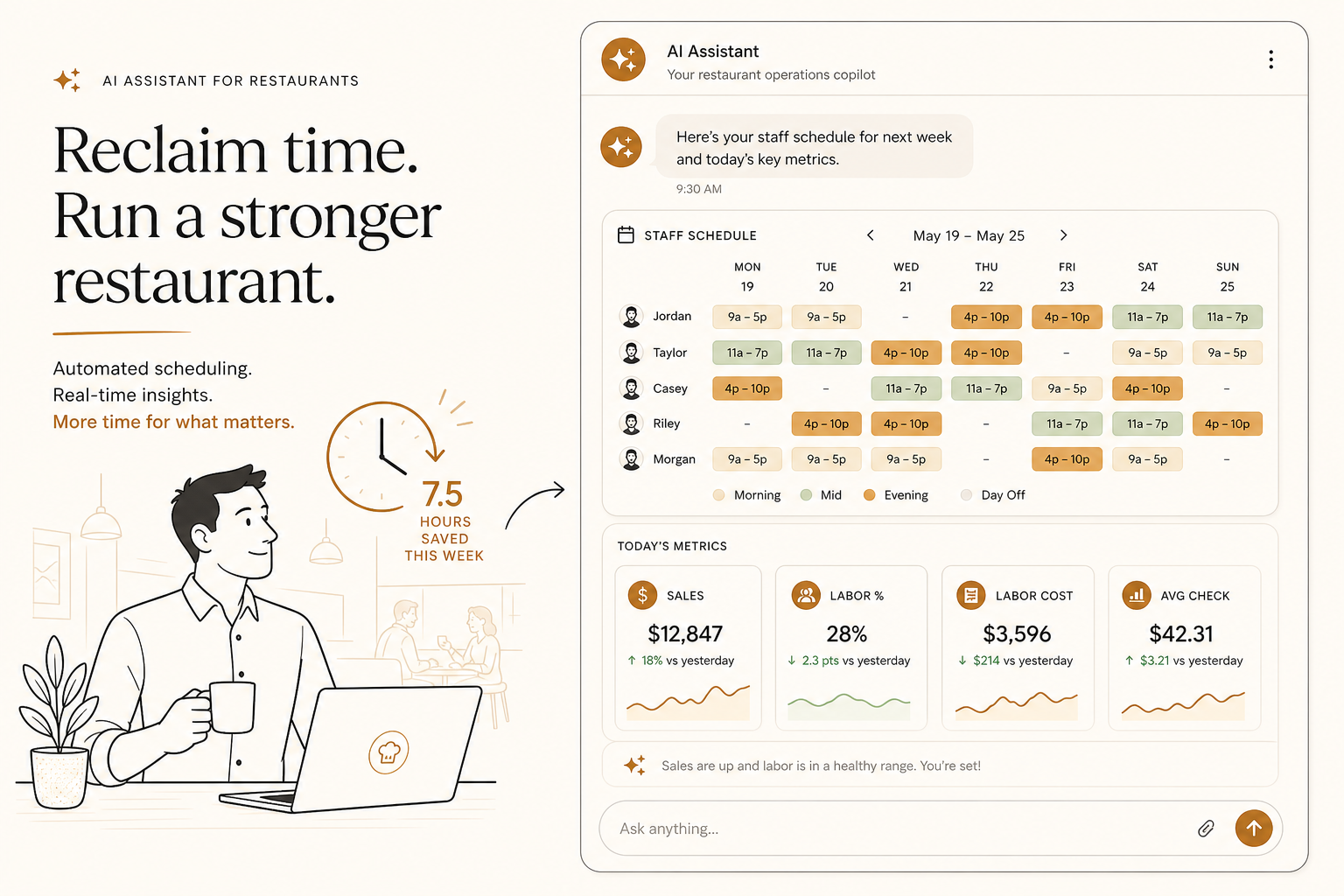
If you need a real-time health check of your business during a busy Friday night, there is no need to run to the office desktop. Simply ask your agent in a chat window for your current labor-to-sales percentage, and get an instant, actionable answer.
Building the right tech foundation
You cannot run advanced conversational agents on legacy, siloed hardware. To leverage the power of automated workflows, you need an open, modern foundation.
This starts with your core restaurant platform. Spindl serves as the perfect bedrock, integrating front-of-house ordering, delivery channels, self-service kiosks, point-of-sale, and customer loyalty into one intuitive device. It consolidates your entire operational footprint, removing the friction points of fragmented software.
On top of this clean infrastructure, you can deploy AgenticPOS to act as your intelligent control layer. By offering over 140 agent-callable tools, AgenticPOS connects directly to your POS system and allows you to execute back-office operations like menu updates, scheduling, and multi-location changes via text. You retain absolute control over every action with robust safety features, including customized permissions, guardrails, activities logging, and instantly reversible commands.
Stop wasting valuable hours clicking through outdated dashboards. Visit AgenticPOS today to discover how easy it is to manage your daily restaurant operations through chat.