Architecting persistent memory for AI agents
Architect persistent memory for AI agents by using hybrid memory systems. Learn about short-term context, long-term memory, and state persistence patterns.
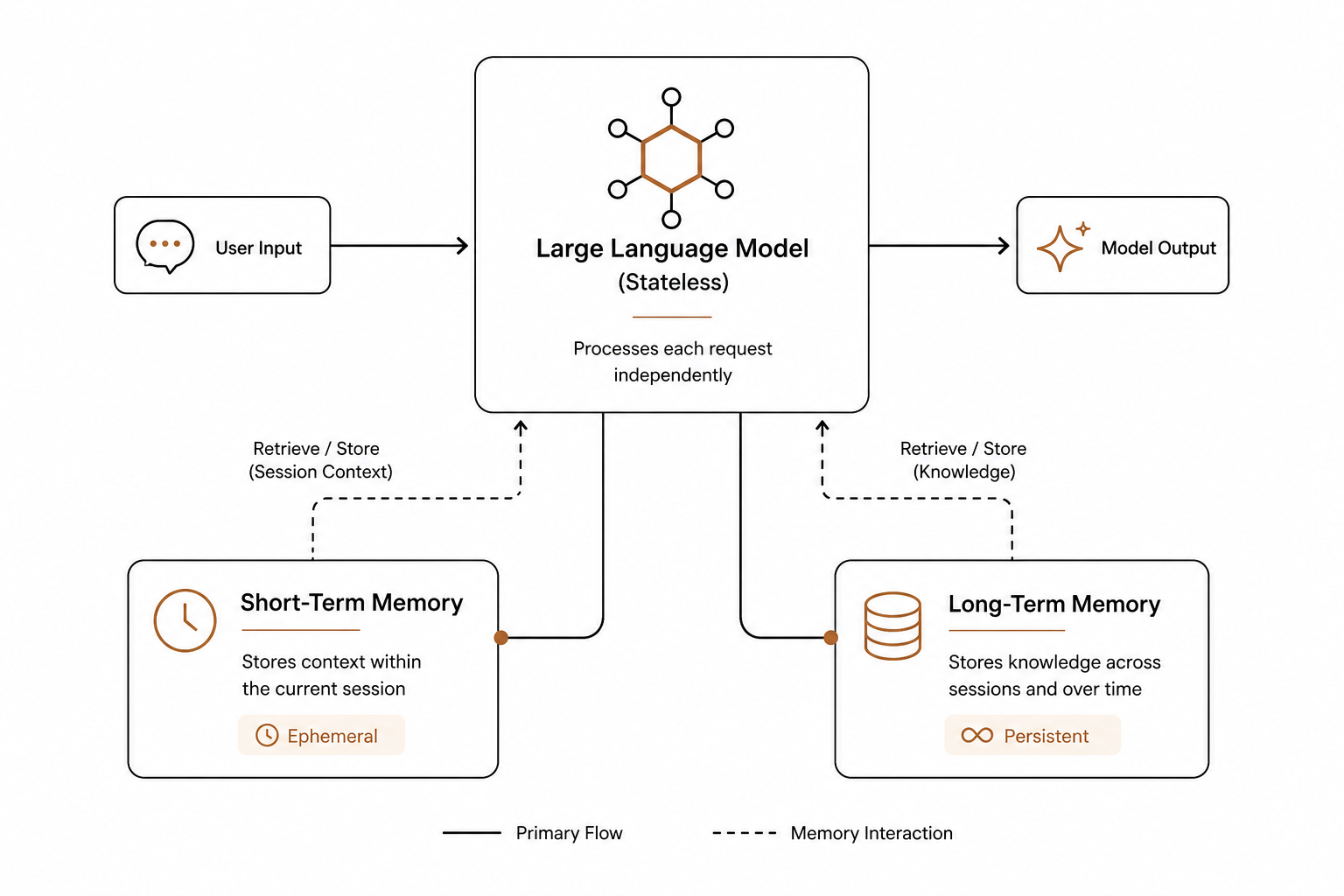
Large language models are completely stateless by default. Every API request starts from a blank slate unless you build dedicated memory infrastructure to maintain context. To build an AI agent that can manage complex, multi-step tasks over long periods, you must implement a hybrid memory architecture.
This blueprint combines immediate, thread-scoped memory with persistent databases to mimic human cognition. By partitioning how your agent stores and retrieves data, you ensure it remains coherent during a single chat session and over months of operational history.
The blueprint: Short-term vs. long-term agent memory
A production-grade agent relies on a clear division of labor between short-term and long-term memory systems. This setup prevents the model from becoming overwhelmed by irrelevant history while ensuring it never forgets critical business facts.
Short-term memory for session context
Short-term memory is strictly scoped to an active conversation thread or a specific workflow session. It serves as a rolling context window to maintain immediate coherence. Because LLM context windows have physical token limits and processing costs, developers use specific patterns to manage this space:
- Windowed memory: This approach keeps only the most recent messages in the active context, discarding older exchanges to save space.
- Summarized memory: This pattern periodically compresses earlier conversation history into a concise narrative, preserving the core context without the token bloat.
- Working memory: This tracks intermediate reasoning steps during multi-step tasks. For example, if an agent is updating ingredient quantities in your recipe database, its working memory stores the raw calculations before committing the final numbers.
Long-term memory for persistent context
Long-term memory survives system restarts, server crashes, and closed sessions. It allows the agent to recall user preferences, past decisions, and system patterns over weeks or months.
- Episodic memory: This is a timestamped record of past agent actions and their direct outcomes. For instance, the agent can remember that a shift manager requested a temporary price reduction when cold-brew coffee inventory exceeded fifty units.
- Semantic memory: This stores structured, factual knowledge. It is typically saved as high-dimensional vector embeddings, allowing the agent to perform a semantic search to retrieve highly relevant historical facts on demand.
- Procedural memory: This represents the explicit workflows, rules, and integration skills of the agent. In practice, this is defined by system prompts, code-level tool definitions, and API schemas.
Architectural patterns for state persistence
When your agent executes long-running operations, you need a dependable persistence layer. Developers look to three core patterns to manage this state.
Checkpoint and restore
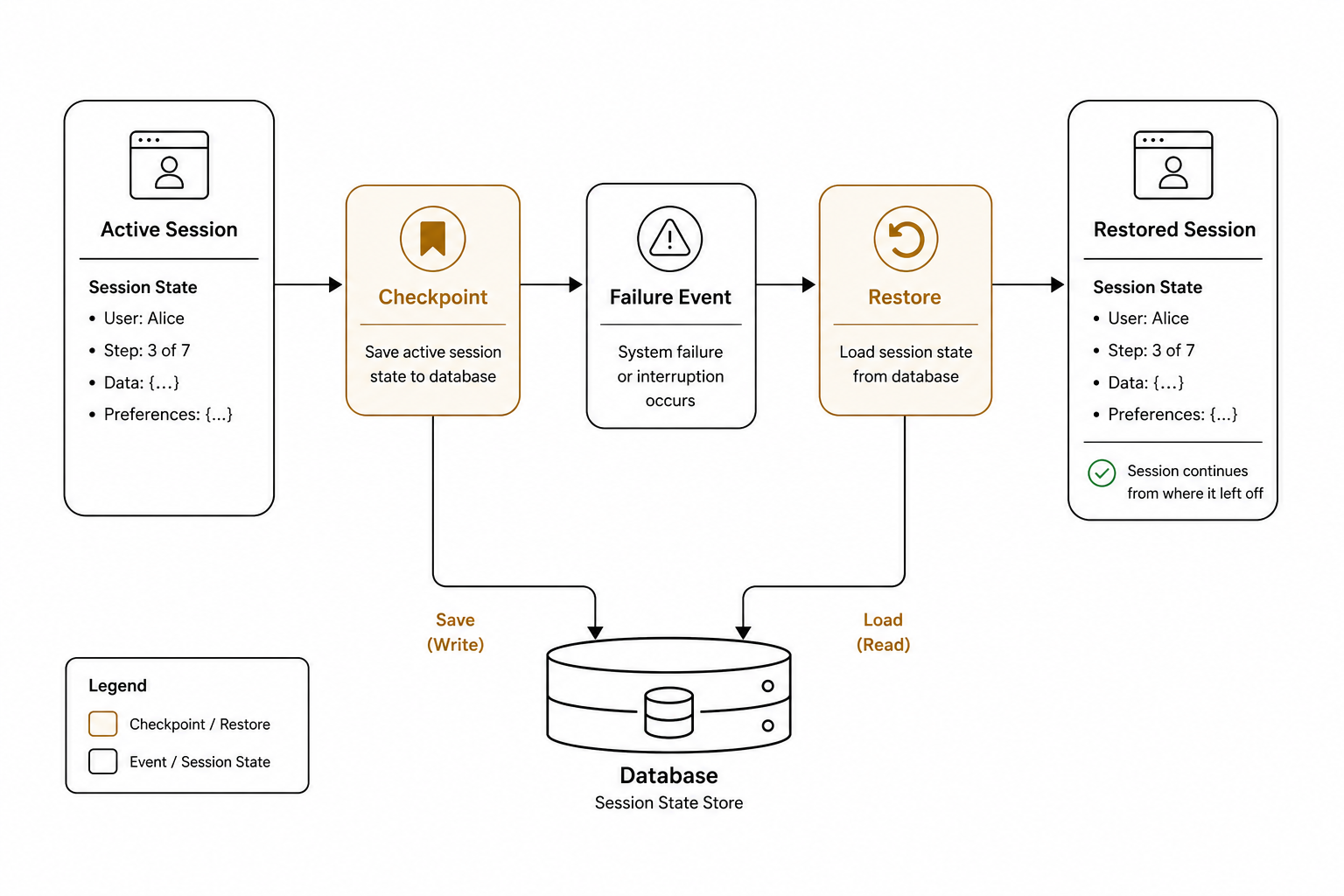
For complex workflows, you must capture the entire agent state at critical junctions, often called supersteps. If a connection drops, you can load the last saved checkpoint and resume execution without starting over.
This pattern serializes the active session state – including local variables, pending tool calls, and message queues – into a database record or JSON payload. When the system recovers, it hydrates the state back into the active session. Modern frameworks offer pluggable checkpoint storage protocols, allowing you to easily swap between non-durable in-memory systems for development and distributed cloud databases for production.
Hybrid memory segmentation
No single database fits every type of agent state. High-performance systems split data into specialized layers based on how it is accessed:
- Conversation state: Fast, document-oriented databases handle rapid, real-time chat histories.
- Task state: Relational databases with ACID transactions ensure operational updates and multi-step workflows never conflict.
- File state: Object storage manages long-term audit logs and heavy attachments.
- Vector state: Vector databases index embeddings to power semantic retrieval.
Multi-agent state coordination
Running multiple agents simultaneously introduces the risk of conflicting writes. If one agent tries to adjust employee shifts while another modifies labor pricing, they might overwrite each other's work or duplicate actions.
To prevent this, you must implement shared context coordination alongside isolated agent memories. Agents should write to a central, atomic transaction ledger. This ensure that only one agent can modify a specific record at any given millisecond.
The restaurant challenge: Zero-downtime state requirements
In the high-stakes restaurant industry, operational software must be exceptionally stable. Kitchen staff cannot wait on spinning loading icons, and a spotty internet connection should never halt service.
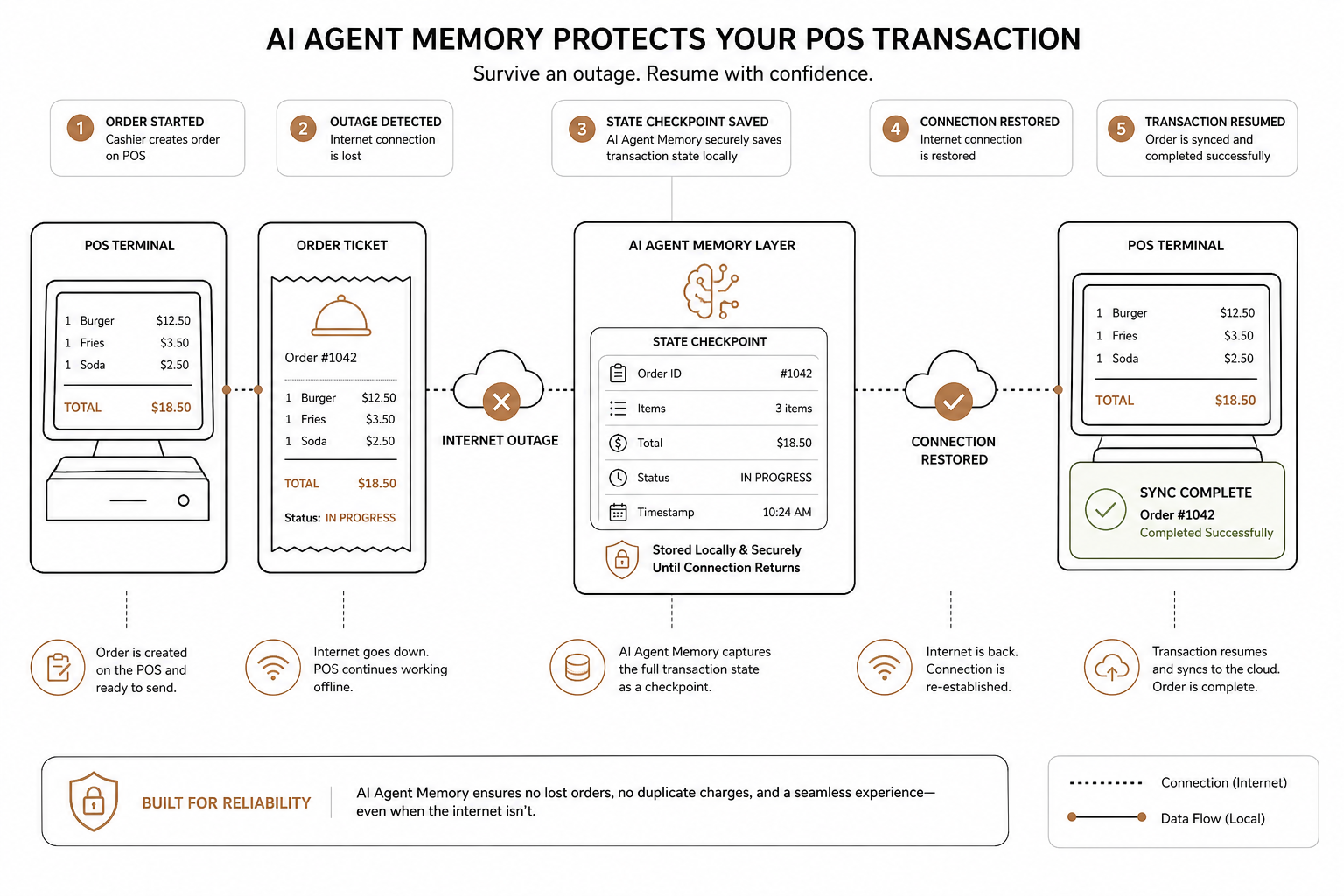
To mitigate these risks, modern restaurant operations rely on robust, offline-capable systems. Spindl is an all-in-one restaurant management platform that integrates order taking, delivery, self-service, point-of-sale, and loyalty systems into a single, durable device. High-reliability systems like Spindl use hardwired connections and local data caching to process credit card transactions even when the local network goes offline, automatically syncing back to the cloud when connectivity returns.
If you deploy AI agents to manage operations on top of a system like Spindl, your agent state layer must match this level of resilience. If the restaurant's internet drops mid-transaction, the agent's memory must preserve the exact state of the pending request. Once the connection is restored, the agent must resume gracefully from its last checkpoint without double-charging a guest or losing track of custom order modifications.
How AgenticPOS handles memory, tools, and state
AgenticPOS bridges the gap between stateless AI models and the zero-downtime, high-reliability needs of restaurant environments. Operating as an open Model Context Protocol (MCP) server, AgenticPOS connects LLMs directly to your existing restaurant POS, including platforms like Spindl. It translates conversational inputs from tools like Claude, ChatGPT, or custom internal copilots into secure, stateful actions on your physical restaurant hardware.
By mapping the entire POS surface area into more than 140 agent-callable tools, AgenticPOS manages complex state coordination behind the scenes:
- Atomic tool execution: Every action – from managing menus and pricing to running real-time analytics – executes as an atomic step. This prevents conflicting writes when multiple assistants query your systems.
- Granular permission states: Instead of granting agents unchecked root access, you issue secure tokens with precise permissions. You can set an agent's state-access scope to read-only, limit it to a single location, or grant full operator rights in a single click.
- Multi-assistant coordination: Because the server relies on open protocols, you can coordinate state seamlessly across Slack bots, desktop interfaces, and scheduling backends.
This architecture lets restaurant operators run their daily tasks using simple conversational commands. The underlying platform handles the complex state synchronization; you just focus on your guests.
Ready to bring robust, conversational intelligence to your restaurant operations? Connect your systems to the open agent ecosystem and explore AgenticPOS today.