How to raise restaurant menu prices without losing guests
Learn how to raise restaurant menu prices strategically using data-driven menu engineering. Discover how to automate POS updates and ensure legal compliance.
U.S. restaurant menu prices rose 3.6% year-over-year in April 2026, keeping pace with ongoing inflation pressures after a massive 31% cumulative hike between 2020 and 2025. Running a restaurant means constantly balancing guest satisfaction with rising operational costs. When margins shrink, raising prices is inevitable. But doing it incorrectly can trigger immediate customer backlash.
The strategy: Use data, not guesswork
Never raise prices across the board by a flat percentage. That is a lazy approach that alienates customers and leaves money on the table. Instead, use menu engineering to analyze your dishes by both popularity (sales mix) and profitability.
Menu engineering is a strategic, data-driven process of analyzing every menu item by both its profitability and popularity. This analysis helps you make informed decisions about pricing, placement, design, and whether to keep, modify, or remove items.
To begin, calculate the contribution margin for each item:
$$text{Contribution Margin} = text{Selling Price} - text{Portion Cost}$$
The portion cost (food cost per serving) must be accurate. While many restaurants target an overall food cost percentage of 28% to 35%, the appropriate target depends on your concept and the specific dish.
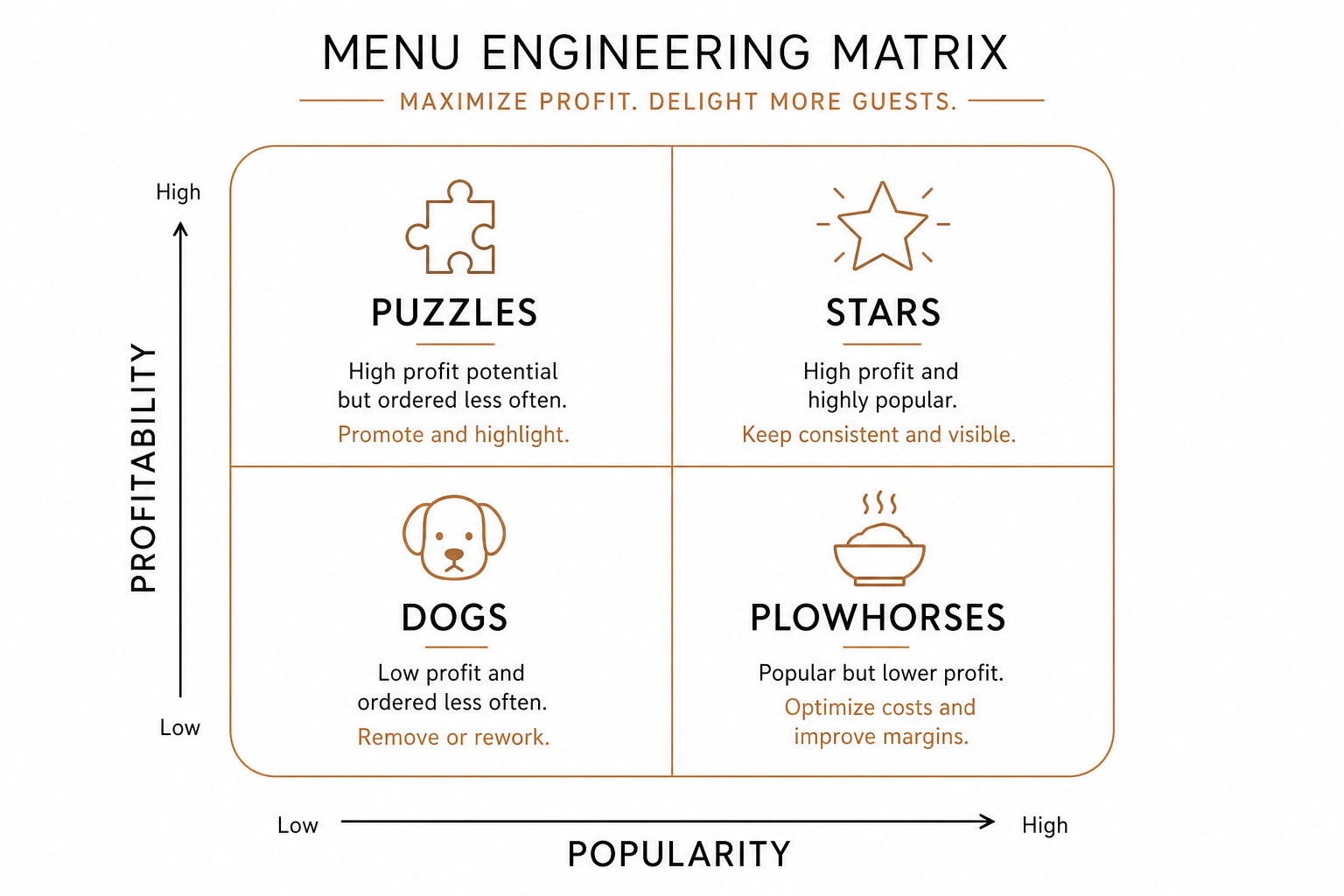
Once you have your contribution margins and sales volume, categorize your items into four buckets:
- Stars (High Profit, High Popularity): Your champions. Protect these items. Keep their quality high and placement prominent, but raise prices only slightly and with caution.
- Plowhorses (Low Profit, High Popularity): Guests love these, but they are expensive to make. These are your prime targets for price increases, subtle portion reductions, or ingredient substitutions.
- Puzzles (High Profit, Low Popularity): Great margins, but nobody orders them. Instead of raising prices, try renaming them, moving them to a more prominent spot on the menu, or having your staff actively recommend them.
- Dogs (Low Profit, Low Popularity): These waste inventory and prep time. Consider removing them entirely or replacing them with higher-margin alternatives.
Alternatively, apply the "4 R's" decision framework to guide your menu adjustments:
- Retain your Stars
- Reprice your Plowhorses
- Replate (or reposition) your Puzzles
- Rethink your Dogs
Navigating guest perception and compliance
Diners are highly sensitive to price changes. Research on restaurant pricing shows that customer perceptions of price fairness directly impact guest satisfaction and loyalty. If guests feel a price hike is unfair, they will punish you. While they might not stop dining out altogether, some diners respond to higher prices by reducing visit frequency or limiting what they order – such as skipping appetizers, drinks, or higher-priced entrées.
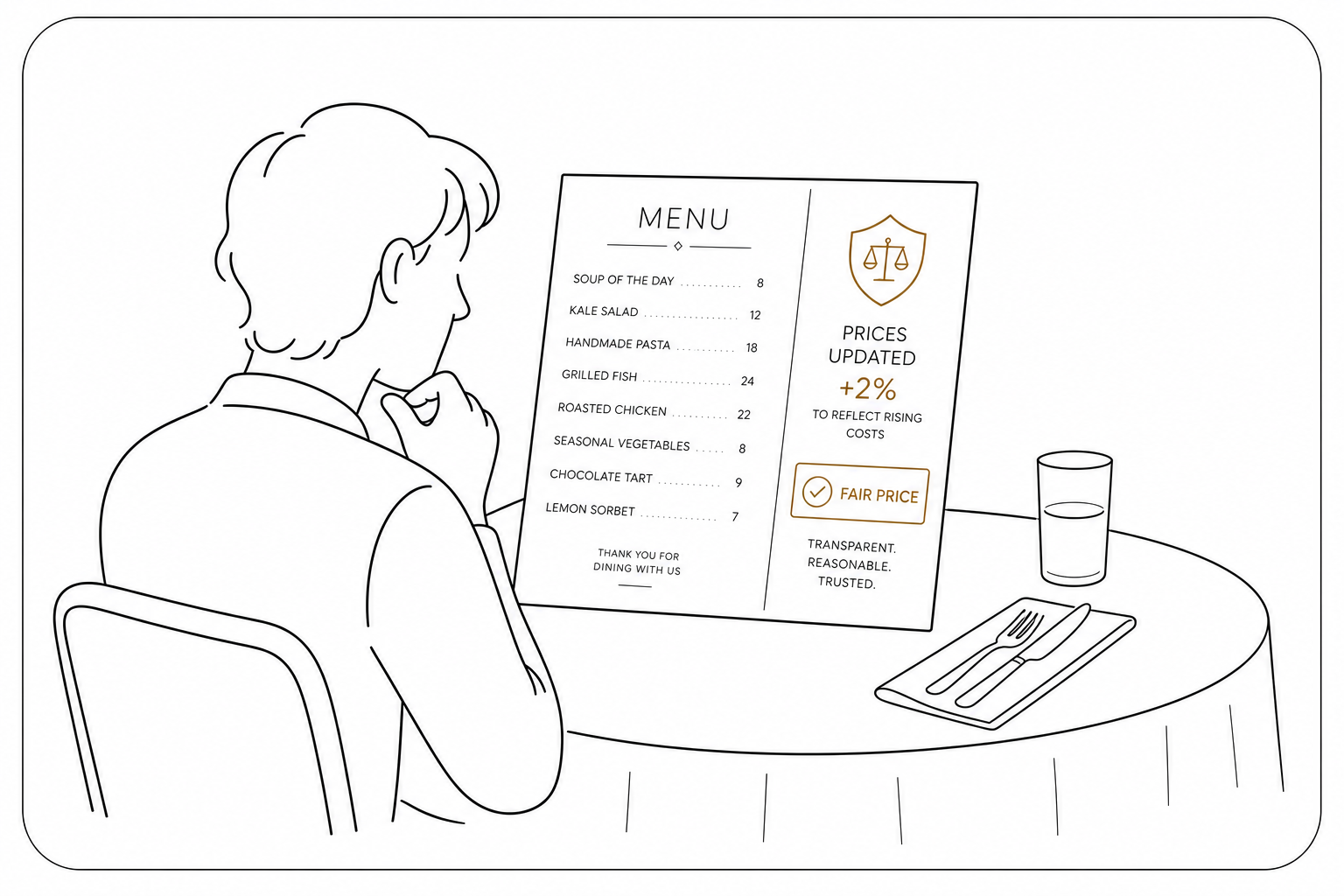
To mitigate this, maintain clear communication and avoid dynamic, demand-based pricing practices that can feel deceptive. Transparent communication about the reasons for higher prices, such as ingredient scarcity or wage increases, can help maintain customer trust.
Beyond customer perception, your pricing strategy must comply with state and federal regulations:
- Federal Menu Labeling Rules: If you operate chain restaurants or retail food establishments with 20 or more locations, the FDA requires you to disclose calorie information directly on menus and menu boards, alongside standard statements about daily calorie intake.
- California’s SB 478 (Honest Pricing Law): Under this legislation, California restaurants cannot hide mandatory fees. You must build all mandatory surcharges and service fees directly into the displayed menu price. The price the guest sees must be the price they pay.
- Credit Card Surcharges: If you implement card surcharges, check your state laws. For instance, New Jersey requires clear, conspicuous disclosures both in the customer service area and on the menus before a transaction occurs.
The operational bottleneck: Executing the update in your POS
Once you have your new pricing structure, you have to execute it.
If you are using a legacy POS, this is where your strategy stalls. You have to log into an administrative portal, click through hundreds of individual modifier groups, adjust third-party delivery channel markups, and repeat the tedious process for every single location. It is slow, repetitive, and prone to error.
To streamline this process, you need modern POS infrastructure. An all-in-one restaurant platform like Spindl simplifies your front-of-house operations by integrating order taking, delivery, self-service, POS, and loyalty into a single device. By consolidating these functions, you can manage delivery platforms from one place and drive operational efficiency.
But if you want to bypass the back-office dashboard entirely, you can manage your menu using artificial intelligence.
AgenticPOS is an MCP server that exposes your entire POS system to AI agents. Instead of clicking through menu trees and pricing tiers, you can manage your operations through natural language. You can easily plug the server into Claude, ChatGPT, or your own internal Slack copilot.
Because the entire POS surface area – including menus, pricing, channels, shifts, inventory, and loyalty – is mapped into over 140 agent-callable tools, you can execute complex, multi-location pricing updates with a single instruction.
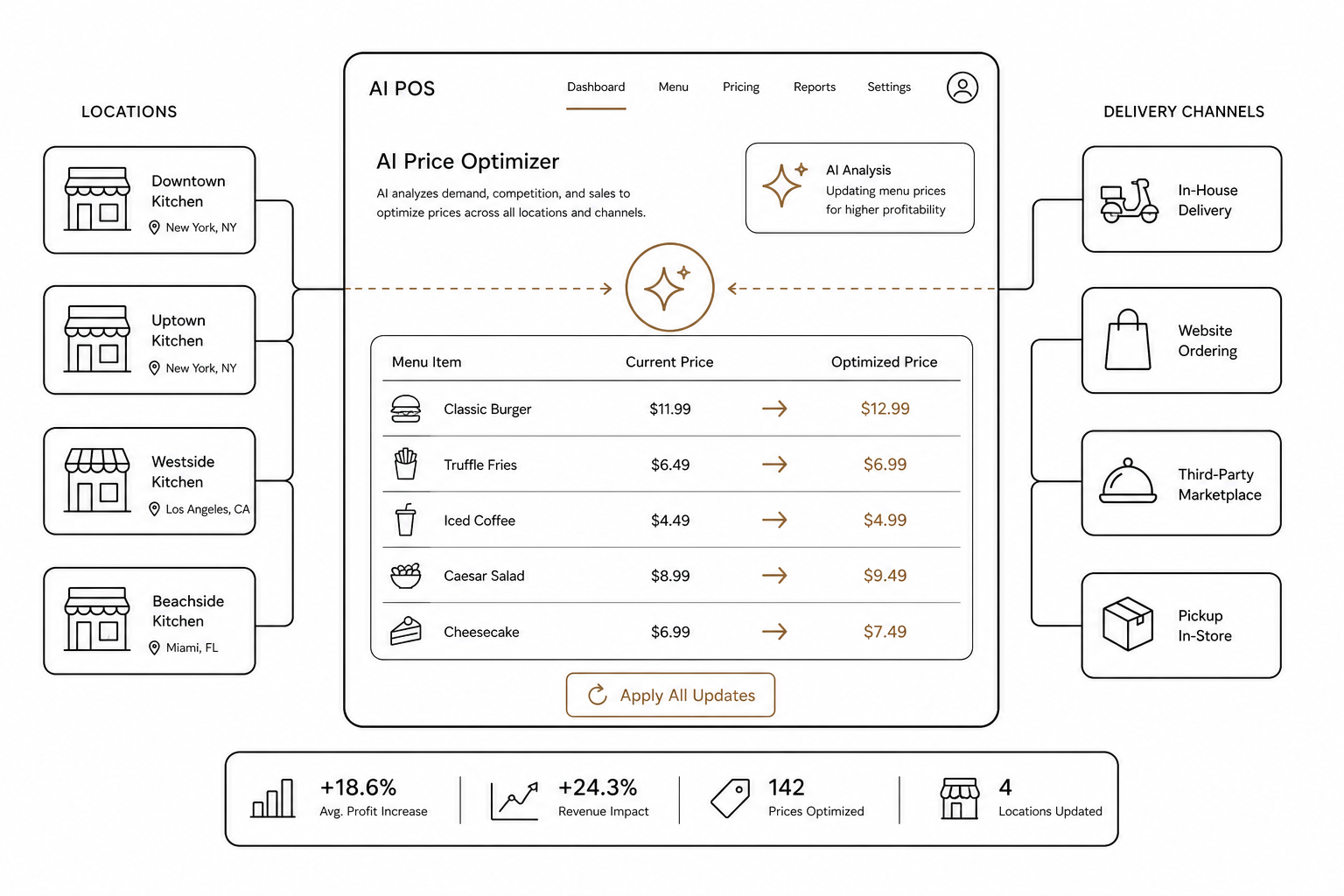
Instead of spending hours in a database, you can simply type a single instruction:
"Increase the price of all Plowhorse items on DoorDash and UberEats by 5% starting Friday, but keep dine-in prices exactly the same."
Or, if you manage a regional chain:
"Sync the new menu everywhere except London, the supplier's late."
With robust permissions, guardrails, and reversible actions, you retain total control while letting the AI handle the heavy lifting of back-office menu management.
Stop wasting hours on manual data entry and back-office clicking. If you are ready to streamline your daily operations and handle menu updates through simple conversation, see how AgenticPOS can transform your restaurant management.