How to scale a restaurant business to multiple units
Scale your restaurant to multiple units by mastering financial targets, building SOPs, and using AI-driven POS systems to manage operations across locations.
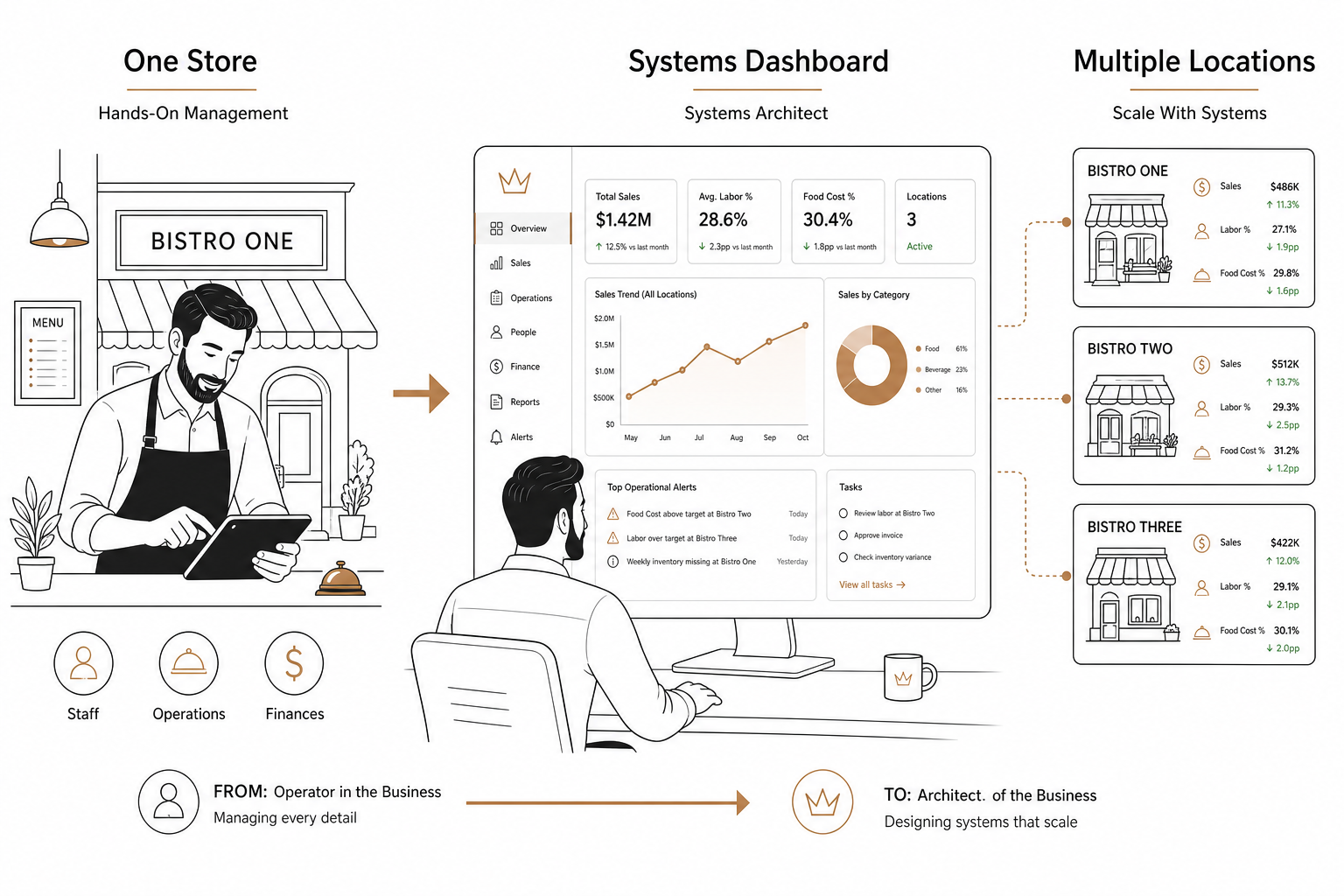
Opening your first restaurant is an act of passion. Opening your second, third, and fourth is an act of systems.
While the U.S. food service industry is massive – generating over $1.52 trillion in sales in 2024 – the reality for most operators is highly localized. More than 7 in 10 restaurants operate as single-unit establishments.
Moving from that single-unit majority into a successful multi-unit brand requires a complete shift in operations. You can no longer rely on your physical presence to solve daily crises. To scale successfully, you must transition from a hands-on manager to a systems architect.
Here is how to build the financial, operational, and technological framework to scale your restaurant business without losing control.
Master the multi-unit financial blueprint
When you run a single location, you can often feel your way through cash flow. With multiple locations, minor inefficiencies at one store can compound and drag down your entire enterprise. You need to manage your business strictly by the numbers.
According to standard restaurant industry financial benchmarks, your financial targets should align with these metrics:
- Prime Cost: Keep this below 60% of gross sales. Your prime cost – the combined total of your cost of goods sold (COGS) and labor – is the ultimate indicator of operational health. A prime cost under 55% represents elite performance.
- Food Cost: Target a range of 28% to 35% of gross sales, depending on your service model. Quick-service brands lean closer to 25%, while casual and fine dining can range up to 38%.
- Labor Cost: Aim for 25% to 35% of gross sales. Elevated labor costs are a primary threat to profitability, making structured scheduling and labor optimization vital.
- Rent: Keep occupancy costs between 6% and 10% of gross sales.
- Net Profit Margin: Target a healthy margin of 3% to 6% of gross sales.
To maintain these margins across a growing footprint, you must negotiate bulk purchasing agreements, standardize portions, and implement strict labor-scheduling models before you sign the lease on your next location.
Build standard operating procedures that scale
Consistency is the bedrock of brand loyalty. If a customer gets a perfect meal at your original location but experiences slow service and cold food at your second, your brand reputation suffers.
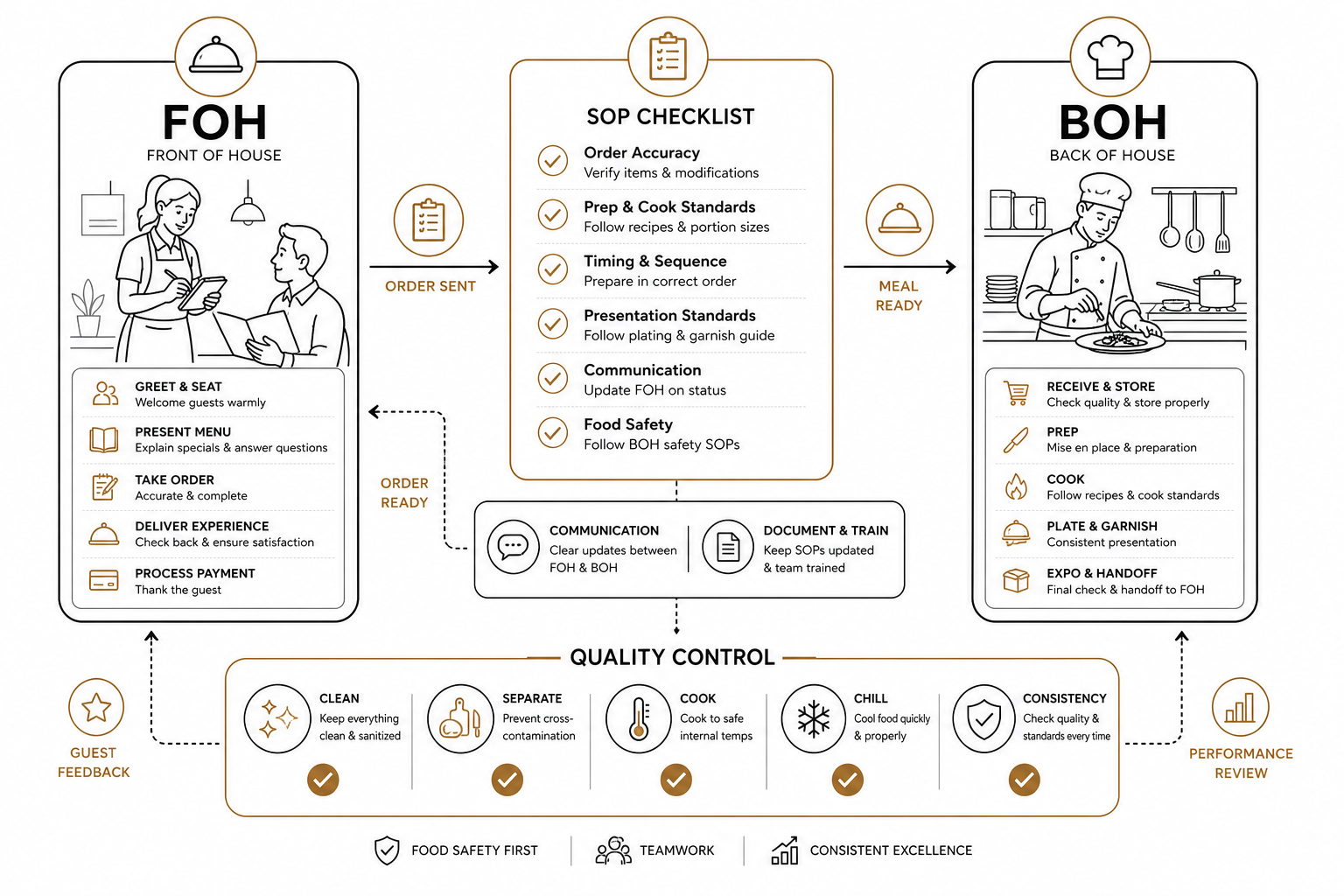
Standard Operating Procedures (SOPs) are written, step-by-step instructions that govern every recurring task in your business. When scaling, you must document and digitize workflows for both the Front of House (FOH) and Back of House (BOH).
Food safety and quality control
Your kitchen SOPs should be anchored in food safety. Build clear guidelines around the FDA's core safe food-handling procedures: clean, separate, cook, and chill. Establish daily, shift-by-shift checklists for:
- Standardizing recipe builds with photos of correct portioning and presentation.
- Strict handwashing and sanitation schedules.
- HACCP-aligned temperature logs for cooking and cold storage.
- Systematic allergen management to prevent cross-contamination.
Digitizing checklists
Paper checklists get lost, ignored, or "dry-labeled" by staff filling them out all at once at the end of a shift. Use digital management tools to build a centralized checklist library. Introduce these protocols systematically: pilot them at your original location, train your managers first, and then roll them out to new locations with weekly review cadences.
Implement ironclad internal controls
As your footprint expands, your exposure to waste, administrative errors, and internal theft grows. You cannot personally watch every cash drawer or invoice. Instead, you must implement strict accounts payable and inventory controls.
Segregation of duties
The golden rule of internal financial controls is that no single employee should control a financial transaction from start to finish.
- The person who places food orders with vendors must not be the person who receives the delivery.
- The employee who receives the invoice must not be authorized to approve the payment.
- The cashier running the register must not be the individual reconciling the cash drawer against the POS report at the end of the night.
Inventory verification
Establish a tight, three-way verification system for all inventory receiving. The receiving staff must verify that the actual physical delivery matches both the original authorized purchase order and the vendor’s invoice.
Perform regular physical counts – counting high-value items like proteins and alcohol daily or weekly – and compare your actual inventory usage against your theoretical usage to quickly spot variance, waste, or theft.
Accounts payable automation
For multi-unit groups, centralized AP is essential. Maintain an authorized vendor list and clean it periodically to remove inactive accounts. Set up duplicate-bill detection in your accounting software and route all payments through a consolidated platform that requires dual authorization for payouts above a specific dollar threshold.
Leverage technology to automate multi-unit management
You cannot scale a multi-unit restaurant group using legacy, fragmented technology. If your managers are wasting hours manually updating prices, adjusting menus across three different delivery apps, or compiling spreadsheets to compare sales, you cannot scale efficiently.
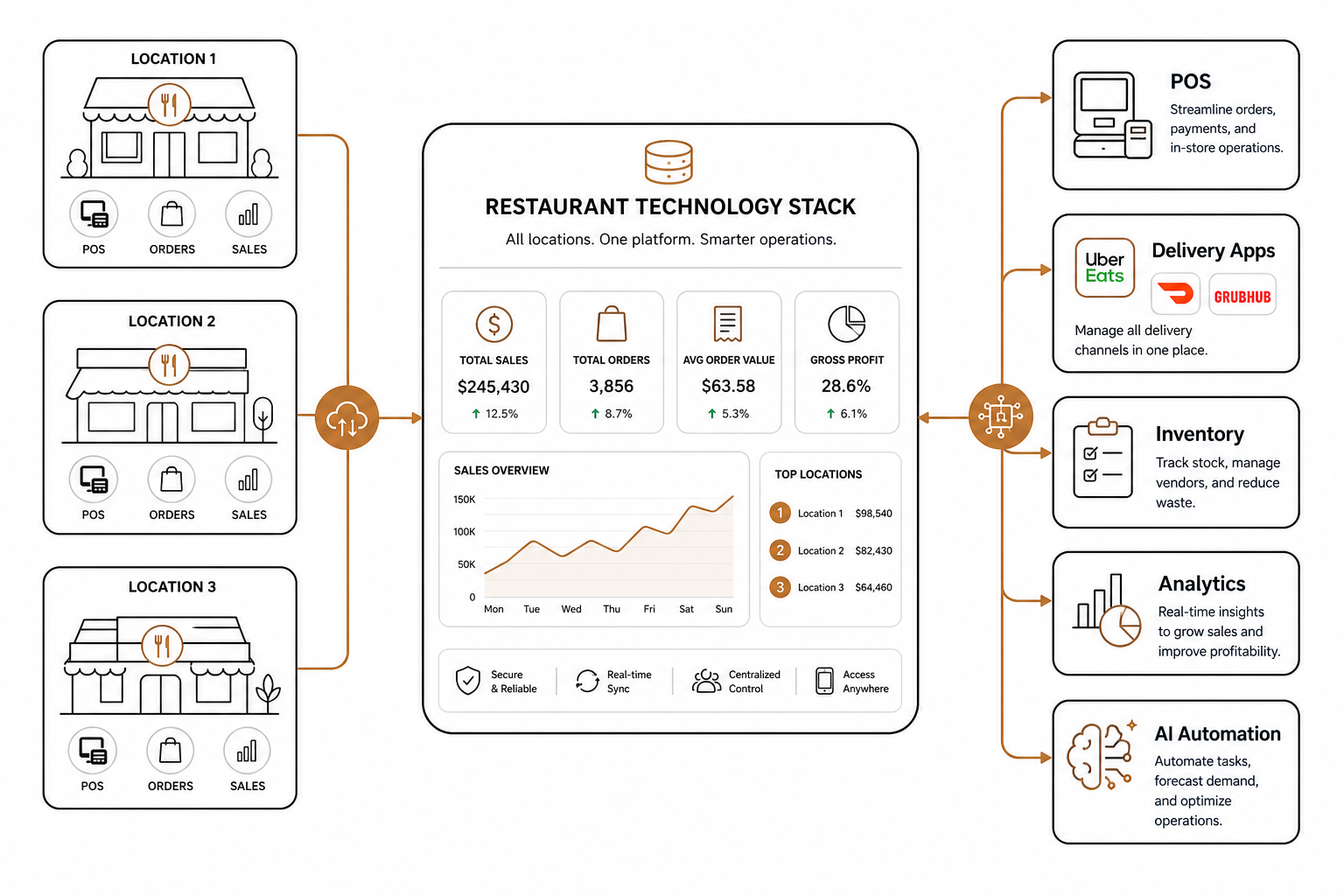
To support rapid growth, you need a modern technology stack that connects your front-of-house, back-of-house, and corporate operations.
The foundation: Spindl POS
Managing multiple locations starts with a unified point of sale. Spindl POS is an all-in-one restaurant management platform designed to make multi-location management effortless.
Instead of dealing with the headaches of legacy POS hardware, Spindl integrates order-taking, delivery app management, self-service kiosks, and loyalty programs into a single, cohesive ecosystem. Spindl acts as a centralized dashboard, allowing you to track real-time analytics, monitor labor costs, and streamline your entire digital order flow across all of your locations from day one.
The future: AI-driven operations with AgenticPOS
Once you have Spindl or your existing POS in place, you can supercharge your operational control by layer-handling your backend with artificial intelligence.
AgenticPOS is an MCP server that connects directly to your restaurant's POS system, exposing critical back-office operations to AI agents. Instead of clicking through complex dashboards to manage five different stores, you can run your restaurant business simply by talking to it.
Through tools like Claude, ChatGPT, or your internal Slack channels, AgenticPOS allows you to:
- Make bulk updates: Instantly adjust menu items, pricing, and promotional campaigns across all of your locations simultaneously.
- Streamline inventory and scheduling: Automate shift coordination, update stock levels, and coordinate with vendors using conversational AI.
- Pull instant analytics: Ask your AI agent to pull real-time prime cost reports, identify top-performing menu items, or flag labor variances across your entire multi-unit enterprise.
By combining the streamlined, all-in-one hardware and software of Spindl POS with the conversational automation of AgenticPOS, you can free your management team from administrative bottlenecking. This gives you the freedom to focus on what matters most: growing your brand, maintaining quality, and securing your next location.