MCP vs function calling: Designing your restaurant AI stack
Compare MCP vs function calling for restaurant AI. Learn how to choose a scalable architecture to connect agents to POS systems and manage inventory reports.
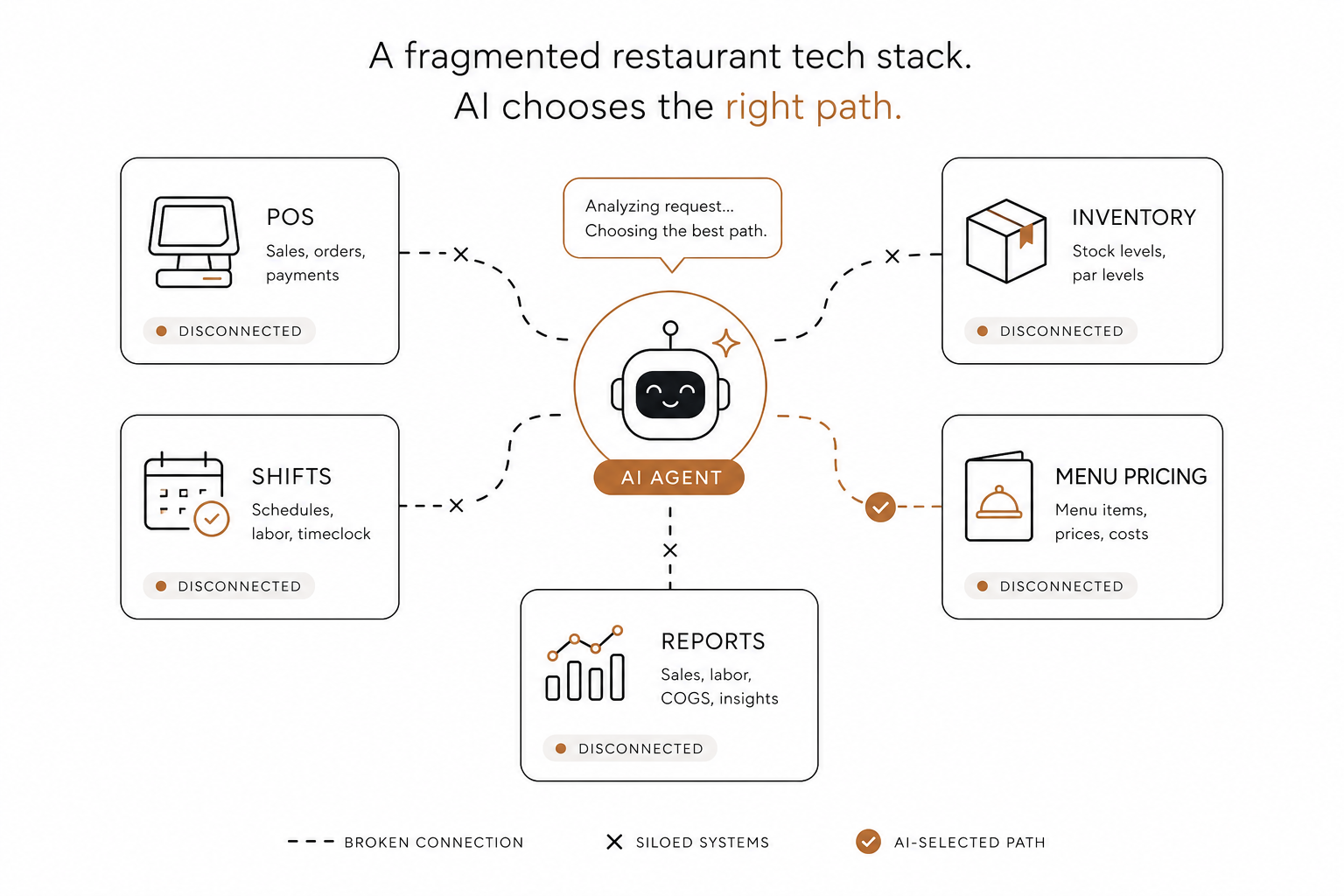
Restaurant tech stacks are notoriously fragmented. If you are building AI agents to manage shifts, update menu prices, or pull real-time inventory reports, you face a critical architectural decision. How should your AI agent talk to your database or point-of-sale (POS) system?
You have likely run into two main approaches: function calling and the newer Model Context Protocol (MCP).
While they might sound like competing technologies, they operate at different layers of your tech stack. Here is a practical breakdown of how they work, how they differ, and when to use each to build reliable AI integrations for your restaurants.
What is function calling?
Function calling, also known as tool calling, is a native capability built into modern Large Language Models (LLMs) like OpenAI’s GPT-4 or Anthropic’s Claude. It allows the model to act as a bridge between natural language and structured code.
When you configure function calling, you provide the LLM with a list of available tools, complete with descriptions and JSON schemas. The core flow operates in a continuous loop:
- The Request: You send a user prompt along with a list of tool definitions to the LLM.
- The Decision: The LLM decides if a tool is needed. It does not run the code itself but instead outputs a structured JSON object containing the function name and the arguments to pass to it.
- The Execution: Your application code intercepts this JSON, runs the actual API call or database query, and retrieves the results.
- The Response: Your application feeds the results back to the LLM, which uses that data to write a natural language response.
Function calling is highly effective for tightly coupled, application-specific tasks. However, every AI provider has slightly different syntax, and you must write custom glue code to map every single function to your backend APIs.
What is Model Context Protocol (MCP)?
Introduced by Anthropic as an open-source standard, the Model Context Protocol (MCP) standardizes how AI systems securely connect to data sources and tools.
Think of MCP as the USB-C port for AI applications.
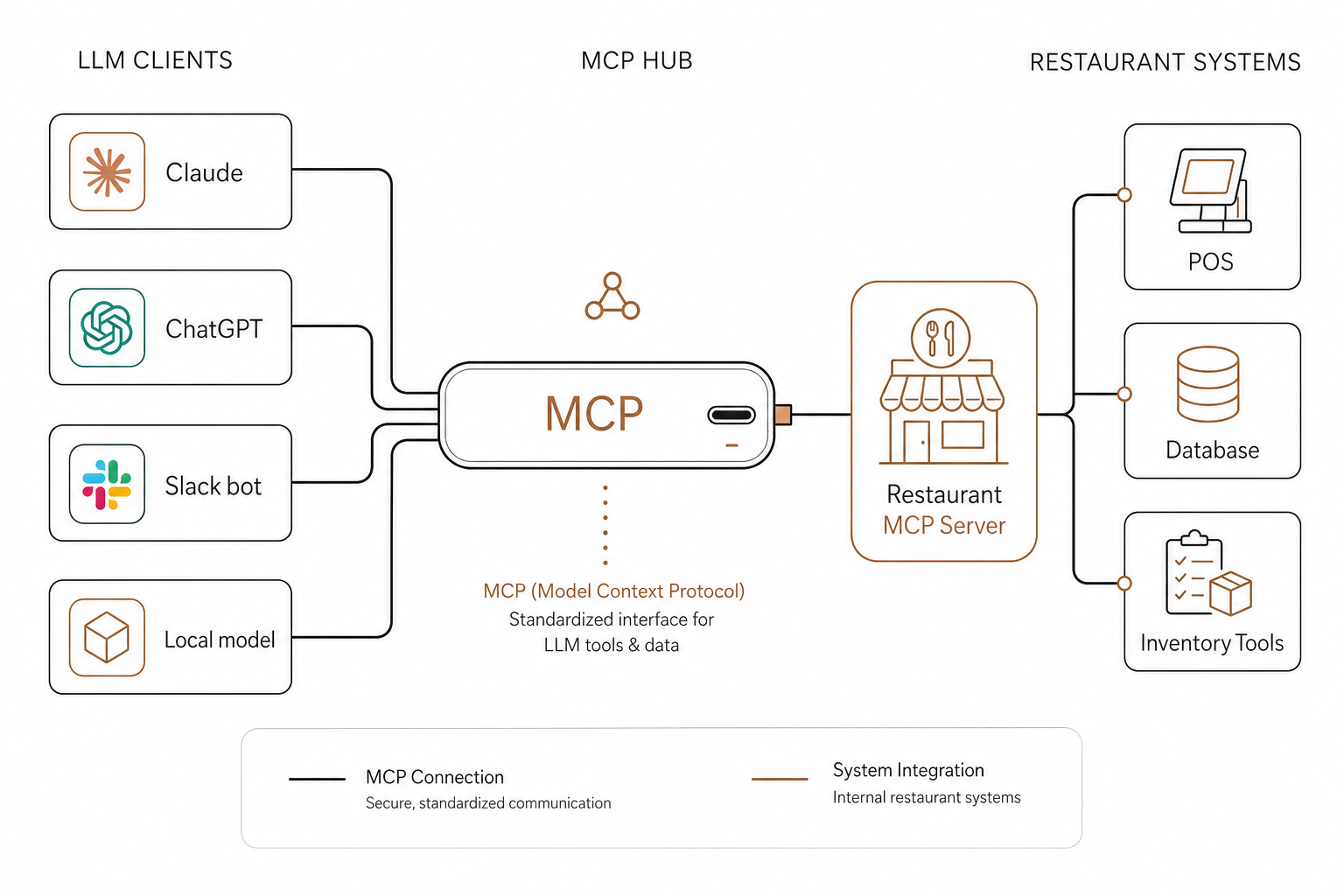
Before MCP, connecting different LLMs to different restaurant databases required writing custom integrations for almost every combination. MCP solves this combinatorial integration problem by introducing a unified client-server architecture. Under the official MCP specification, an MCP server exposes three main primitives to any compatible AI client:
- Prompts: Reusable templates and instructions for the LLM.
- Resources: Read-only data sources, such as inventory logs, sales reports, or menu schemas, that provide immediate context.
- Tools: Executable functions that can perform actions, like changing a price or updating a shifts roster.
Because MCP is model-agnostic, you can build or buy a single MCP server, and any compliant AI client – whether it is Claude, a custom ChatGPT instance, or an internal Slack copilot – can immediately discover and use its capabilities.
The key differences: MCP vs. function calling
To choose the right pattern, it helps to compare their technical footprints side-by-side:
| Feature | Function Calling | Model Context Protocol (MCP) |
|---|---|---|
| What is it? | A native LLM capability to output structured JSON. | An open-source, model-agnostic integration protocol. |
| Architecture | Embedded directly inside your application’s request loop. | Client-server architecture over standardized JSON-RPC. |
| Integration Effort | High. Requires custom glue code for every new tool and LLM provider. | Low. Implement the server once, and any MCP client can consume it. |
| Capabilities | Strictly executable tool calls. | Multi-dimensional: Prompts, Tools, and read-only Resources. |
| Portability | Hard to move between different model providers without rewriting code. | High. Workflows remain identical whether using Claude, Gemini, or local models. |
Do they work together?
Yes. MCP does not replace function calling. Instead, it standardizes the infrastructure that executes those requests.
When an AI agent uses an MCP server to update a menu item, the underlying model still uses its internal function-calling capability to decide which tool to run and with what arguments. MCP simply provides the standardized network wrapper, discovery mechanism, and execution layer so your developers do not have to write custom integration code for every API.
When to use each in restaurant tech
Your choice depends heavily on the complexity of your restaurant operations and who is building the tools.
Choose function calling if:
- You are building a single-purpose tool with a narrow scope – for example, a simple bot that only checks if a specific table is reserved.
- You are fully committed to a single LLM provider's ecosystem and have no plans to swap models or support external clients.
- You are running rapid, lightweight prototypes where spinning up a separate server architecture is unnecessary overhead.
Choose MCP if:
- You want to connect your AI agents directly to your Point of Sale (POS) system without building bespoke, brittle integrations for every single operational tool.
- You are using a modern, all-in-one POS platform like Spindl's restaurant management platform and want to control menu management, real-time analytics, and delivery channels using natural language.
- You need model flexibility. You want your team to be able to use the Claude desktop app, custom Slack bots, or internal web interfaces interchangeably without rewriting the underlying tool definitions.
- You want to leverage pre-built infrastructure. Instead of writing dozens of custom endpoints for your operations, you can plug in AgenticPOS's AI-ready integration layer – an out-of-the-box MCP server designed specifically to expose deep POS operations to AI agents.
Security considerations for restaurant operators
Allowing AI to execute actions on live production systems is powerful, but it introduces distinct security risks. An unchecked LLM decision could accidentally delete a menu category, modify loyalty point balances, or leak shift schedules.
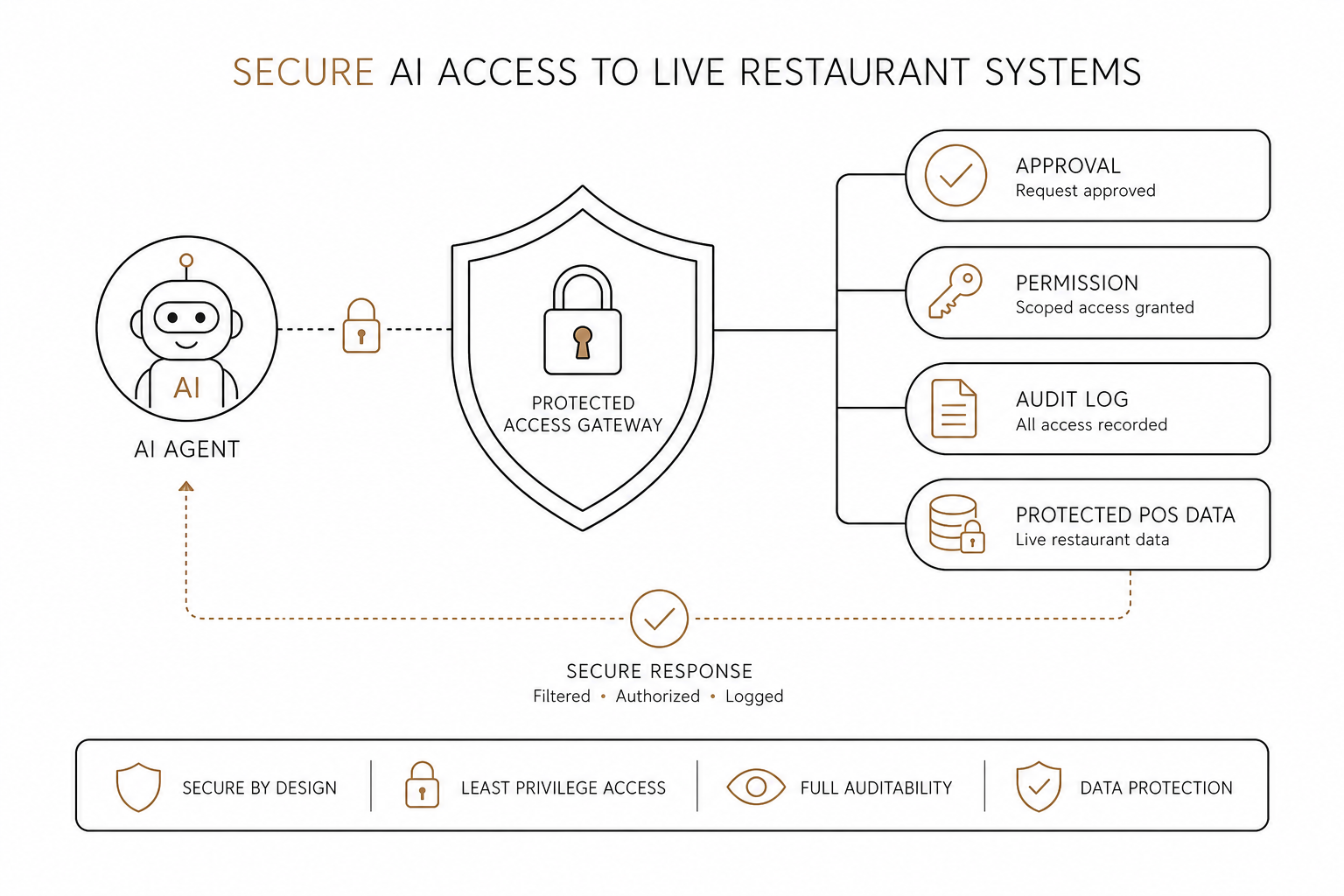
When designing your agentic POS architecture, apply these enterprise-grade security standards:
- Least-privilege access: Never give your AI agent root access to your POS. If the agent only needs to pull reports, configure the credentials as read-only.
- Human-in-the-loop (HITL): For state-changing actions – such as changing a menu price on Spindl's unified POS platform or processing a vendor payment – the AI should generate the action but require a manager's physical approval before execution.
- Comprehensive audit logs: Track every command issued by the AI agent. Ensure your integration architecture records who prompted the agent, what tool was selected, and the exact payload sent to the POS.
- Sandboxed execution: Run your MCP servers and integration layers in isolated environments to prevent lateral network access in the event of a vulnerability.
Scaling your restaurant automation
Building custom integrations for every back-of-house tool is a fast track to technical debt. By using standardized protocols like MCP, you build an open, future-proof architecture that can easily swap models as AI technology evolves.
If you want to run your restaurant operations efficiently through natural language, explore how AgenticPOS acts as a secure, pre-built MCP server that connects your AI agents directly to your restaurant's core management systems.