Track the 4 restaurant KPIs that protect your cash flow
Track prime cost, food cost, labor, and RevPASH automatically. Protect your restaurant margins by using real-time POS data and AI to monitor cash flow daily.
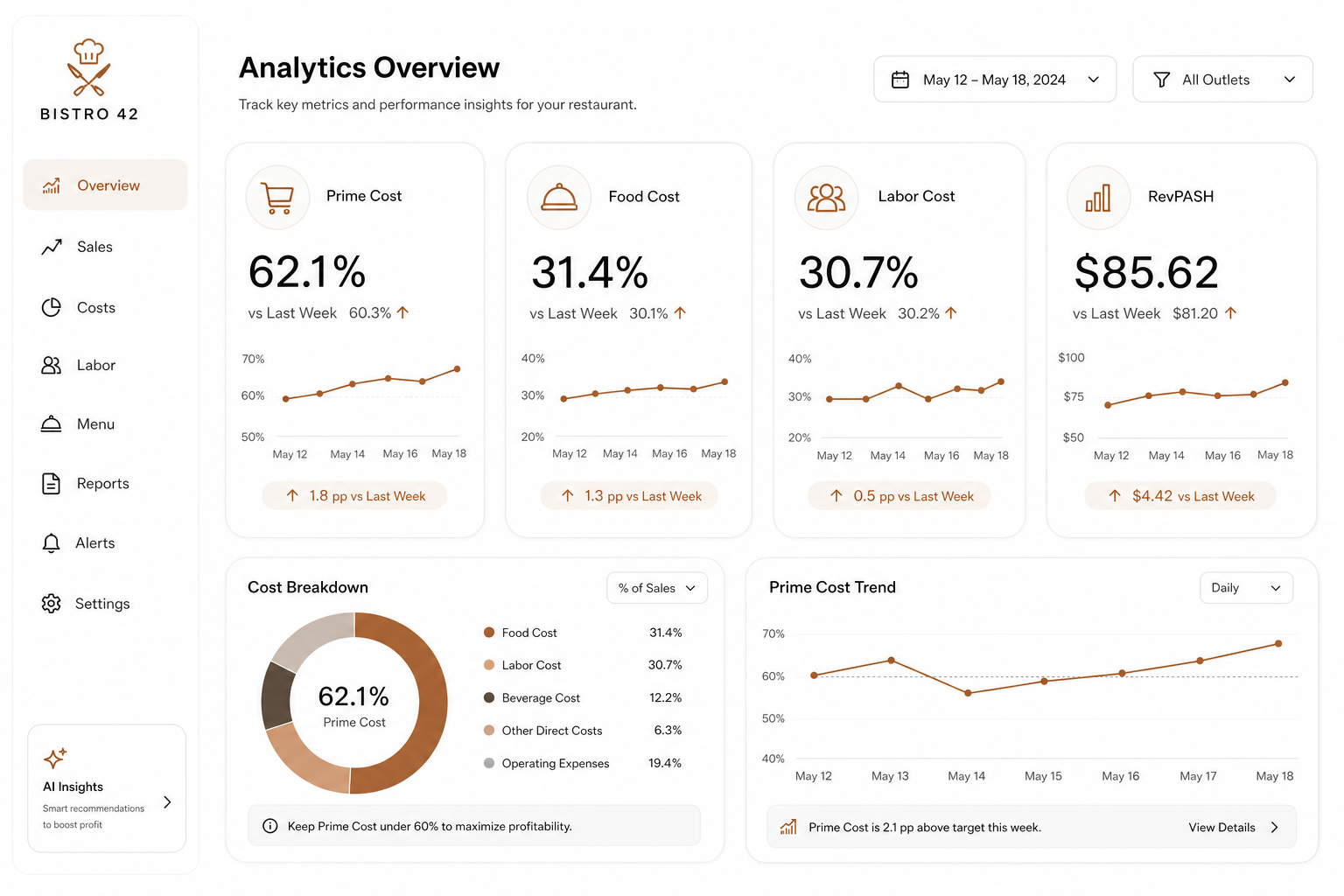
Operating a restaurant in today's economic climate is a game of razor-thin margins. Since the pandemic, overall restaurant input costs have soared by 30%. The National Restaurant Association estimates that food and labor costs alone have skyrocketed 35% since 2019. Historically, food and labor each consumed about 33 cents of every dollar in sales. Today, persistent inflation, unpredictable foot traffic, and rising operational expenses mean you cannot afford to manage your business by gut feeling.
To protect your cash flow, you must focus on the core financial and operational metrics that define your restaurant’s health. Moving from retrospective spreadsheet work to real-time automation is no longer a luxury – it is a survival strategy.
The essential restaurant KPIs you must track
You do not need to drown in data to understand your business health. Focusing on these four critical metrics will give you a clear, actionable view of your cash flow and operational efficiency.
Prime cost
Your prime cost is the combined total of your cost of goods sold (COGS) and your total labor costs, which includes wages, salaries, benefits, payroll taxes, and related employee expenses. It is the single most important number on your profit and loss statement.
$$text{Prime Cost} = text{Total COGS} + text{Total Labor Costs}$$
$$text{Prime Cost Percentage} = left(frac{text{Prime Cost}}{text{Total Sales}}right) times 100$$
Profitable, well-managed restaurants typically aim to keep their prime cost under 60% of total revenue. If your prime cost is climbing toward 65% or higher, your business is likely operating at a loss, especially with modern industry profit margins hovering in the low single digits.
Food cost percentage
This metric tracks the cost of the ingredients used to prepare food relative to the revenue generated from those menu items.
$$text{Food Cost Percentage} = left(frac{text{Cost of Goods Sold}}{text{Total Food Sales}}right) times 100$$
For a more precise, inventory-backed calculation that exposes food waste, theft, or portion-control issues, use the actual food cost formula:
$$text{Actual Food Cost Percentage} = left(frac{text{Beginning Inventory} + text{Purchases} - text{Ending Inventory}}{text{Total Food Sales}}right) times 100$$
The optimal target for most restaurants is 28% to 35% of revenue, though the exact baseline depends heavily on your service model. For instance, full-service restaurants run a historical average food cost of 32.4%.
Labor cost percentage
Labor is your other major cost driver. This percentage reflects the share of your total revenue spent on wages, payroll taxes, benefits, and insurance for your entire team.
$$text{Labor Cost Percentage} = left(frac{text{Total Labor Cost}}{text{Total Sales}}right) times 100$$
Most sustainable operators aim to keep labor costs at around 30% of sales. If your labor percentage spikes while sales are flat, it usually indicates staffing inefficiencies during low-volume shifts.
Revenue per available seat hour (RevPASH)
For table-service concepts, overall sales figures do not show how effectively you are utilizing your dining room. RevPASH measures your revenue against both your physical seating capacity and operational hours.
$$text{RevPASH} = frac{text{Total Revenue}}{text{Available Seat Hours}}$$
$$text{Available Seat Hours} = text{Number of Seats} times text{Operating Hours}$$
Tracking RevPASH helps you pinpoint sluggish hours, optimize table turnover, and design promotions to fill empty tables during slower shifts.
Moving from manual tracking to real-time POS data
The old way of tracking these performance indicators is painfully slow. Calculating actual food cost by hand involves late-night clipboard counts, digging through paper invoices, and manual spreadsheet entries. By the time you spot a margin problem, weeks have passed, and the profit is already gone.
To automate this process, you need a modern, integrated point-of-sale (POS) system that serves as your single source of truth. Platforms like Spindl consolidate order taking, delivery channels, self-service kiosks, and loyalty programs into a single device. Spindl acts like an iPhone in a market full of outdated, Nokia 3310-style systems, simplifying multi-location management and improving order accuracy.
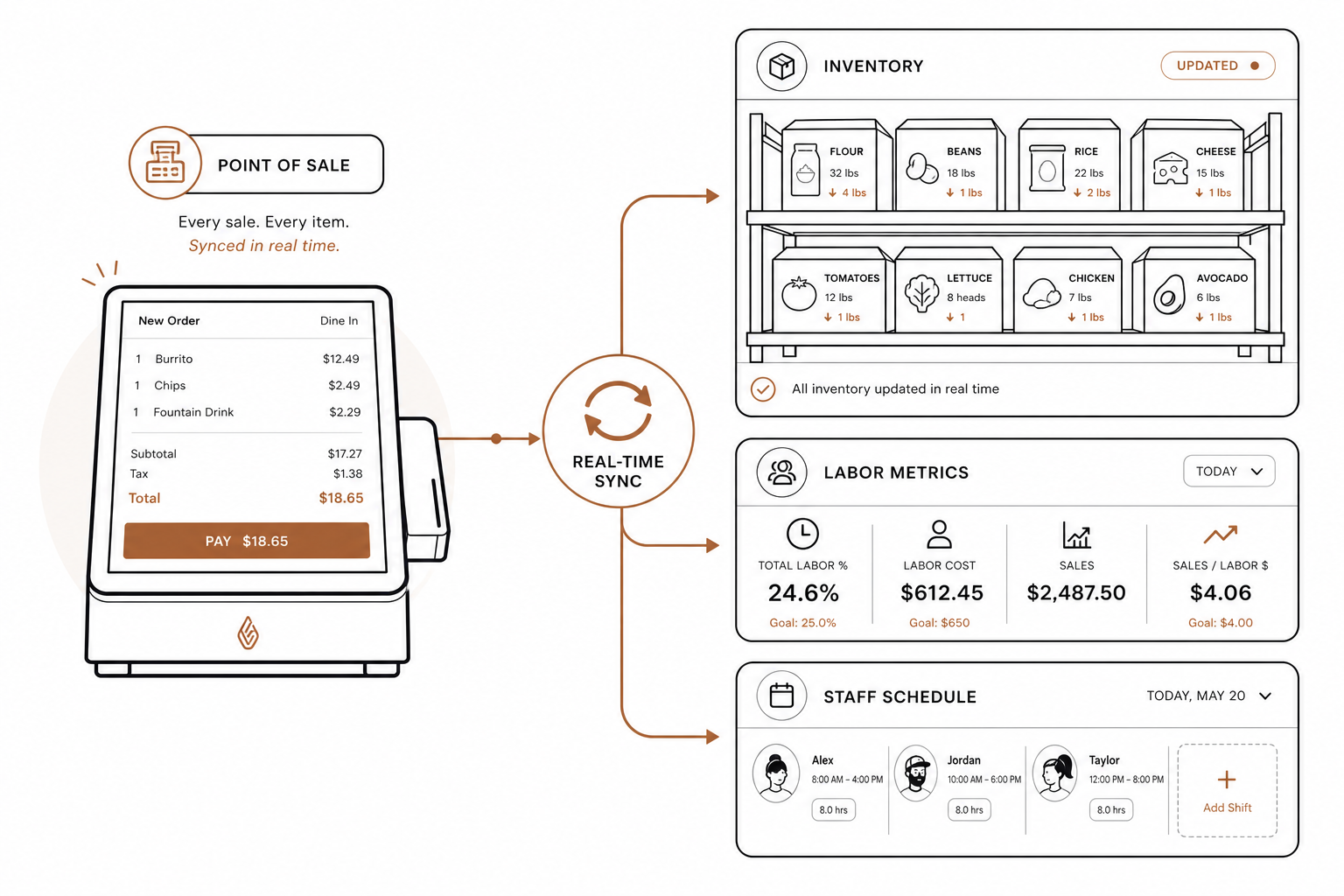
When your POS automatically syncs with your inventory, every transaction adjusts your stock levels in real time. This integration allows you to instantly compare actual versus theoretical inventory usage, identify food waste, and track labor costs against live sales velocity. The data is generated automatically, removing the human error of manual calculations.
Automating your reporting with AI and AgenticPOS
Even with a robust POS system, logging into multiple back-office dashboards and building pivot tables is time-consuming. AI-driven systems remove these hurdles entirely.
With AgenticPOS, you can connect your existing POS infrastructure to AI platforms like Claude, ChatGPT, or your internal Slack channels. Operating as an MCP server, AgenticPOS maps over 140 back-office operations – including inventory tracking, shifts, pricing, and real-time analytics – into agent-callable tools. If an experienced operator can execute a task inside your POS, you can now execute it with a simple, written sentence.
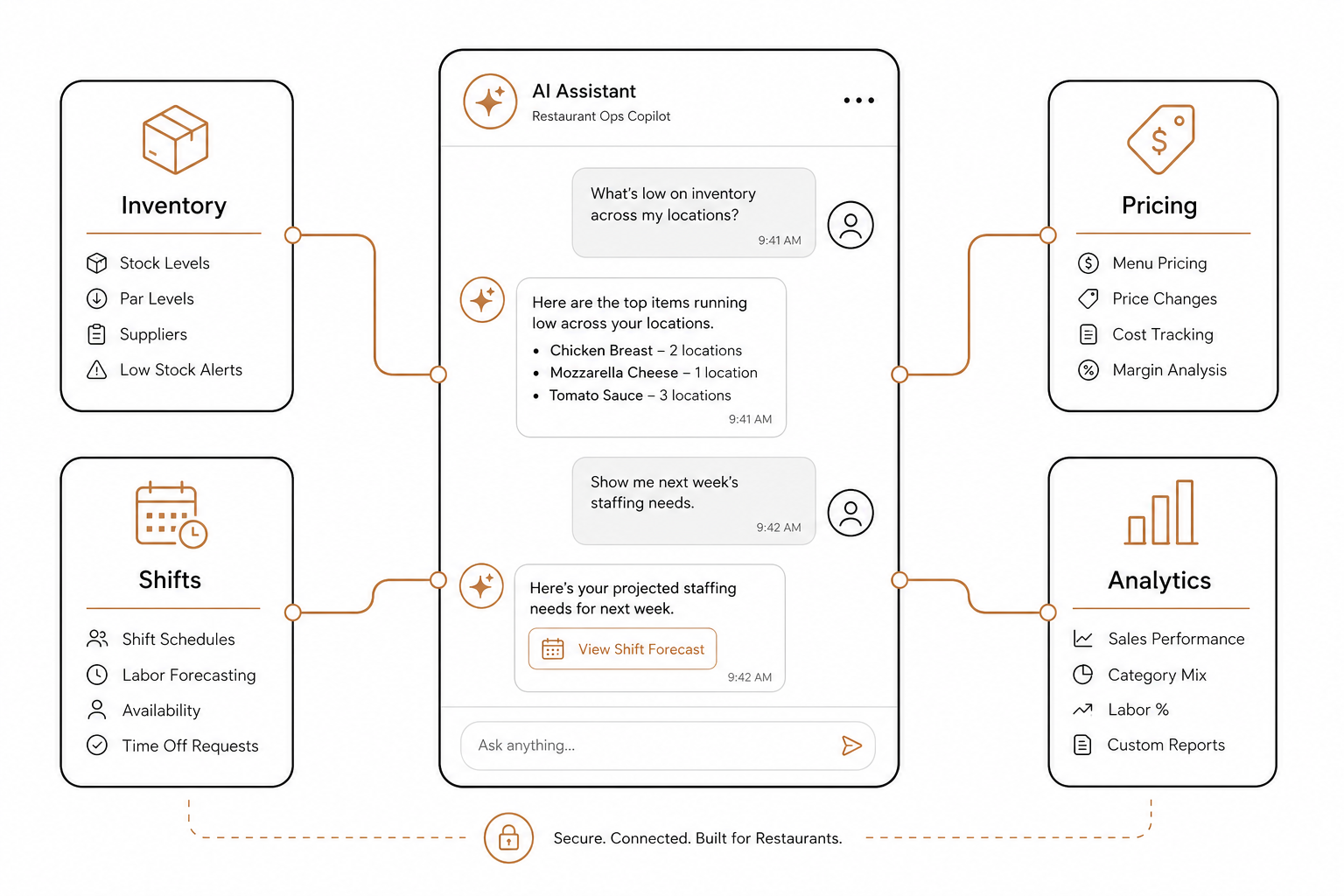
Instead of manual reporting, you can run and monitor your operations through natural conversation:
- Get instant metric summaries: Ask your AI agent to calculate yesterday's prime cost percentage and compare it to your historical Thursday average.
- Expose inventory variances: Query the system for theoretical versus actual inventory discrepancies on high-ticket items like ribeyes or liquor.
- Break down sales channels: Get an instant breakdown of your delivery app mix compared to dine-in revenue for a specific lunch rush.
- Configure automated alerts: Program your AI assistant to alert you on Slack if your labor cost percentage climbs above 35% during any shift, giving you the chance to adjust scheduling before your margins shrink.
You cannot manage what you do not measure, and you cannot measure effectively using yesterday's spreadsheet. Unifying your restaurant management under an all-in-one system like Spindl gives you the operational foundation you need to capture clean data.
By connecting your POS to AgenticPOS, you turn that raw data into direct, real-time control. You stop managing through the rearview mirror and start running your kitchen by simply talking to it. Connect your system to your preferred AI platform today and bring automated KPI tracking to your operations.