How to lower your restaurant labor cost percentage
Master your restaurant labor cost percentage with real-time POS tracking. Learn industry benchmarks, the labor formula, and how AI automation protects margins.
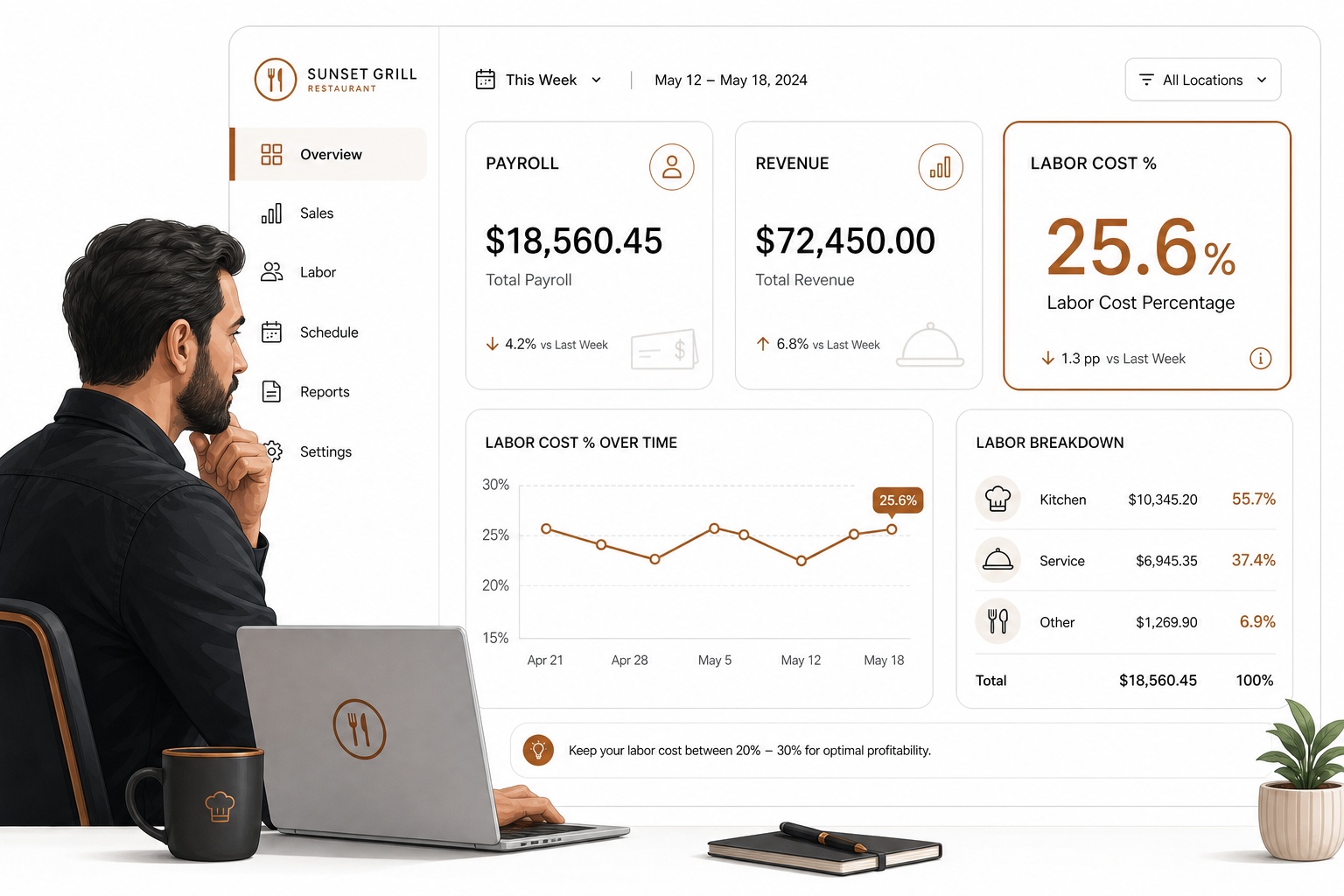
Labor is one of your largest recurring expenses. If you do not track it in real time, it will quietly eat your profit margins. To run a profitable kitchen, you must master your labor cost percentage. This metric shows how much of your total revenue is spent on payroll and employee-related expenses.
The labor cost percentage formula
The baseline calculation for labor cost is straightforward:
Labor Cost Percentage = (Total Labor Costs ÷ Total Sales) × 100
Many operators make the mistake of only counting base hourly wages. To get an accurate picture of your actual costs, your calculation must include the full cost of employment. Your total labor costs should account for:
- Hourly wages and salaries
- Overtime pay
- Payroll taxes
- Employee benefits and health insurance
- Bonuses and training costs
- Workers’ compensation and payroll-related fees
For a deep dive into structuring these accounts correctly, review the Taxfyle guide on calculating restaurant labor costs.
Restaurant labor cost benchmarks
Generally, a healthy labor cost percentage for a restaurant falls between 25% and 35% of total sales, according to the Gratuity Solutions restaurant labor cost analysis. However, this target depends heavily on your specific operating concept:
- Quick-service restaurants (QSR) aim for 20% to 30%, running the leanest service models.
- Fast-casual concepts typically operate between 25% and 33%.
- Casual and full-service dining establishments fall between 30% and 35%, and can push up to 40% in high-wage markets.
- Fine-dining restaurants frequently reach 30% to 40% or more due to labor-intensive, high-touch guest service.
Many operators budget using the classic 30/30/30 rule. This framework allocates 30% of revenue to labor, 30% to food costs (COGS), and 30% to overhead expenses like rent and utilities. This structure leaves you with a reliable 10% net profit margin.
How a modern POS system automates tracking
Calculating these numbers manually on a spreadsheet is a slow, error-prone process. A modern point-of-sale system turns retroactive bookkeeping into a proactive management strategy.
An all-in-one platform like Spindl acts as the central hub for your business. It is the "iPhone" of restaurant tech, bringing order taking, delivery integrations, and shifts into a single device. When your POS integrates directly with your labor management tools, your operational capabilities expand significantly:
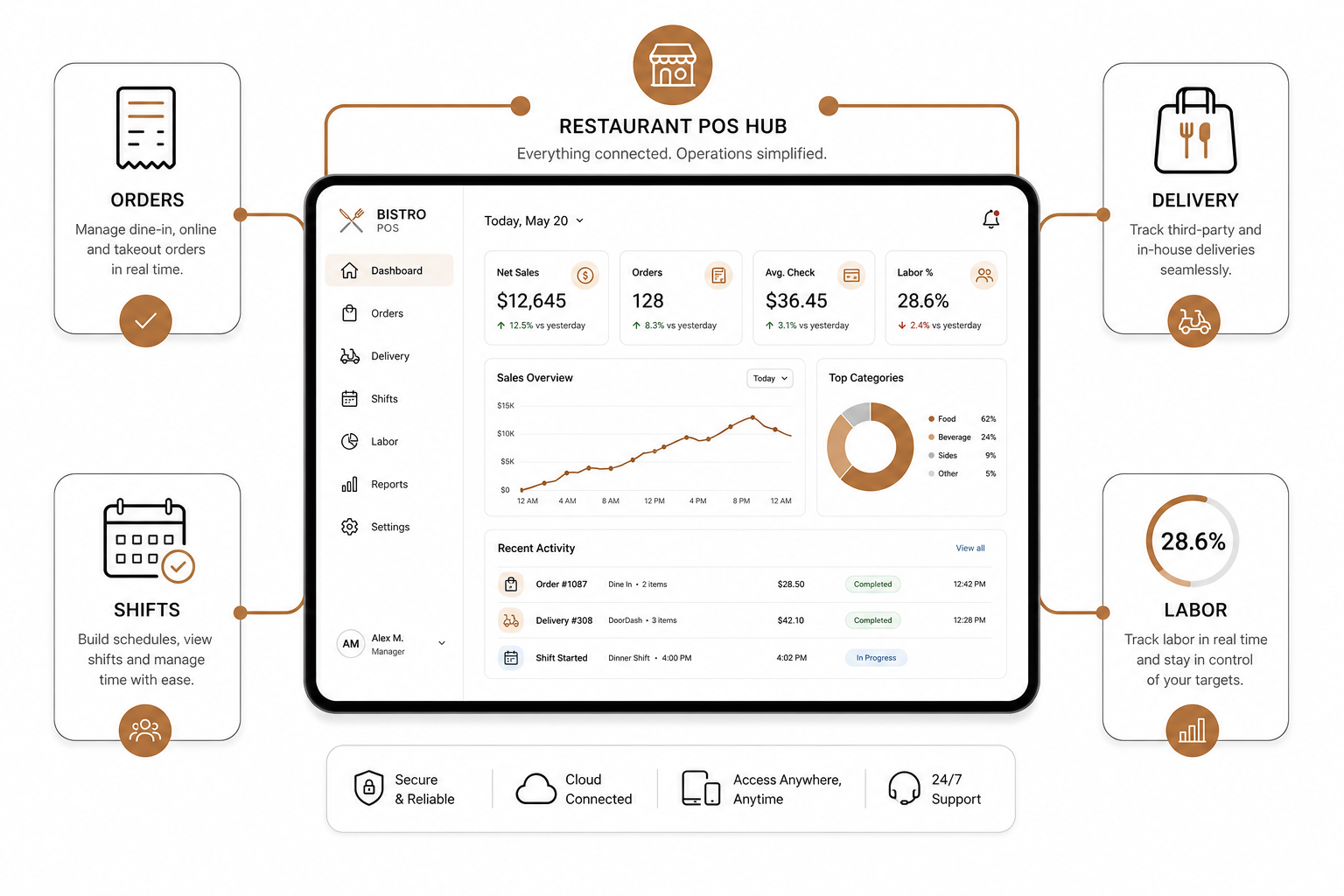
- Real-time labor vs. sales dashboards: Instead of waiting for payroll to run, you can view your active sales against active clock-ins. If foot traffic drops on a slow afternoon, you can spot the labor spike immediately and send staff home early.
- Predictive demand forecasting: Advanced POS systems analyze historical sales trends to predict guest volume hour by hour. This helps you build schedules matched to actual demand, preventing both understaffing and expensive overstaffing.
- Overtime prevention alerts: Unplanned overtime kills margins. Integrated POS systems monitor shifts and alert managers before an employee approaches the 40-hour weekly threshold.
- Flawless FLSA recordkeeping: The Fair Labor Standards Act (FLSA) requires precise tracking of non-exempt worker hours. Under federal rules, employers must retain three years of payroll records and two years of wage computation tables like schedules and time cards. As highlighted in the Workforce Software guide on FLSA recordkeeping requirements, having an integrated POS log these punches automatically keeps your restaurant audit-ready.
Practical tactics to lower your labor percentage
Software tracks the numbers, but your team must change its operational habits to lower them:
- Cross-train your staff: Train your front-of-house team to help with light prep work, or teach cooks to run plates. This versatility keeps the floor lean during transition hours.
- Stagger shift start times: Avoid scheduling five people to start simultaneously at 4:00 PM. Schedule two at 4:00 PM, two at 5:00 PM, and one at 5:30 PM to match the gradual build-up of guests.
- Perform weekly reviews: Do not wait for monthly financial statements to make adjustments. Conducting regular audits, as recommended in the CloudKitchens guide on reducing restaurant labor costs, helps you catch scheduling leaks before they damage your monthly margins.
Run your labor analytics without clicking dashboards
Tracking these operational metrics usually requires clicking through clunky back-office dashboards. You can bypass this administrative work entirely.
With AgenticPOS, you can manage your restaurant's back-office operations simply by asking for what you need. AgenticPOS is an MCP server that connects directly to your existing POS system and exposes key operational tools to AI assistants.
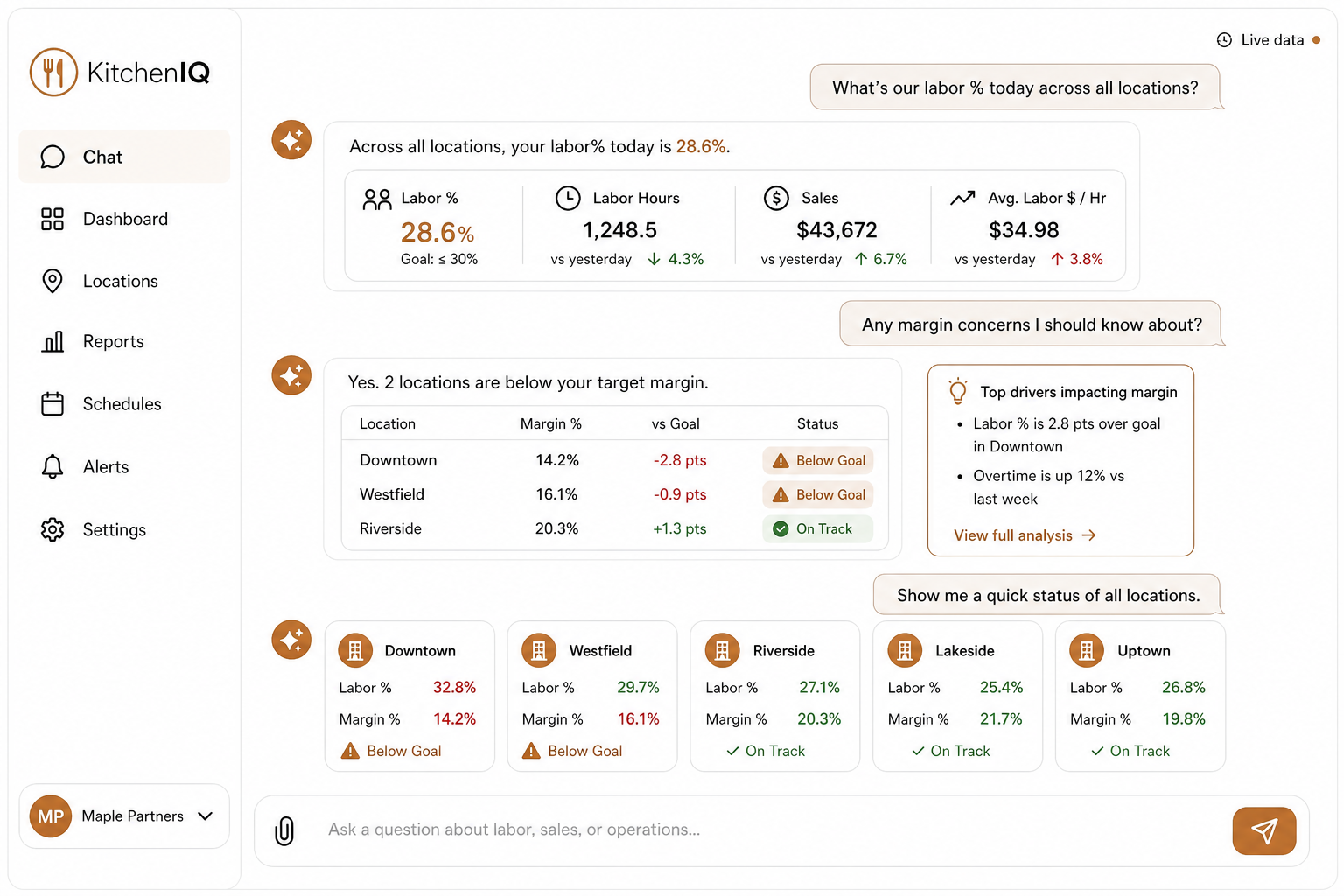
Instead of logging into multiple systems, you can use Claude, ChatGPT, or your team's Slack channel to ask direct questions. You can ask: "What was our labor cost percentage yesterday across all locations?" or "Are we pacing toward any overtime alerts today?"
You get real-time shift analytics, multi-location updates, and immediate labor metrics through a simple chat interface. This approach gives you total control to protect your margins without spending hours inside reporting panels.
Take control of your operations and connect your system to AgenticPOS today.