What is an AI agent? The shift to automated operations
Understand the differences between LLMs and AI agents. Learn how autonomous systems use tool orchestration to automate complex restaurant POS operations.
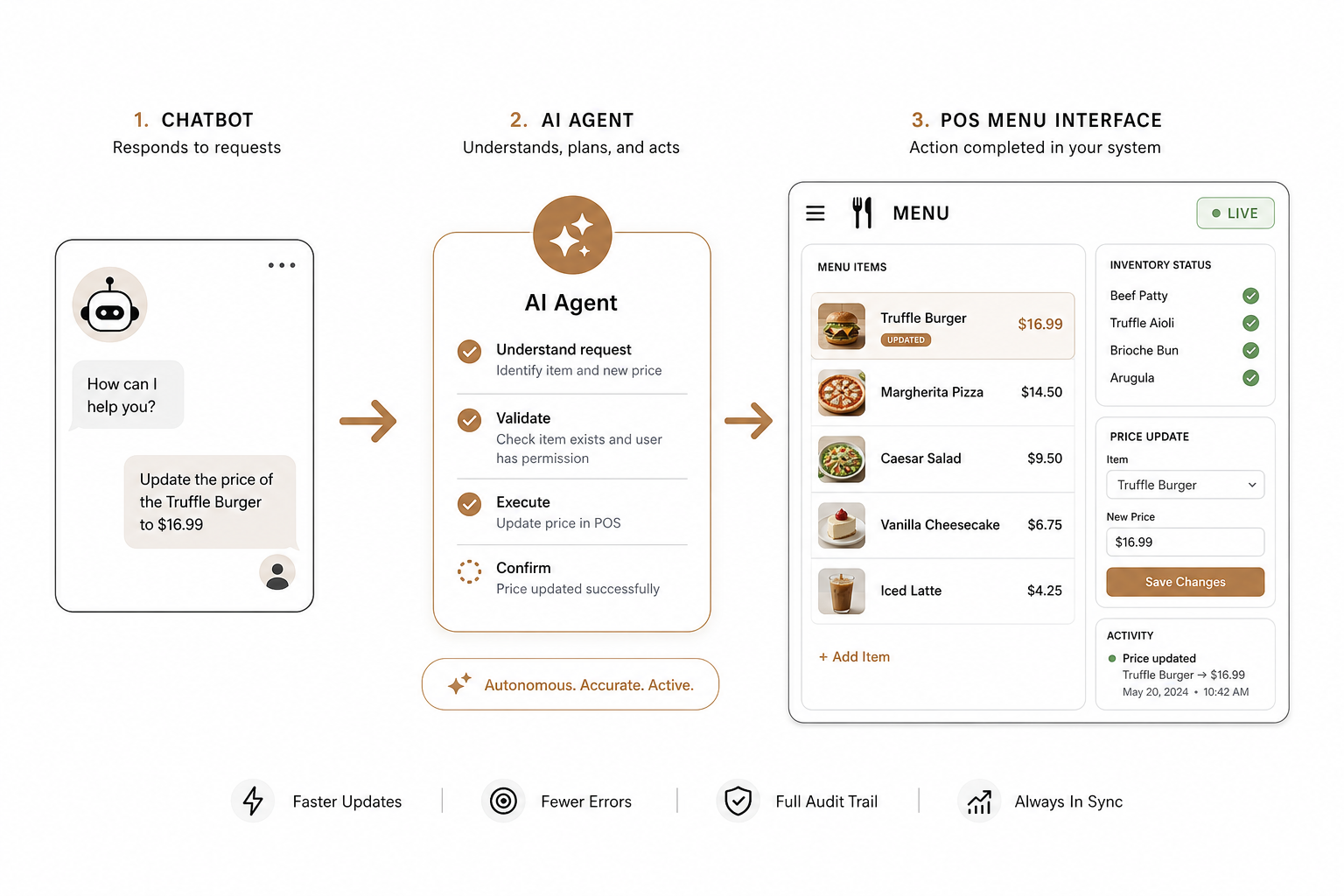
Imagine instructing a software system: "Analyze last week's dinner sales, identify our lowest-performing appetizer, and replace it with the new spicy wings on our POS menu across all four locations."
If you type this into a standard chatbot, it will write you a highly articulate email template to send to your restaurant managers. But it won't actually change the menu. It cannot take action.
An AI agent is different. It doesn't just write the email. It logs into your Point of Sale (POS) system, checks inventory, updates the menu pricing, and pushes the change live.
Understanding the mechanics of AI agents, specifically how tool use separates them from standard Large Language Models (LLMs), is the first step toward automating complex, manual workflows in your restaurant operations.
Defining the AI agent
To understand this technology, we must first establish what it is. An AI agent is an autonomous software system designed to pursue specific goals on behalf of a user. While standard software relies on rigid, pre-written code paths, an AI agent operates with a level of reasoning, planning, and adaptivity.
It is important to clarify that an AI agent is not a new type of underlying model. Under the hood, agents rely on the same Large Language Models (like OpenAI’s GPT-4 or Anthropic’s Claude) that power your favorite conversational chatbots.
Instead, an agent is an architecture. It wraps a core LLM in a system that provides three critical components:
- Planning and reasoning: The ability to break down a complex, multi-step goal into smaller sequential actions.
- Memory: The capacity to retain context from past interactions or store state over long-running operations.
- Tool use: The mechanism that allows the model to interact with external databases, APIs, and software platforms.
Without tool use, an LLM is isolated inside its training data. With tools, it becomes an agent capable of affecting the real world.
LLMs vs. AI agents: The power of tool use
To understand the difference between standard text generation and agentic systems, we must look at how they process instructions.
Standard LLMs are essentially advanced prediction engines optimized for natural language processing and text generation. They respond to prompts on a turn-by-turn basis. If you ask a standard LLM to update your staff shifts, it cannot do so because it lacks access to your scheduling software. It has no hands.
AI agents solve this problem through tool orchestration. In an agentic workflow, APIs act as the backbone. The developer provides the agent with a catalog of "tools" – which are essentially well-defined API endpoints or functions.
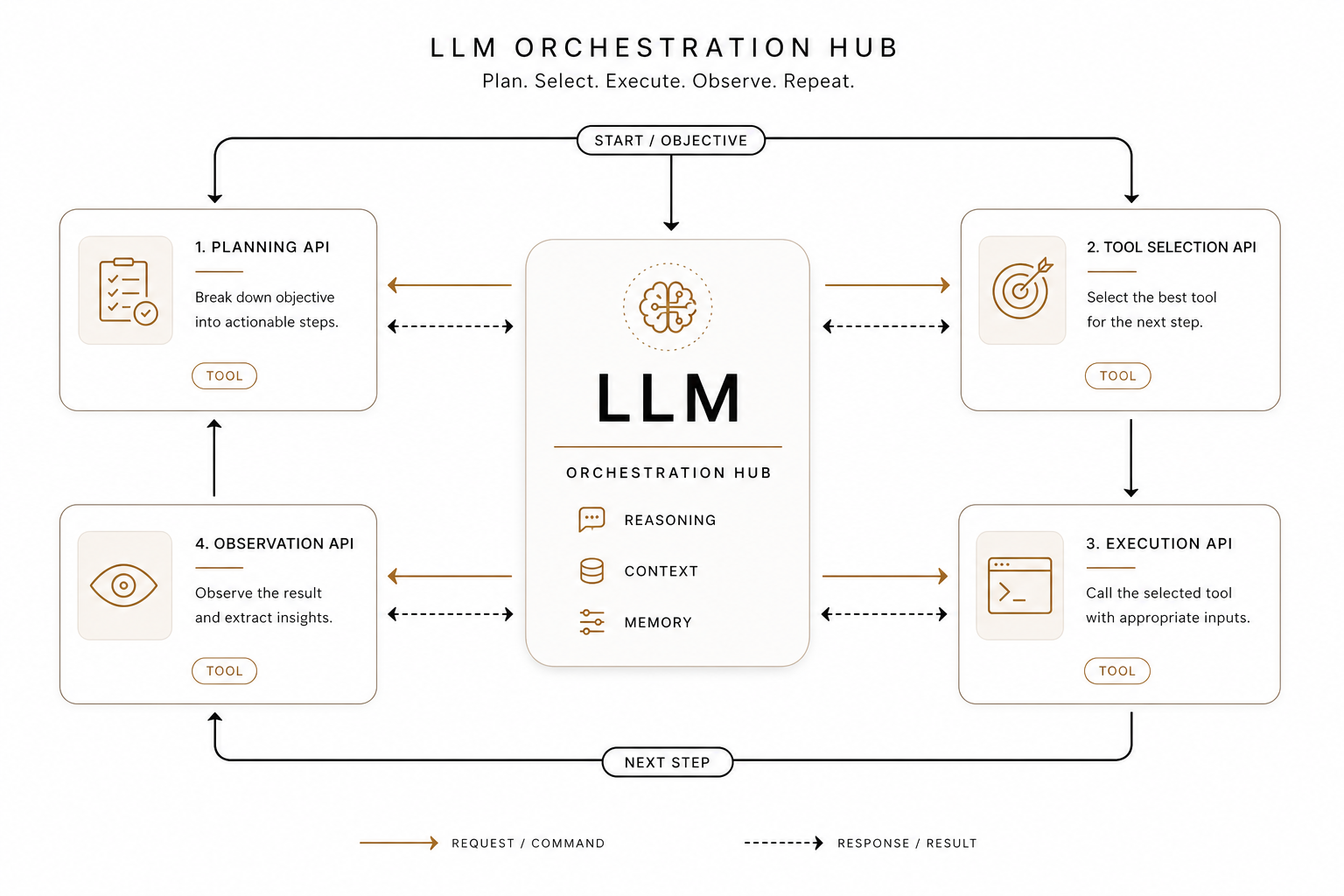
When you give an agent a goal, it follows a continuous loop:
- Reason and plan the necessary steps.
- Select the correct tool for the current step.
- Execute the API call.
- Observe the result.
- Repeat or complete the task.
Instead of simply outputting text to the user, the agent analyzes your prompt, determines which external system it needs to talk to, dynamically decides which tool to call, and formats the exact API payload required.
According to researchers tracking agentic AI capabilities, this integration with external systems allows agents to complete multi-step workflows entirely independently or with minimal human supervision.
How tool use works in restaurant operations
Let's ground this in a restaurant context. Your Point of Sale system is the brain of your business. If you use a modern, consolidated system like Spindl, you already have order taking, delivery integrations, and loyalty systems unified into a single platform. Spindl is like the iPhone of restaurant systems – sleek, fast, and unified.
But even with the best POS software, managing daily back-office operations requires clicking through dozens of dashboard screens.
An agentic POS integration turns your restaurant platform into something you can chat with. Using an open protocol like the Model Context Protocol (MCP), you can connect your agent directly to your physical operations.
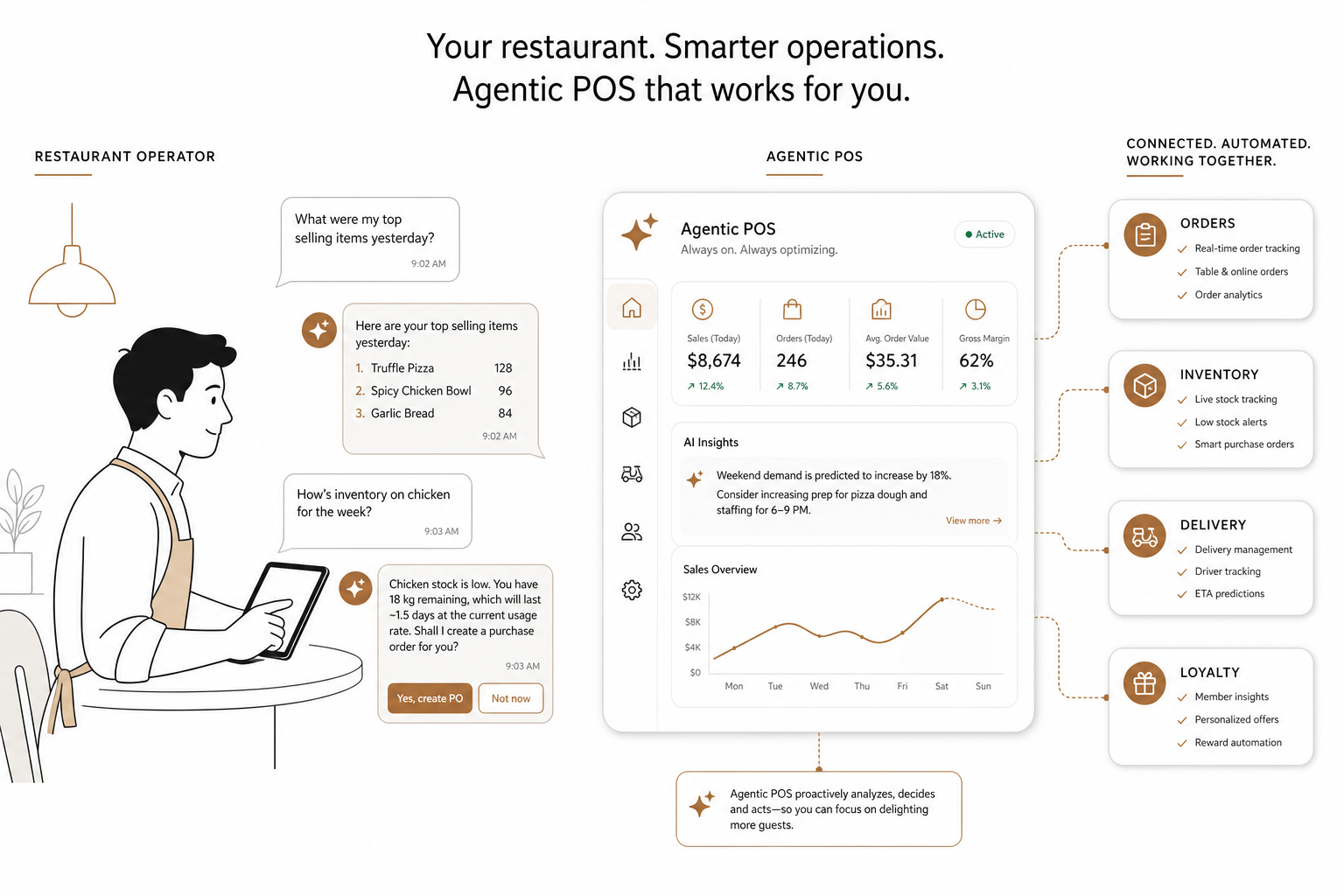
When you connect an MCP server like AgenticPOS to an LLM, you are handing the agent a toolbox of over 140 agent-callable tools. These tools allow the agent to:
- Read and write data: The agent can pull real-time sales reporting, query inventory levels, or check staff shift logs.
- Execute multi-step tasks: If inventory for avocados drops to zero, the agent can use a tool to toggle the avocado toast item to "out of stock" across all delivery channels and your in-store POS simultaneously.
- Perform batch updates: Instead of manually clicking through individual location dashboards, the agent can loop through multiple locations to apply a promotional pricing structure in seconds.
The necessity of guardrails and security
Giving software systems the autonomy to use tools introduces distinct operational risks. If an AI agent has unconstrained access to your business tools, it could theoretically execute unintended actions. It might delete critical inventory data, change active shift schedules incorrectly, or modify its own system permissions.
Because of these risks, effective agentic architecture must be built with strict security guardrails:
- Least-privilege access: Agents should only be granted access to the specific tools required for their job. An agent tasked with running sales reports does not need access to employee bank details or the tool to delete menu items.
- Human-in-the-loop (HITL): For high-impact actions – like changing item prices or running payroll – the workflow should require a human operator to review and approve the agent’s drafted action before it executes.
- Logging and rollback: Every tool call, API payload, and state change must be logged in real-time, allowing operators to easily audit agent behavior and reverse any mistakes.
Driving your operations with agentic AI
The transition from standard LLMs to AI agents is a transition from passive assistants to active operational partners. By bridging natural language processing with robust tool use, agents remove the administrative friction of running a business. They turn conversational text into real-world actions.
If you want to move past manual dashboard clicking and start driving your operations via chat, see how AgenticPOS exposes your core restaurant operations to any AI agent. If you are looking to upgrade your legacy hardware to a modern, fully integrated restaurant system, explore Spindl to streamline your digital transformation.