Understanding Model Context Protocol for restaurant POS
Explore Model Context Protocol (MCP), an open standard connecting AI to restaurant POS systems. Manage menu pricing, inventory, and operations via conversation.
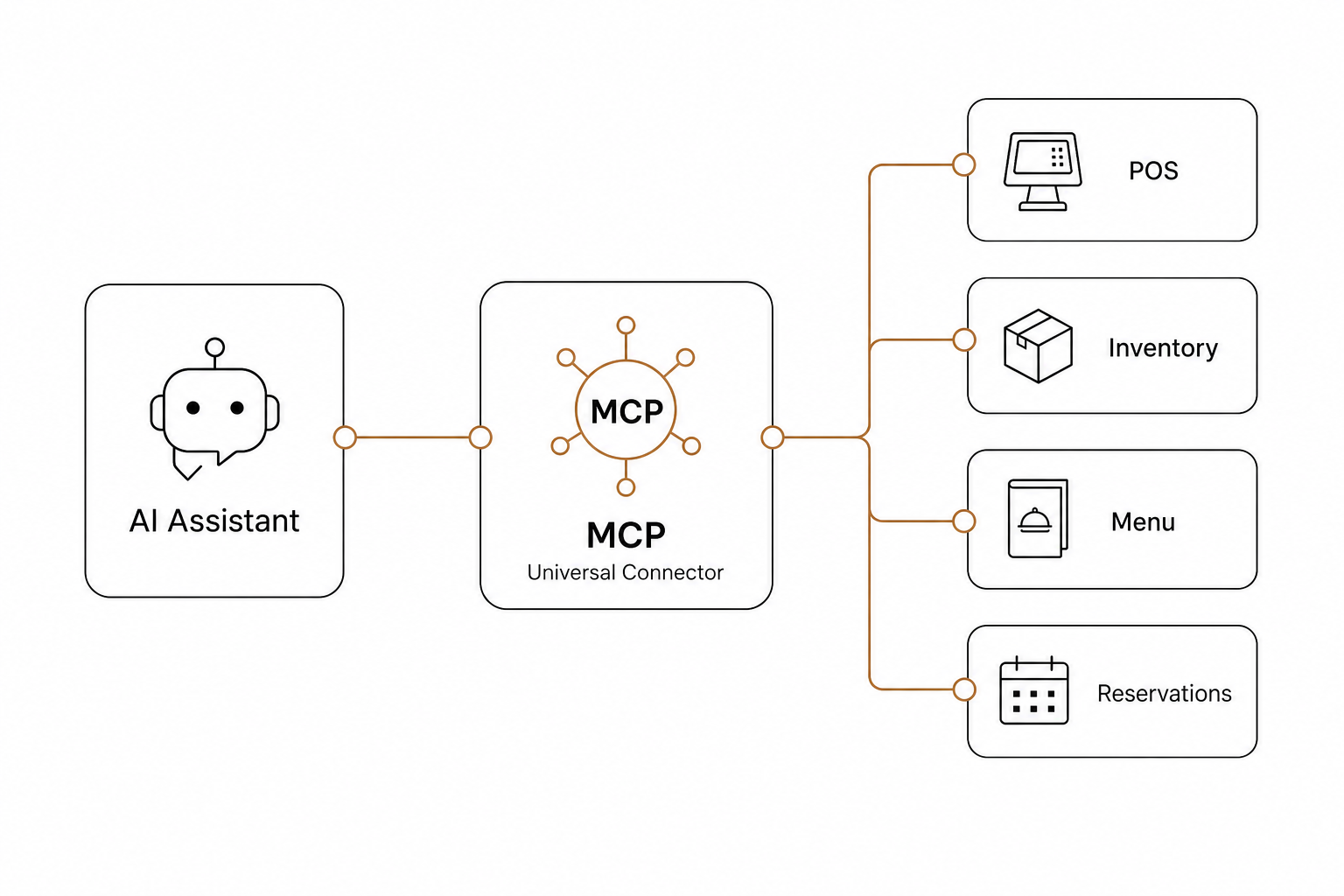
In 2024, Anthropic introduced the Model Context Protocol (MCP) as an open-source standard designed to solve one of the biggest challenges in artificial intelligence: how to safely connect large language models (LLMs) to the real-world systems where data actually lives.
Think of MCP as the "USB-C port" for AI tools. Before USB-C, you needed different cables and adapters for every device you wanted to connect to your computer. In the same way, developers previously had to write unique, custom code to connect an AI model to every separate database, application programming interface (API), or business system. MCP replaces this fragmented approach with a single, standardized, two-way connection layer.
For restaurant operators and POS users, this standard is a quiet revolution. It bridges the gap between sophisticated AI models and the daily operational systems that keep your doors open.
How the Model Context Protocol works
MCP operates on a clean, secure client-host-server architecture over JSON-RPC 2.0. This structure allows the AI to both retrieve context and execute actions against external applications. To understand how it functions in a restaurant setting, it helps to break down the three main parts of this architecture:
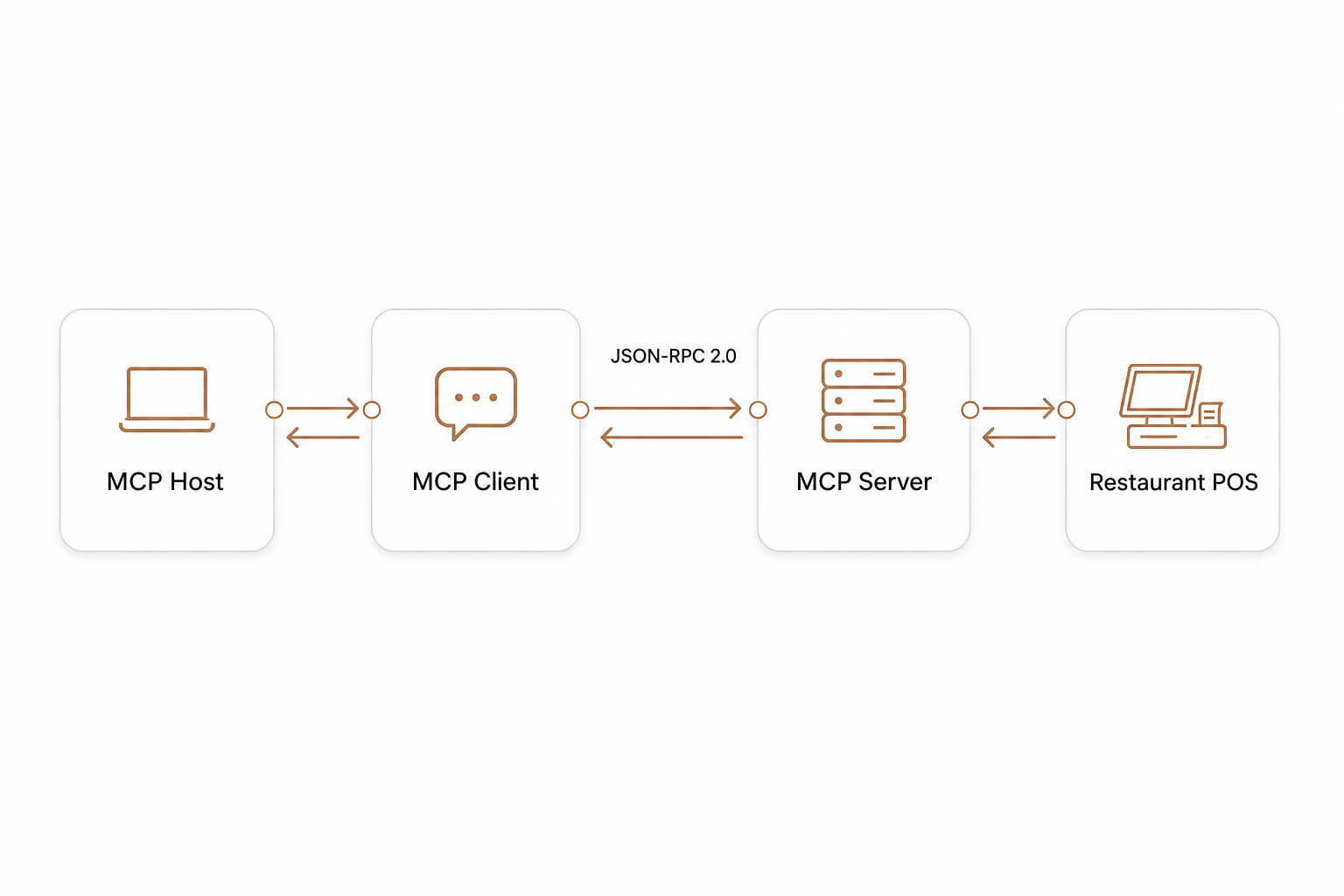
- The MCP Host: This is the user-facing application where you interact with the AI. It acts as the container, managing security and LLM integration. This could be Claude, ChatGPT, an internal operations copilot, or even a custom Slack bot.
- The MCP Client: This is a lightweight, secure protocol bridge embedded directly within the host. The client establishes a stateful session with the server, negotiating capabilities and routing messages bidirectionally between the AI model and your systems.
- The MCP Server: This is an independent program that wraps your external tools or databases and exposes their capabilities. In a restaurant environment, the MCP server sits directly on top of your point-of-sale (POS) system.
Instead of attempting to train an AI model to navigate a complex, proprietary POS system API, you connect an MCP server to your POS. The host application then communicates with the server, discovering exactly what the POS can do and translating your instructions into actions automatically.
The three primitives of MCP
Every MCP server organizes and exposes its functionality using three core building blocks. These primitives allow an AI model to understand its boundaries and perform tasks reliably.
Tools (Model-controlled actions)
Tools are executable functions that allow the AI to perform physical actions and change states. In a restaurant context, a tool might change a menu price, adjust employee shifts, or update inventory. The LLM determines when and how to invoke these tools based on the instructions you give it.
Resources (Application-controlled data)
Resources are read-only data sources that provide vital business context to the AI model. They act like GET requests, serving up raw data without altering the state of your systems. For example, a resource might expose your live channel mix, actual inventory levels, or local loyalty program metrics so the AI can analyze them.
Prompts (User-controlled templates)
Prompts are structured, pre-built templates and workflows exposed by the server. Instead of typing out a long, complex prompt every time you want to complete a task, you select a template. For instance, a server could expose an "End of Day Reconciliation" prompt template that guides the AI through checking register drops and variance reports.
Why MCP matters for restaurant operators
Modern restaurant management is often bogged down by administrative friction. Managers spend too much time clicking through rigid back-office dashboards just to toggle a delivery channel, update pricing, or analyze margins. MCP introduces a much simpler paradigm: command by conversation.
Instead of navigating tab after tab, you simply tell your software what you need. You can instruct your assistant to "lower the price of the draft beer by fifty cents during happy hour," and the AI selects the correct tools to update the POS system.
Because MCP is an open standard, it offers two major operational advantages:
- No vendor lock-in: You are not locked into a single AI provider or a closed ecosystem. Because the standard is open, the same MCP server will work whether you choose to use Claude, ChatGPT, or your own proprietary internal tools.
- Dynamic discovery: When you connect an MCP server to an AI client, the model automatically queries the server and downloads its machine-readable capabilities catalog. It immediately learns what it can do without requiring any manual code updates.
Security, consent, and guardrails
Letting an AI model interface with a live business system requires robust security. The official MCP specification explicitly warns that because the protocol enables arbitrary data access and action execution, implementors must carefully design security layers.
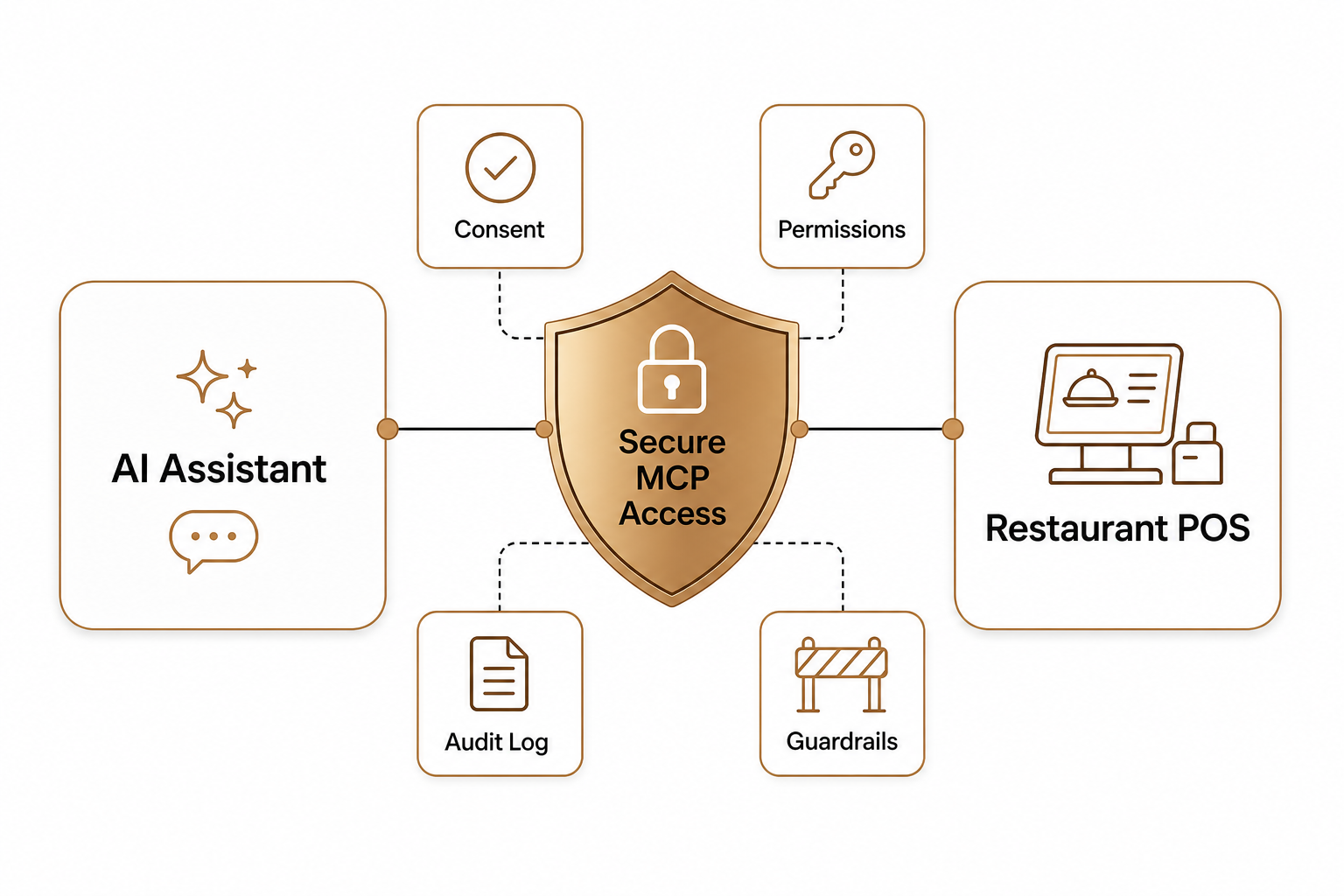
MCP does not give AI unchecked access to your operations. Instead, it relies on strict safety protocols:
- Explicit consent: The host application is required to get user consent before transmitting any data or executing an action. You remain in control of what is shared.
- Customizable access controls: Operators can easily configure permissions. You can set the system to read-only, limit operations to a single physical location, or grant full operator permissions.
- Strict guardrails: Sensitive operations, such as changing menu prices beyond a certain percentage or writing off inventory, can be locked behind approval thresholds or price caps. Every single action is fully logged, reviewable, and reversible.
Bringing MCP to your restaurant
At AgenticPOS, we have built a dedicated MCP server for POS systems that maps the entire POS surface area into over 140 agent-callable tools. This lets you securely manage your menu, pricing, channels, shifts, inventory, and promotions through the AI interface of your choice.
To get the most out of these tools, pairing them with an intuitive, unified point-of-sale platform like Spindl allows you to consolidate your order management, delivery channels, and loyalty systems into a single, high-efficiency system.
The future of restaurant operations isn't about managing more complex software dashboards – it is about using conversational AI to eliminate them. Explore how AgenticPOS can connect your existing POS to the next generation of AI tools today.