How to manage restaurant POS discounts without losing margin
Learn how to set up compliant POS discounts, navigate state sales tax laws, and track metrics like prime cost to ensure your promotions remain profitable.
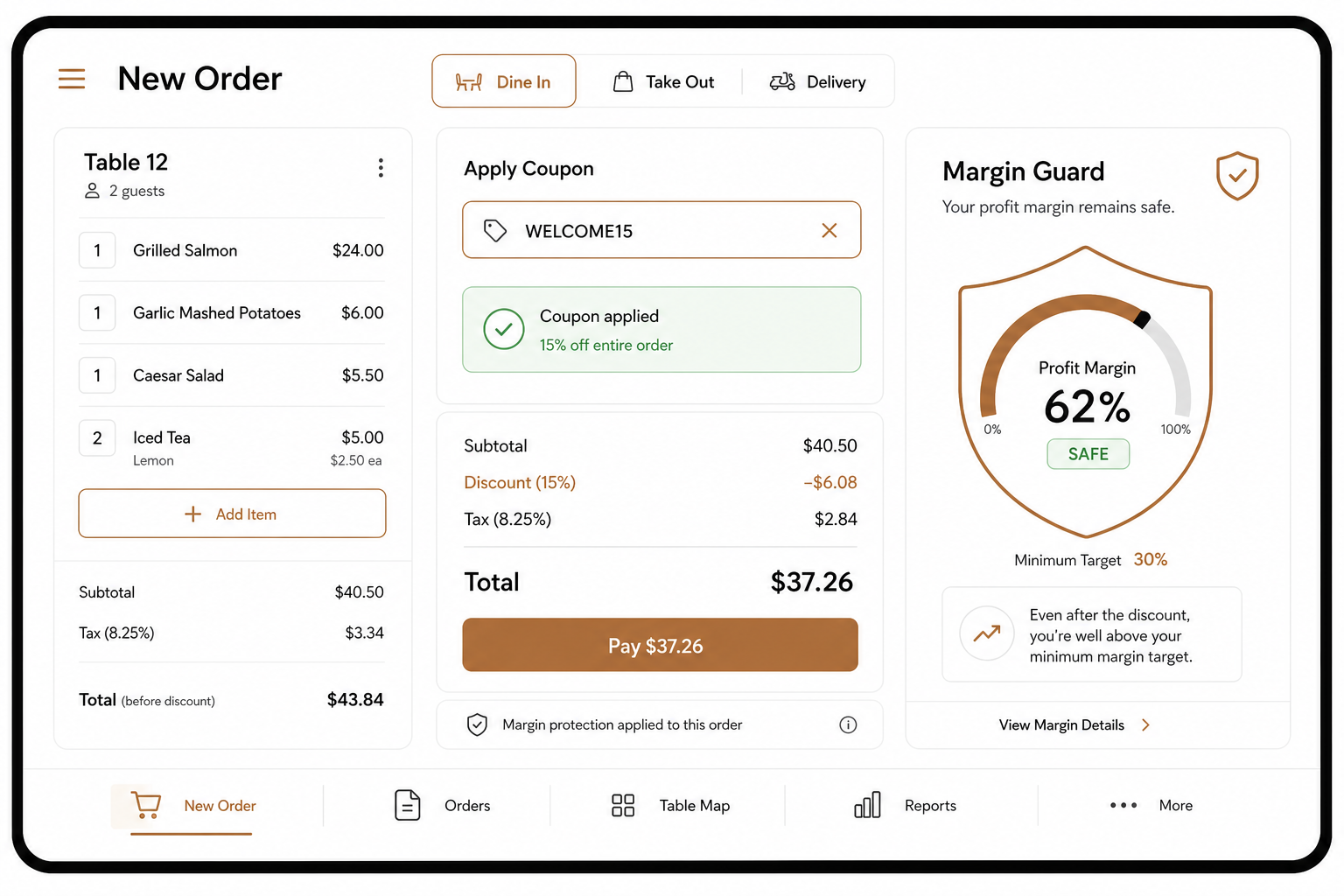
Discounts can fill empty tables during sluggish shifts, but poorly configured promotions will quickly erode your profit margins. To run a profitable restaurant, you must design your coupon codes to be operationally seamless, legally compliant, and easy to analyze.
Using an advanced, all-in-one system like Spindl keeps your front-of-house operations running smoothly. When you couple that infrastructure with smart back-office configuration, your marketing campaigns will actually protect your cash flow instead of draining it.
Here is how to set up, tax, and track your POS discounts without the operational headaches.
Setting up compliant coupon codes
Every discount you create must comply with federal and state advertising guidelines. If your promotions mislead consumers, you risk costly legal trouble.
Keep it legal: FTC guides and deceptive pricing
Under federal law, all promotional and discount claims must be truthful, fair, and supported by evidence before they are launched. This standard is actively enforced by the Federal Trade Commission [EXT2].
The Federal Trade Commission’s (FTC) Guides Against Deceptive Pricing dictate that advertising a price reduction is deceptive if your original price was artificially inflated or only offered for a short period. If you are comparing a sale price to an original price, that original price must have been offered to the public on a regular basis for a reasonably substantial period – generally interpreted as about 30 days.
Before you roll out a discount, make sure your baseline menu prices are stable. If you are planning a broader pricing adjustment, read our guide on how to do a menu price increase in your POS to avoid driving away loyal guests.
Defining explicit terms and conditions
To prevent customers from stacking promotions or trying to use expired vouchers, your POS configuration must enforce clear boundaries. To avoid claims of deceptive advertising, disclose these terms clearly near the advertised offer:
- Specific expiration date: Ensure any time-limited offer is truly limited. Extending it indefinitely can be flagged as misleading.
- Exact form of discount: Clearly define if it is a percentage off, dollar amount off, or a buy-one-get-one (BOGO) deal.
- Exclusions: Specify exclusions like alcohol, taxes, or delivery fees.
- Non-combinability: Explicitly program the POS so the coupon cannot be combined with other active offers.
- No cash value: Protect yourself from demands for cash refunds.
Navigating the sales tax minefield
Taxing discounted menu items incorrectly is a recipe for a painful audit. States treat coupon and voucher redemptions differently, and your POS receipt templates must reflect these local laws.
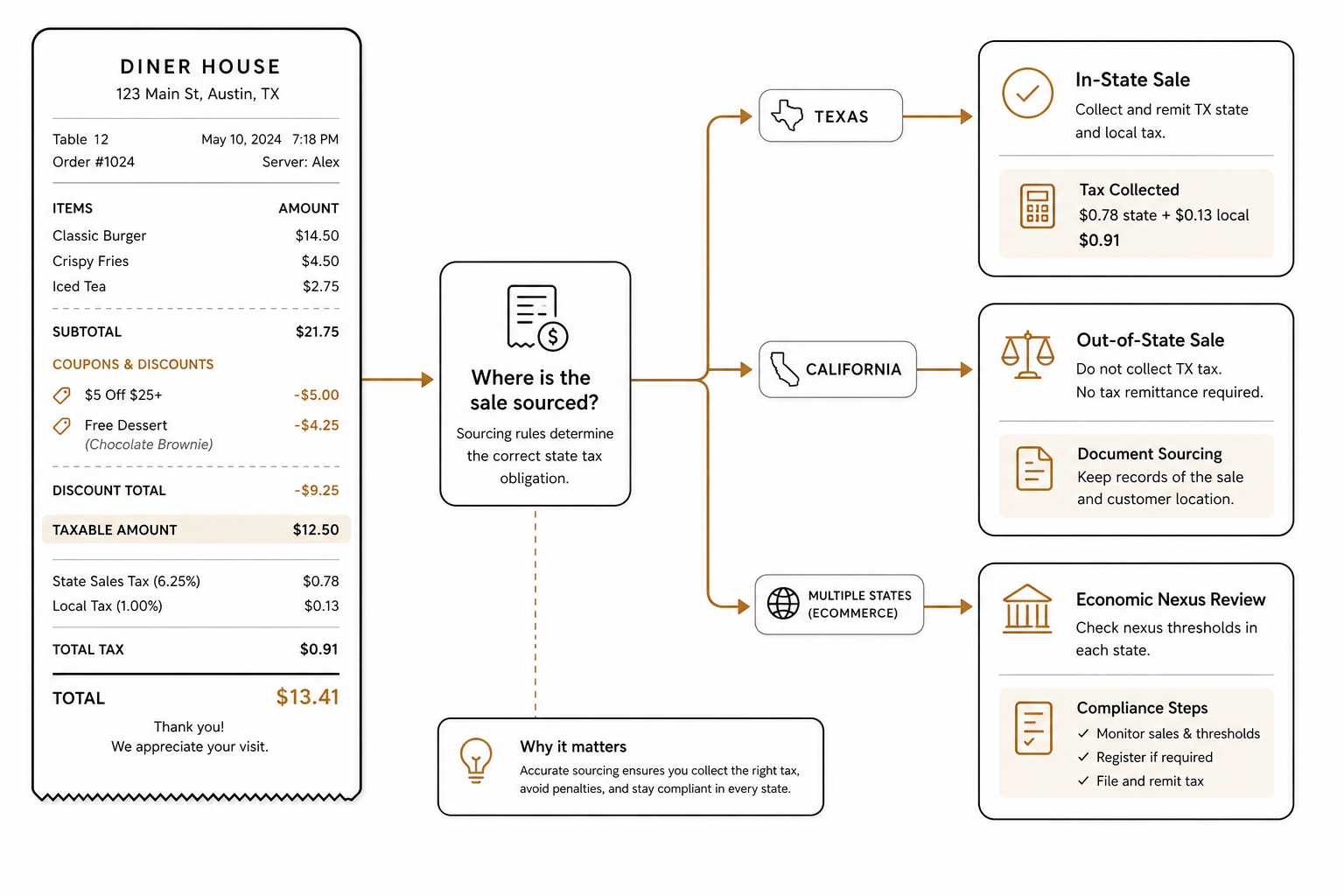
Minnesota: The voucher rule
In Minnesota, purchasing a restaurant discount voucher is not taxable at the time of purchase. Sales tax is instead imposed when the customer redeems the voucher, calculated based on either the amount paid for the voucher (if known) or its face value. Your POS records must preserve this transaction history to justify the tax collected.
Pennsylvania: The linkage rule
The Pennsylvania Supreme Court has ruled that coupon amounts are not subtracted from the sales tax base unless your receipt explicitly states and links the coupon to the specific taxable item. If your receipt template merely lists the discount at the bottom of the bill without linking it to the individual dish, you owe sales tax on the full, pre-discounted price [EXT26].
Retailer-funded vs. manufacturer-reimbursed
States like California, Connecticut, and Illinois distinguish between who funds the discount:
- Retailer-funded discounts: If your restaurant funds the discount (e.g., a "15% off Tuesdays" promo), sales tax is typically calculated on the reduced transaction price.
- Reimbursed discounts: If a third party or manufacturer reimburses you for the discount, the discount amount is considered part of the taxable selling price, and tax is owed on the full original price. This distinction is critical for accurate reporting under state guidelines [EXT28].
Tracking the promotion metrics that actually matter
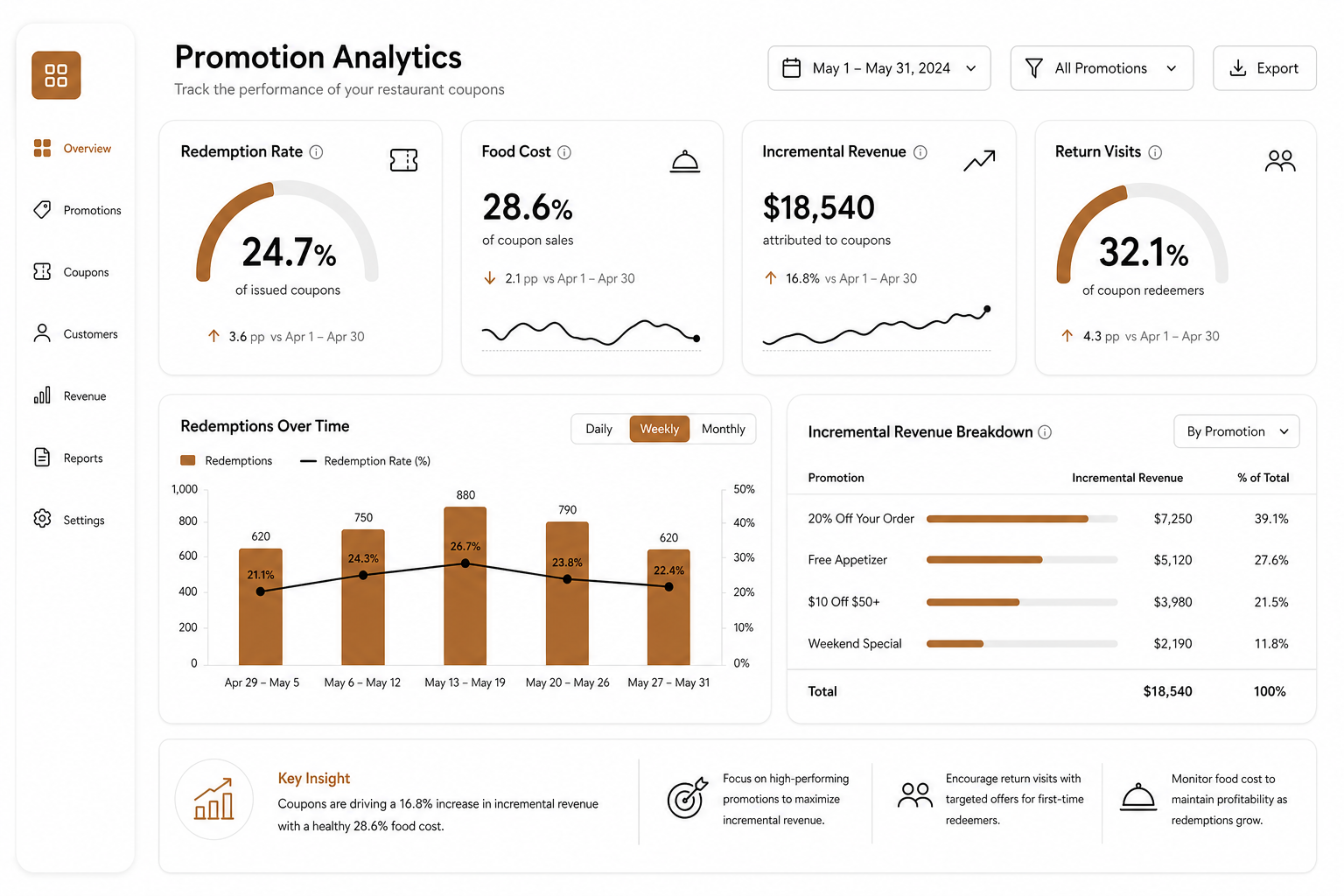
Never evaluate a promotion's success based on gross sales alone. You must analyze key performance metrics to determine if your coupons are driving sustainable business or simply subsidizing cheap meals.
       [ Promotion Launch ]
                │
                ▼
   [ Analyze Menu Performance ] ──► Food Cost % (Keep under 35%)
                │
                ▼
   [ Measure Campaign Metrics ] ──► Redemption Rate & Incremental Revenue
                │
                ▼
   [ Assess Guest Behavior ]    ──► CAC vs. Return Visit Rate
                │
                ▼
  [ Protect Financial Health ]  ──► Keep Prime Cost under 60%
Financial safety checks: Food cost and prime cost ratios
Before you run any promotion, you must know the exact food cost percentage of every item on your menu. Calculate this by dividing the item's cost by its selling price. Focus your discounts on lower-cost, high-margin dishes (like pastas or starch-heavy appetizers) to avoid eroding your profitability.
Watch these critical financial guardrails:
- Food cost ratio: Sustained couponing can easily push your food cost ratio above the healthy restaurant benchmark of 28% to 35% of total revenue. If this ratio spikes, your discounts are too steep.
- Prime cost percentage: Your prime cost – the combined sum of food, beverage, and labor costs – should remain under 60% of total revenue. If your promotions require extra prep labor but lower your average ticket size, your prime cost will climb into dangerous territory.
- Breakeven analysis: Calculate the exact number of additional transactions or the increased average check size needed to offset the cost of the discount and marketing spend.
Operational and behavioral metrics
To paint a complete picture of your campaign's performance, track these indicators:
- Redemption rate: The percentage of distributed coupon codes that are actually redeemed. This tells you how compelling the offer is to your market.
- Incremental revenue: Compare your sales during the promotional period against your baseline sales for the exact same day and daypart in non-promotional weeks. This ensures you are generating new sales, not just discounting orders from guests who would have paid full price anyway.
- Customer Acquisition Cost (CAC) for promotions: Divide your total campaign costs (including marketing spend, food margins, and extra labor) by the number of new customers acquired.
- Return visit rate: Measure how many guests who redeemed a coupon return to dine at full price. High return rates prove your campaign attracted loyal patrons; low rates suggest you are only attracting one-time bargain hunters. Use advanced AI-driven customer segmentation to target high-value lapsed guests rather than relying on blanket discounting.
Streamlining promo management with AgenticPOS
Managing discounts manually across multiple platforms, delivery channels, and locations is a recipe for employee error. That is where AgenticPOS transforms your daily operations.
AgenticPOS is an open Model Context Protocol (MCP) server that connects directly to your existing restaurant POS, including popular platforms like Square, SumUp, and Spindl. It turns your back-office data – menus, pricing, inventory, and promotions – into agent-callable tools.
Instead of clicking through complex POS back-office dashboards to build, edit, or disable coupon codes, you can control your entire setup using natural language through Claude, ChatGPT, or your internal Slack channels.
For example, you can manage your promotions instantly with simple commands:
- "Exclude alcoholic beverages from our active 'SPRING20' discount code."
- "Deactivate the '15OFF' coupon code at our downtown location."
- "Compare the redemption rate and average check size of our Tuesday and Thursday dinner promotions."
Because AgenticPOS is built with strong operator control and strict guardrails, your AI agent will show you a preview of the proposed POS changes first. The modifications are only pushed to your live POS once you click to confirm. This eliminates manual data entry mistakes and simplifies your restaurant workflow automation.
To see how easy it is to manage your menus, pricing, and promotions through natural language, start your 14-day free trial of AgenticPOS today.