How to slash restaurant labor costs without losing staff
Reduce restaurant labor costs through demand-driven scheduling, cross-training, and automation. Learn to protect your profit margins without losing staff.
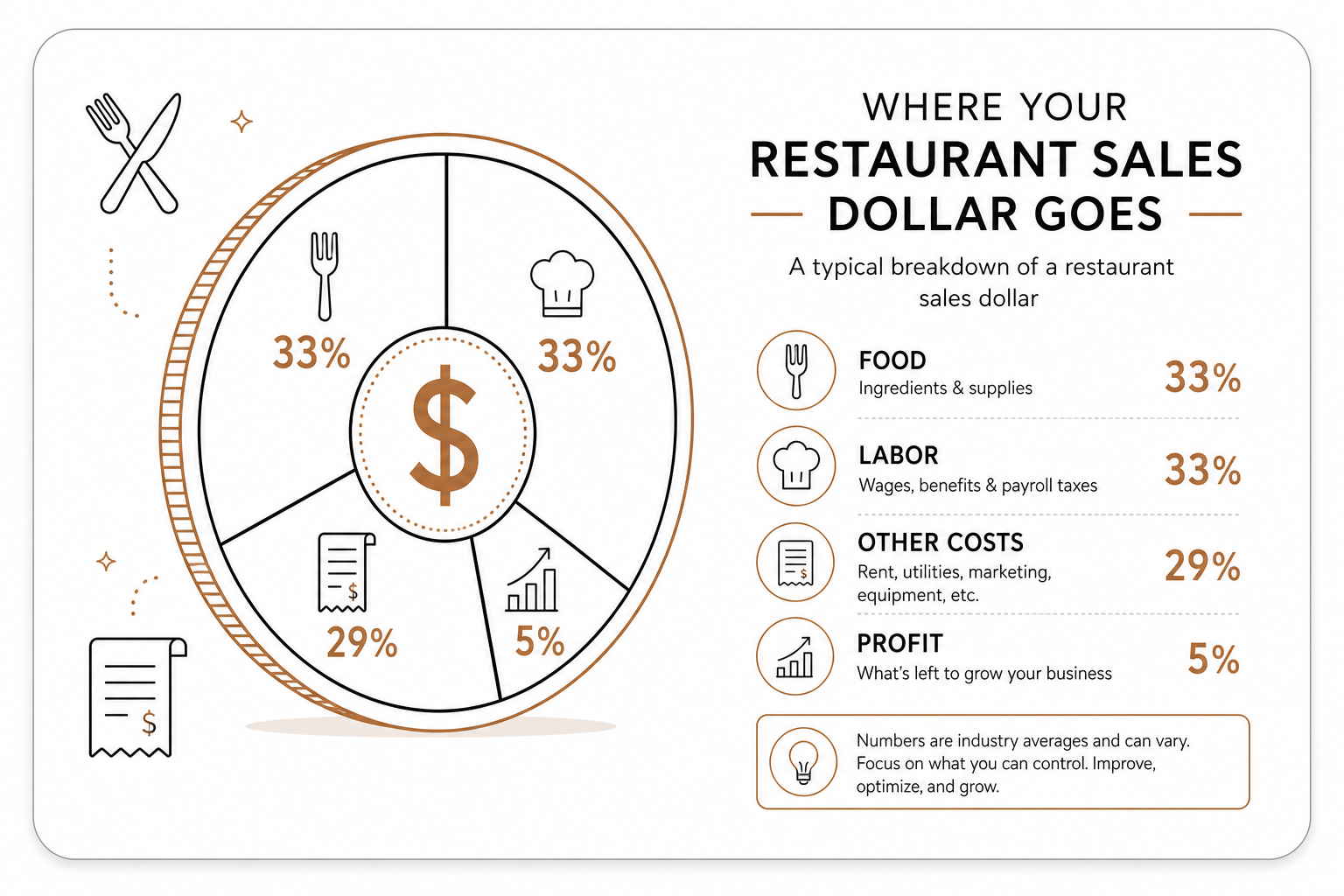
Operating a restaurant has always been a high-wire balancing act, but today's market is especially unforgiving. Food and labor costs represent the two heaviest anchors on your profit and loss statement, with each devouring approximately 33 cents of every dollar in sales. This leaves a razor-thin pre-tax profit margin of roughly 5%. To make matters more challenging, restaurant labor costs have surged 35% over the last five years.
According to data from the National Restaurant Association, salaries, wages, and benefits reached a median of 36.5% of sales for full-service restaurants in 2024. Highly profitable operations successfully capped this figure at a median of 34.2%, whereas operators suffering a loss saw labor costs balloon to a median of 42.9%. For limited-service establishments, profitable units maintained labor at 30.0% of sales, compared to 34.1% for those reporting a loss.
Lowering your labor expenses is no longer just about survival. It is about protecting your cash flow and unlocking the ability to scale. Here are four actionable, data-driven strategies to reduce your restaurant labor costs while maintaining excellent service quality.
Build demand-driven schedules
The most common scheduling trap is simple repetition. Copying the previous week’s schedule and making minor adjustments relies entirely on guesswork. This practice leads to costly overstaffing during slow afternoons and frantic understaffing during peak dining rushes.
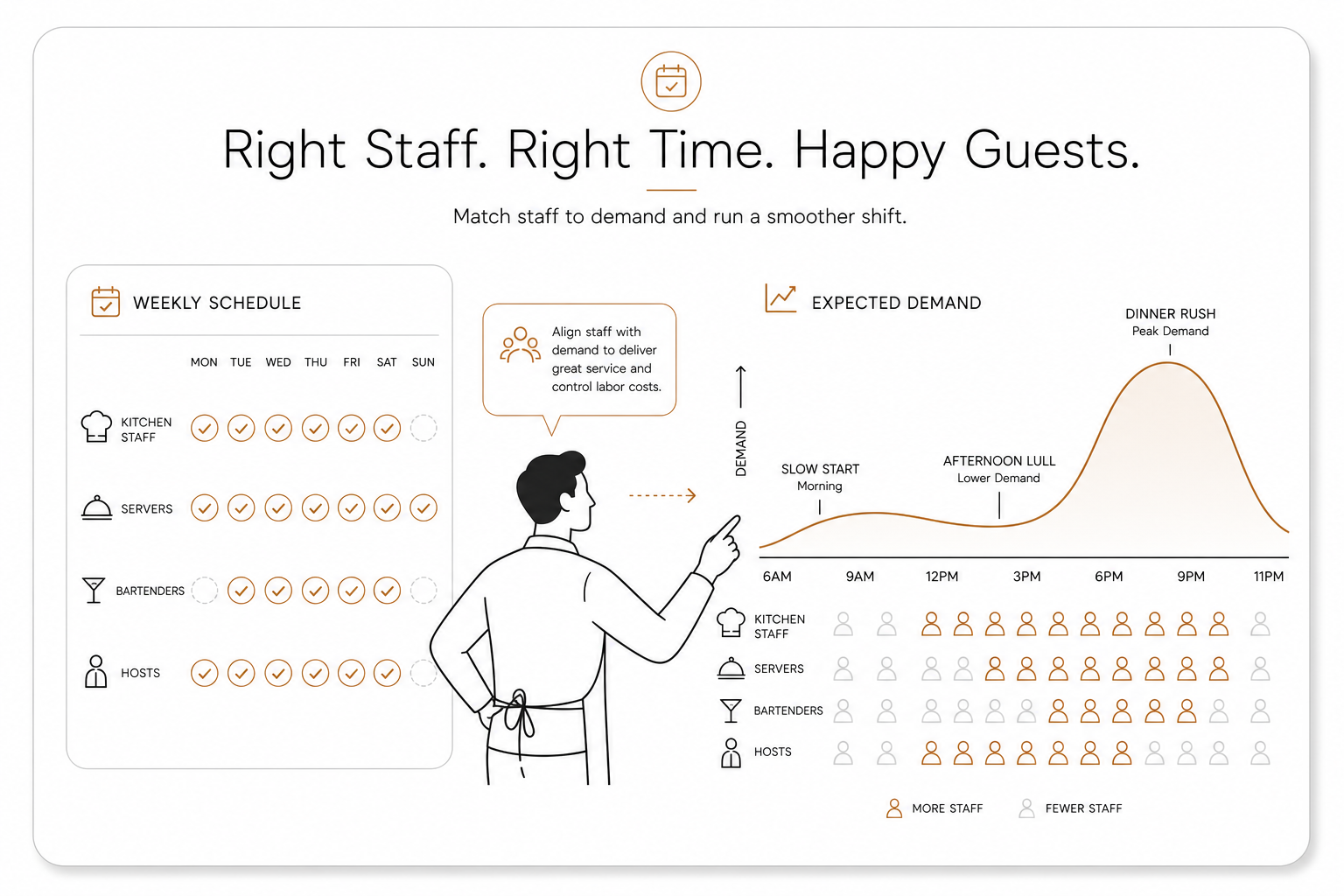
To build precise, cost-effective schedules, adopt these habits:
- Establish a strict labor budget: Determine your target labor-cost percentage before drafting any shifts and communicate these constraints clearly to your managers.
- Analyze historical POS data: Use historical sales patterns and anticipated customer demand from your point-of-sale system to forecast exact staffing requirements.
- Stagger shift start times: Avoid scheduling your entire dinner crew to arrive simultaneously at 4:00 PM. Bring hosts, prep cooks, and servers in at staggered intervals to match the gradual build-up of customer traffic.
- Incorporate on-call shifts: Keep your team flexible on days with volatile weather or unpredictable local events by utilizing on-call schedules.
If you operate multiple units, coordinating shifts across different teams can quickly become a logistical headache. Implementing data-driven multi-location restaurant staff scheduling helps you seamlessly align workforce hours with real-time traffic trends.
Cross-train your staff for maximum flexibility
When your employees are trained to handle only one role, you are forced to overhire to keep every station covered. Cross-training is a highly effective, low-cost strategy to build a versatile team that can adapt on the fly.
Cross-training your front-of-house and back-of-house staff enables you to:
- Dynamically shift roles: A server who can also bartend can easily step behind the bar during an unexpected rush, eliminating the need to schedule two separate employees.
- Optimize prep and service hours: Front-of-house staff can assist with light kitchen prep work or rolling silverware during slow mid-afternoon hours.
- Improve service quality: Cross-trained employees are more knowledgeable, which directly translates to faster ticket times and lower customer wait times.
Operating with a smaller, more cohesive team keeps your kitchen running smoothly. You can monitor the direct impact of these training initiatives by tracking your active clock-ins against real-time sales through automated restaurant POS labor cost percentage tracking.
Implement smart automation tools
Automation is not about removing the human touch from hospitality. Instead, it is about freeing your staff from tedious manual tasks so they can focus on high-impact guest interactions.
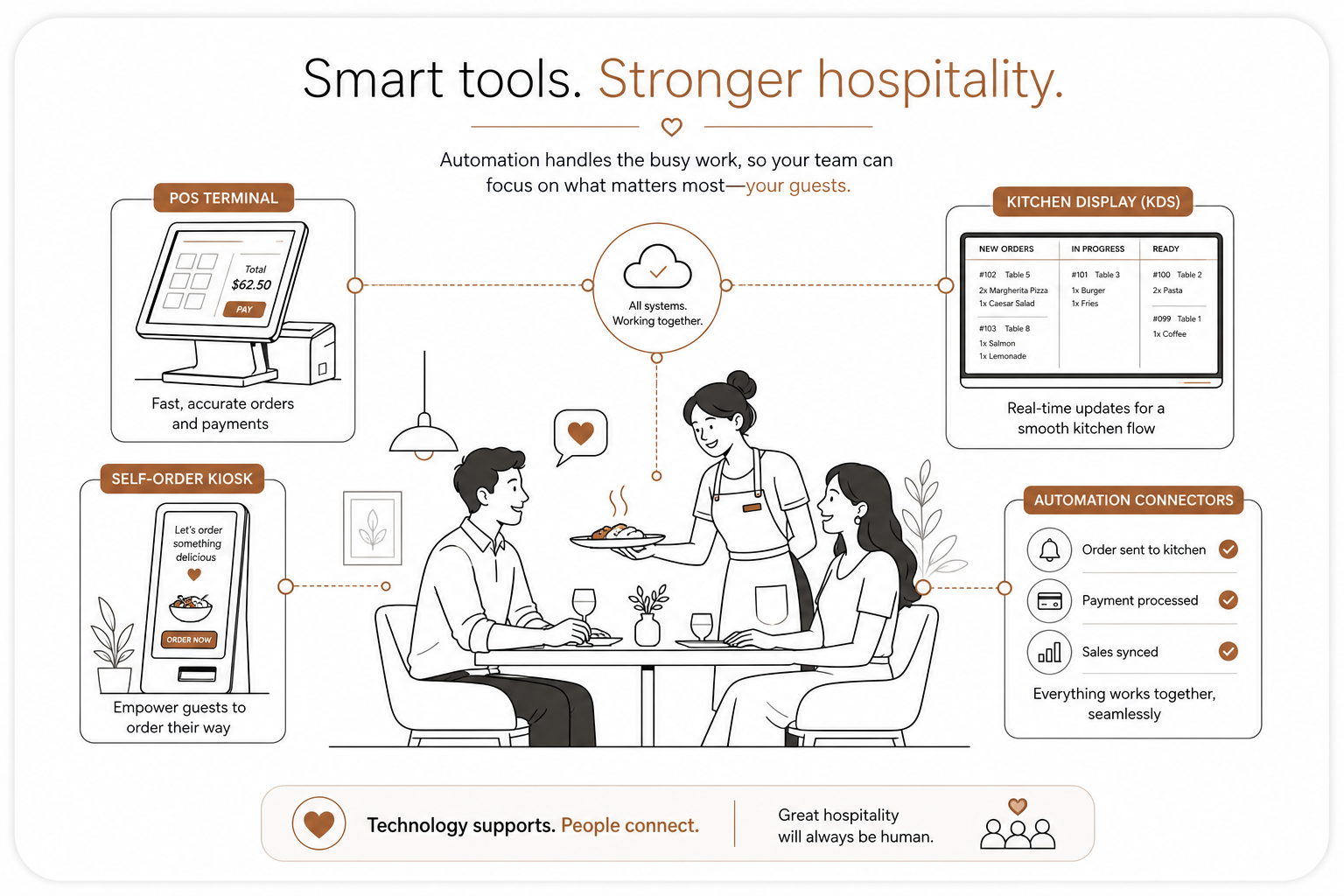
- Front-of-house efficiency: Self-ordering kiosks and table-side payment technologies allow guests to order and pay at their convenience. This reduces the step-by-step workload on your service team, allowing you to run a full dining room floor with fewer servers on the payroll.
- Kitchen synchronization: Kitchen Display Systems eliminate the need for runners to manually carry paper tickets to the line. They optimize course timing, speed up food preparation, and minimize costly human order errors.
- Back-office operations: Digital inventory systems automatically track stock levels based on real-time sales data. This removes the need for managers to spend late-night hours manually counting inventory with clipboards.
By pairing a modern, unified POS system like Spindl with restaurant automation software, you can centralize order-taking, delivery, and reporting in one place. To streamline your operations even further, check out our restaurant ops workflow automation guide to learn how to eliminate administrative friction entirely.
Stay compliant with federal labor laws
When adjusting shift lengths, cutting hours, or reconfiguring schedules to save on labor, you must maintain absolute compliance with federal and state labor laws. Ignoring these rules can lead to expensive fines and legal fees that easily wipe out any scheduling savings.
Under the Fair Labor Standards Act (FLSA), keep these key regulations in mind:
- The 40-hour overtime trigger: Non-exempt restaurant employees must receive overtime pay (at least 1.5 times their regular pay rate) for any hours worked over 40 in a designated 168-hour workweek. Overtime is strictly triggered by weekly hours, not by long shifts, weekends, or holidays.
- Tipped employee regulations: You can utilize a cash wage of $2.13 per hour for tipped employees only if their direct wages plus tips equal at least the federal minimum wage of $7.25 per hour. If they fall short, you must pay the difference.
- Meal and rest breaks: While federal law does not mandate breaks, if you choose to offer short rest breaks of 20 minutes or less, they must be treated as paid working time. Unpaid meal breaks must be at least 30 minutes, and the employee must be completely relieved of all operational duties.
- Youth labor laws: The FLSA places strict limits on the times and total hours that 14- and 15-year-olds can work in a restaurant, especially during school weeks.
Drive operational efficiency with next-generation technology
To successfully lower restaurant labor costs, you need real-time operational control. The days of logging into clunky back-office portals to adjust schedules or pull static CSV files are over.
Modern, forward-thinking operators are turning to platforms like Spindl – a comprehensive, easy-to-use restaurant management platform that consolidates order-taking, POS, delivery, and loyalty into a single device.
To take your digital transformation a step further, AgenticPOS acts as a powerful connection point that lets autonomous AI agents control your existing POS through chat. Instead of clicking through endless dashboards, you can manage your shifts, update menu prices, track inventory, and pull real-time labor-to-sales reports using Claude, ChatGPT, or your internal Slack channels.
Want to see how artificial intelligence is changing the way restaurants manage their labor? Discover how AI agents for restaurant management can help you reclaim your manager's time today.