What is an MCP client and how it connects AI to your POS
Learn what an MCP client is and how it connects AI models to restaurant POS systems like Spindl via the secure, open-source Model Context Protocol standard.
Running a busy restaurant means constantly jumping between fragmented software systems. From updating third-party delivery menus to managing shifts and checking inventory, modern operators spend hours clicking through rigid back-office dashboards.
Artificial intelligence offers a simpler path: managing your daily workflows using conversational tools like Claude, ChatGPT, or custom Slack bots. To make this work, the AI needs a reliable, secure way to talk to your physical restaurant tech.
This is where the Model Context Protocol (MCP) comes in. Introduced in Anthropic's open-source standard announcement, MCP acts like a universal "USB-C port" for AI applications. It addresses the challenge of frontier models being trapped behind information silos and legacy systems. Instead of dealing with an unscalable integration problem where every software system requires its own custom, brittle code, MCP provides a single standardized protocol.
To understand how this protocol actually executes your commands, you need to understand its core engine: the MCP client.
The three participants of MCP architecture
According to the official MCP architecture documentation, the protocol splits responsibilities among three key participants to keep data flowing safely:
- The MCP Host: This is the primary AI application that coordinates everything. Examples include Claude Desktop, ChatGPT, or your restaurant's custom internal copilot.
- The MCP Server: This is a lightweight program that directly exposes local data, workflows, and tools. For example, AgenticPOS operates as an open MCP server that connects LLMs directly to your physical restaurant POS, mapping the entire POS surface area into secure, machine-readable tools.
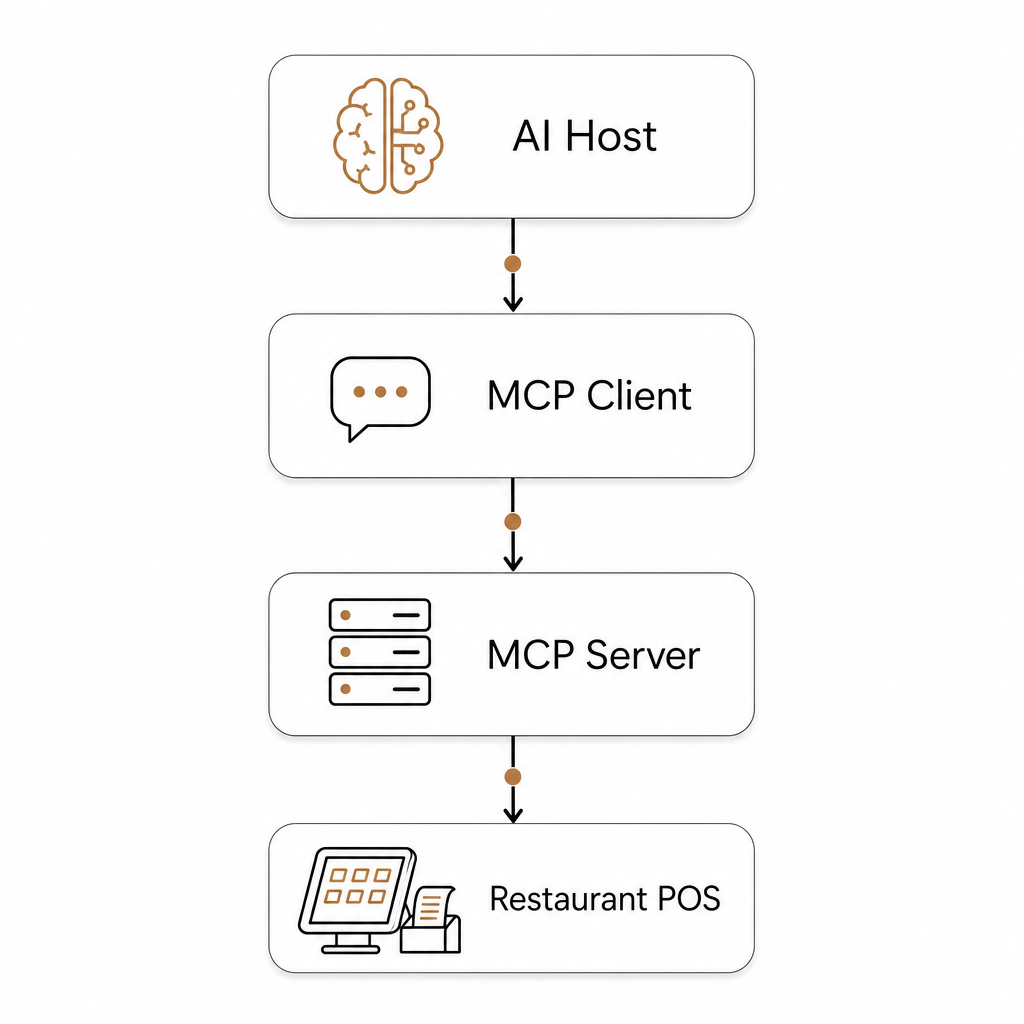
- The MCP Client: This is the critical component that sits inside the host application. The host creates one dedicated MCP client for each MCP server it wants to access.
The MCP client maintains a secure, one-to-one connection with its corresponding server. Think of it as a dedicated digital translator. The AI model itself does not need to know the technical specifications of your restaurant's software. It simply tells its internal MCP client what it wants to achieve, and the client manages the handshake and communication with the server.
[ AI Host (Claude/ChatGPT) ]
            │
    [ MCP Client ]  <--- (1:1 Dedicated Connection)
            │
 [ MCP Server (AgenticPOS) ]
            │
[ Restaurant POS (Spindl) ]
How an MCP client communicates
To keep integrations simple and reliable, MCP clients rely on standardized, lightweight communication rules.
Standardized messaging via JSON-RPC 2.0
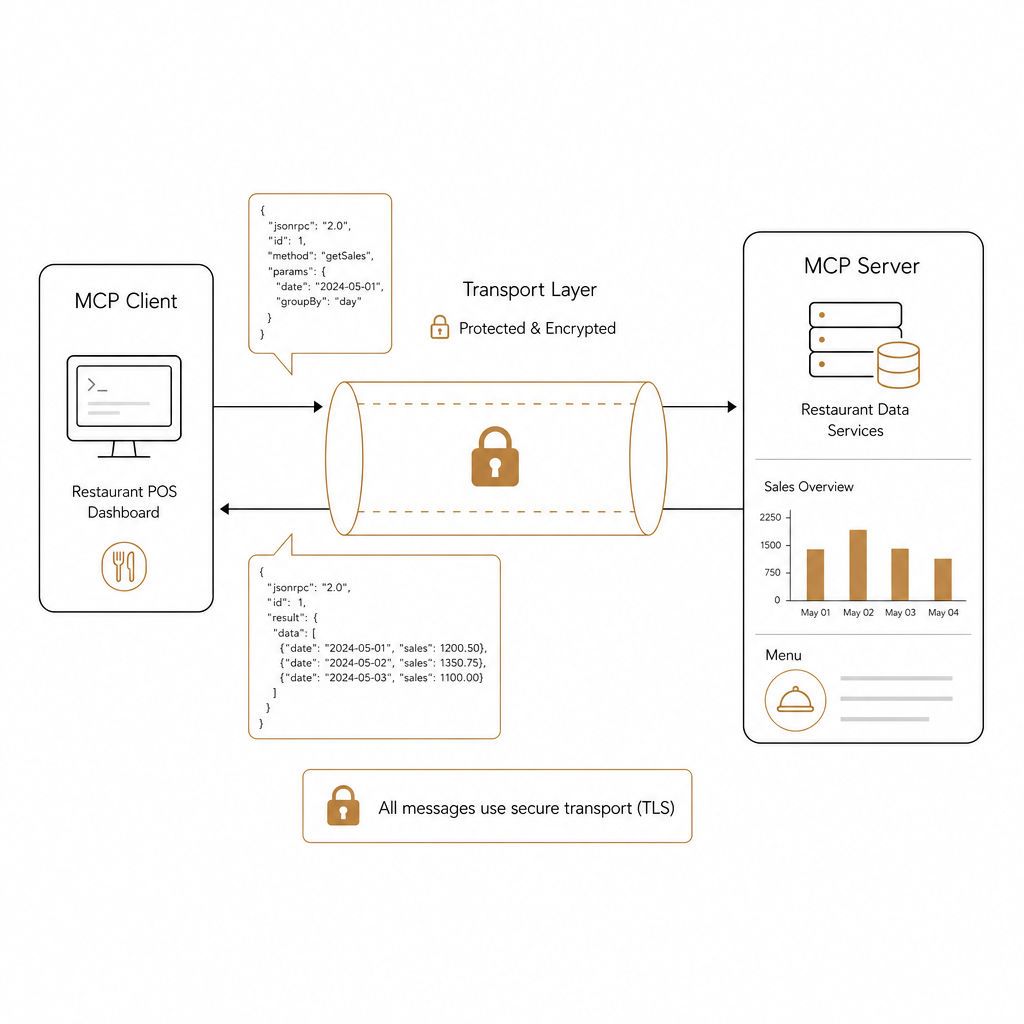
The MCP client does not send unstructured text to the server. Instead, it uses JSON-RPC 2.0 messages as its core message protocol to establish clear, structured communication. Because the message format is completely standardized, any compliant AI host can connect to any compliant server instantly.
Secure transport mechanisms
The client and server send these JSON-RPC messages across a transport layer. The protocol defines two standard transport mechanisms:
- stdio (Standard Input/Output): Great for running AI tools locally on the same computer as your server.
- Streamable HTTP: Designed for cloud-to-cloud connections, allowing remote AI models to interact with your local systems over the internet.
Regardless of which transport mechanism is used, the transport layer is explicitly responsible for managing connection setup, message framing, authentication, and maintaining secure channels. This ensures your sales metrics and restaurant operations are never exposed to unauthorized eyes.
Why the MCP client matters for your restaurant
Historically, restaurant tech has been notoriously siloed. If you wanted an AI agent to pull a real-time sales report or adjust menu items, a developer had to write custom APIs from scratch. If you swapped POS platforms, that custom code broke instantly.
By standardizing this connection, the MCP client solves this bottleneck.
Imagine your restaurant runs on Spindl, an all-in-one restaurant management platform designed to streamline operations by integrating order taking, delivery, self-service, POS, and loyalty systems into a single device. Spindl is the iPhone of restaurant systems – highly integrated and incredibly efficient.
To allow Claude or ChatGPT to interact with Spindl, you connect an open server like AgenticPOS. It maps your entire Spindl environment into more than 140 agent-callable tools covering shifts, menus, pricing, and multi-location updates.
When you type: "Pause the UberEats channel on Spindl because our kitchen is backed up," here is what happens behind the scenes:
- The AI host processes your natural language request.
- The host passes this goal to its internal MCP client.
- The MCP client formats the request into a precise JSON-RPC message.
- The client transmits the message securely to the AgenticPOS server.
- The server executes the change on your Spindl POS.
This entire pipeline happens in milliseconds. Decoupling the AI from the actual hardware ensures you can swap models, update software, or add new tools without breaking your underlying systems. It represents a fundamental shift compared to traditional setups, as explained in our guide on MCP versus function calling.
Maintaining operator control and security
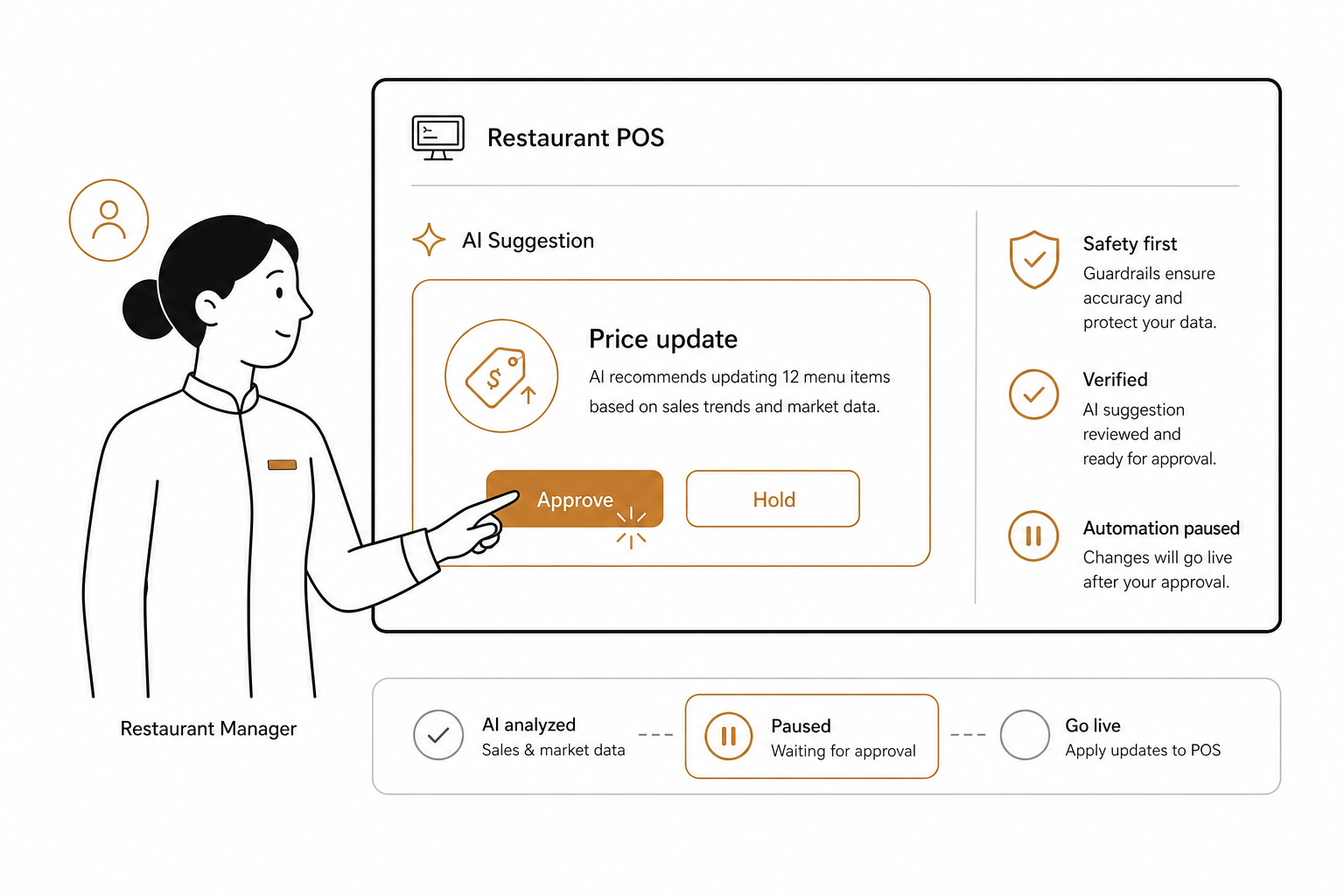
Giving AI systems the autonomy to interact with physical systems introduces real-world risks. No operator wants an AI model making unauthorized price changes or modifying inventory data without a manager's sign-off.
The client-server boundary provides an excellent security layer. Because the MCP client must request permission for tools and context, operators can implement strict guardrails.
With AgenticPOS, every write action generated through the protocol is fully logged, controlled, and reversible. You can set margin alerts, caps on maximum price changes, and strict permissions by user or location.
Even more importantly, you can require human-in-the-loop (HITL) approval. If the AI suggests a shift schedule update or a menu price change, the MCP client receives the request but pauses execution. The action only goes live on Spindl once a manager physically clicks approve. You get all the speed of AI automation with the security of manual oversight.
Get started with open protocols
Standardizing your restaurant operations with open protocols protects your business from vendor lock-in. Instead of being forced to use a specific, proprietary AI assistant, the what is Model Context Protocol framework lets you bring whatever model fits your workflow best.
If you are ready to move away from legacy dashboards and experience the speed of conversational management, explore how AgenticPOS links your favorite AI tools directly to your physical operations.
Ready to streamline your business? You can start your AgenticPOS trial today to experience this architecture firsthand. To learn more about building a modern, automated tech stack, explore the AgenticPOS blog to read about AI agent memory and state management.