Why your restaurant POS needs a modern API ecosystem
Streamline restaurant operations with modern POS API integration. Connect delivery, inventory, and CRM systems while using AI agents to automate workflows.
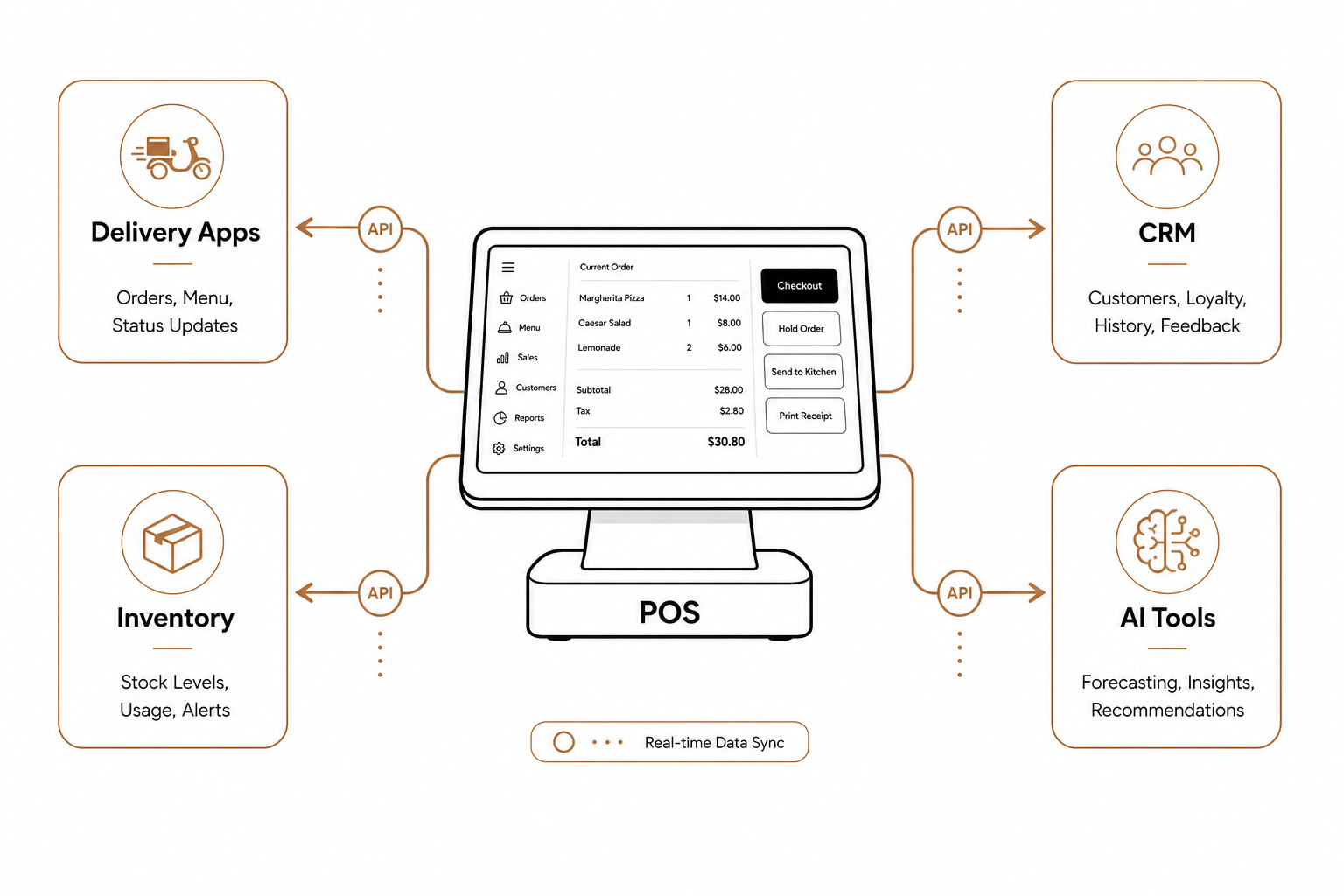
The modern restaurant is no longer just a kitchen; it is a software deployment environment. According to the National Restaurant Association's 2024 technology report, 73% of restaurant operators increased their technology investments this year. Furthermore, 48% of operators marked point-of-sale (POS) systems as their primary spending priority, and 52% planned to integrate tech into their back-office workflows.
Yet, spending more on software does not automatically guarantee smoother operations. If your tools cannot talk to one another, you are simply paying premium prices to manage disjointed digital silos.
Historically, restaurants had to rely on brittle middleware or manual data entry to sync their POS systems with third-party digital channels. This created a massive administrative burden and opened the door to constant errors. Today, forward-thinking operators and developers are shifting toward open, API-first platforms like Spindl that function as a unified restaurant OS. By coupling a robust API architecture with AI execution systems like AgenticPOS, brands are turning static transactional databases into autonomous operational engines.
Core components of a robust developer ecosystem
An API is only as valuable as the infrastructure, governance, and developer community supporting it. A true API ecosystem includes the interfaces, documentation, and policies that allow third-party systems to connect securely and reliably. For a restaurant POS, this architecture must cleanly handle several high-volume data pipelines:
- Online ordering and delivery: Streamlining external order flows directly to the kitchen is vital. For instance, Spindl supports native restaurant delivery app integration with third-party marketplaces like DoorDash, Uber Eats, and Grubhub. This allows operators to build one master menu in Spindl Backstage and push it to all digital channels at once, avoiding the lag and expense of traditional third-party middleware tablets. If you want to configure this directly, you can integrate your POS with DoorDash in a few clicks to automate order flows.
- Inventory management: Manual data discrepancies can devastate your margins. By integrating your POS system with inventory software, you can automatically sync sales and stock data. This prevents costly over-ordering, recipe math errors, and administrative transcription mistakes.
- CRM and loyalty platforms: Capturing guest data across table-side terminals, click-and-collect web apps, and self-service kiosks allows you to centralize marketing campaigns and build highly accurate guest profiles.
When major integration partners list Spindl as an official integration partner, as seen on Wolt's official developer documentation, they rely on these standardized endpoints to guarantee high-reliability order transfers.
Security first: Safeguarding POS integration pipelines
Exposing POS data to third-party tools or AI services introduces clear vulnerabilities. A single weak point can compromise customer payment details or corrupt back-office databases. A secure API platform must enforce rigorous, multi-layered defensive measures:
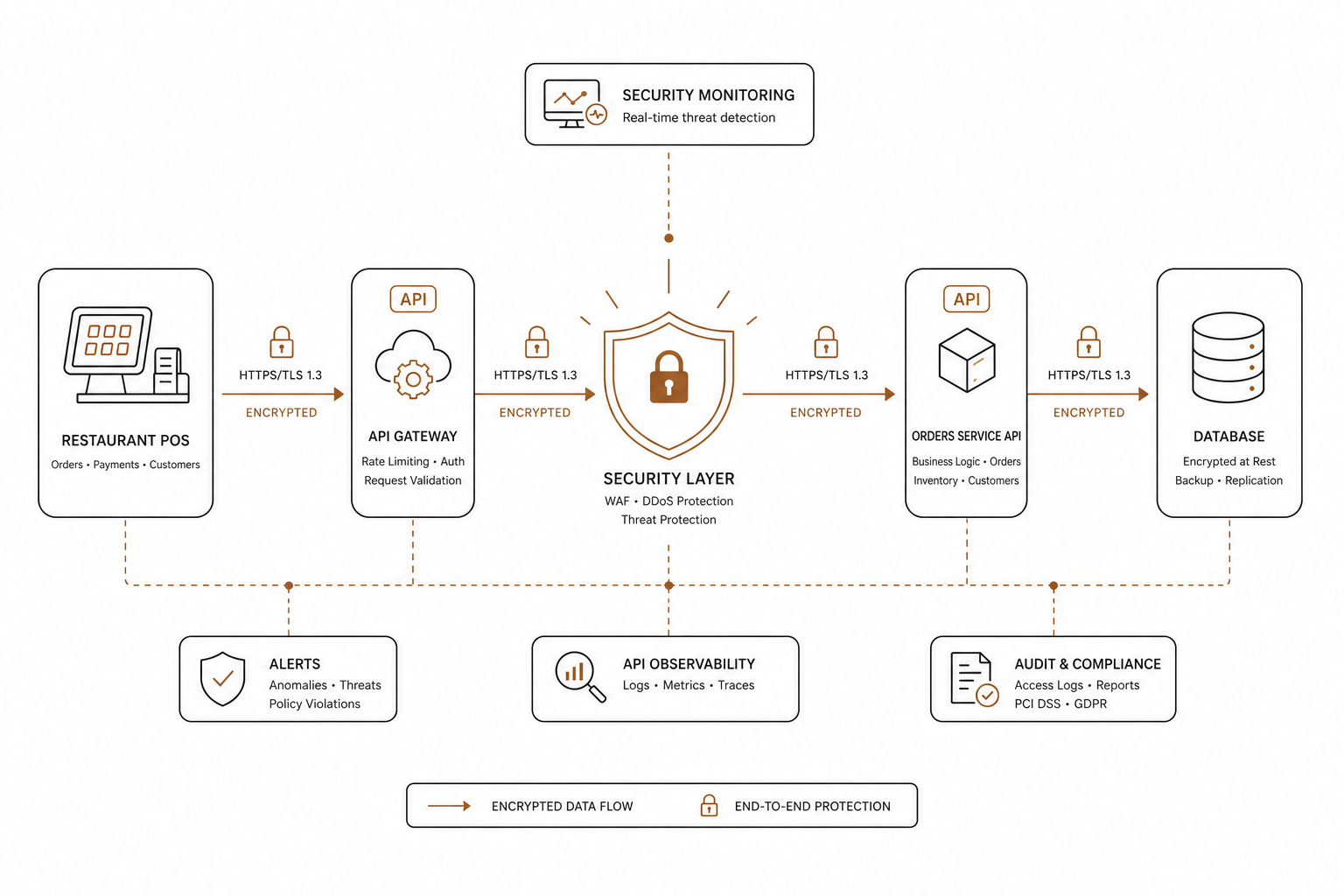
- Zero hardcoded credentials: API keys, tokens, and client secrets must never be hardcoded in application repositories or exposed in client-side code. They should reside in secure environment managers, receive regular rotations, and be scoped to minimal permissions.
- Secure authentication: All integrations should leverage industry-standard protocols, such as OAuth 2.0 or OpenID Connect, to enforce robust authentication and authorization.
- In-transit and at-rest encryption: Every API request must be encrypted in transit using HTTPS/TLS 1.2 or higher. Sensitive storage fields on the platform should be encrypted using strong algorithms like AES-256.
- Input validation and sanitization: POS gateways must strictly validate and sanitize all incoming payloads against schemas to prevent injection attacks and ensure data cleanliness.
- Rate limiting: Implementing strict API throttling at the gateway layer protects the core transactional database from malicious denial-of-service (DoS) attempts and runaway loops.
- Observability and logging: Continuous monitoring and detailed logging of API activity enable security teams to detect anomalies and flag authentication failures in near real time.
The leap from REST and webhooks to agentic tool calling
Traditionally, integrating software meant relying on REST APIs to poll data or configuring POS webhooks to push event-driven updates. When a guest places an order, the webhook instantly fires a payload containing order details to your customer database. While this is highly effective for immediate syncs, it still requires developers to write, test, and maintain custom code paths for every specific scenario.
AI is fundamentally changing this dynamic. Instead of relying entirely on rigid, pre-written code, enterprise teams are deploying autonomous AI agents that interact with software platforms through tool calling and function calling.
We explain this shift in detail in our deep dive on MCP vs function calling, which highlights how modern large language models act as bridges between natural language and structured code.
In an agentic POS framework, the system translates traditional API endpoints into a machine-readable "menu of actions" using open standards like the Model Context Protocol (MCP). Instead of a developer manually coding a script to adjust a menu item, change pricing, or draft a purchase order, these operations are exposed as agent-callable tools.
The AI agent reads the schema, selects the correct tools, structures the payload parameters, and executes the actions directly. This shifts the operator's interface from navigating a confusing back-office dashboard to simply having a conversation with an assistant.
Building the future-proof restaurant tech stack
For operators managing multi-location restaurant groups, managing disjointed systems across several units is unsustainable. The solution lies in combining an all-in-one transactional POS with an intelligent integration layer. Spindl provides the central, high-performance base, uniting point-of-sale, self-service kiosks, online ordering, and delivery integrations into a unified, reliable platform.
By layering AgenticPOS on top, you bridge the gap between stateless AI models and the zero-downtime demands of active restaurant environments. Operating as an open model integration layer, AgenticPOS maps back-office capabilities like shift schedules, menu changes, promotions, and inventory levels into more than 140 secure, agent-callable tools.
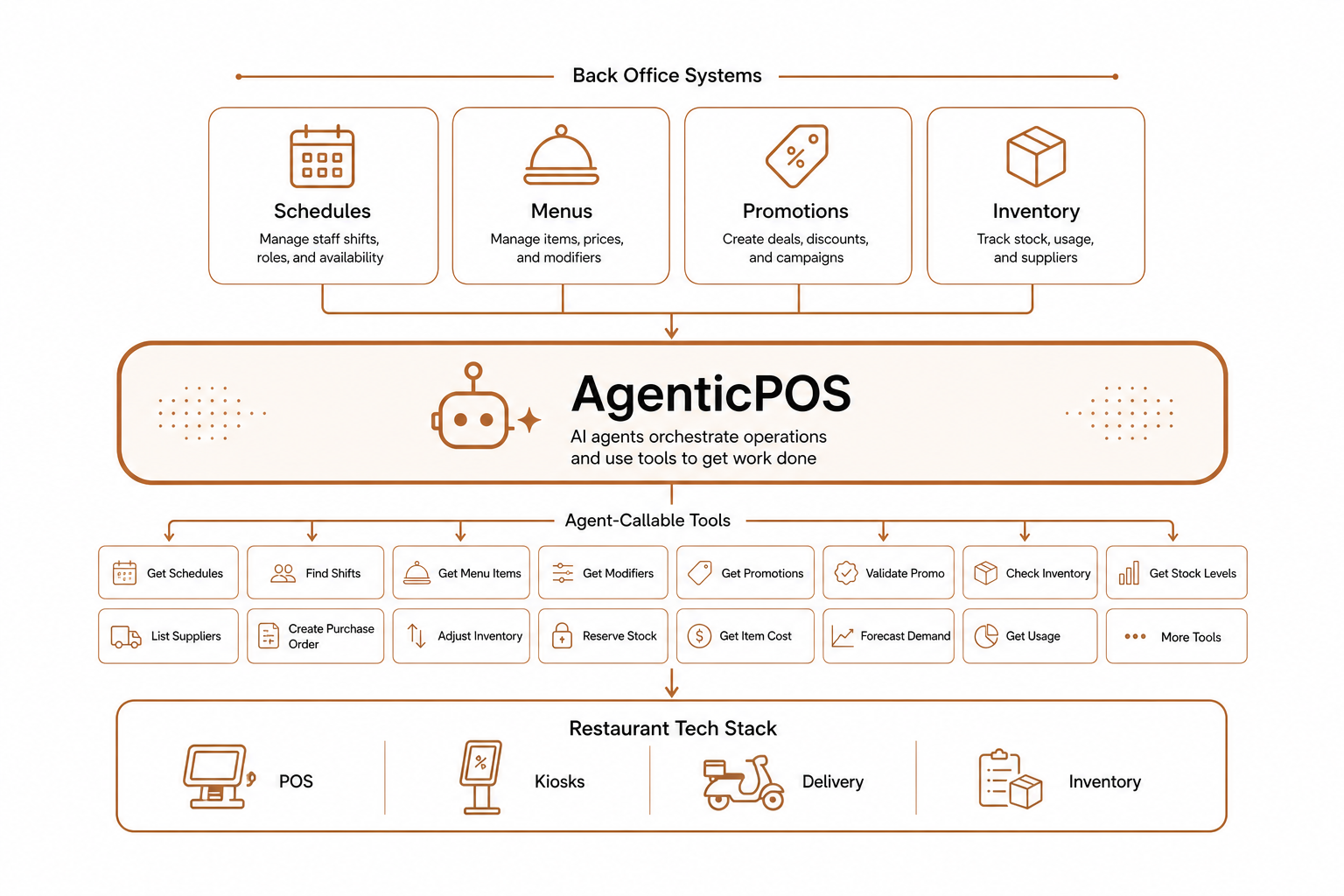
You do not need to write custom code to connect your POS to Claude, ChatGPT, or internal Slack channels. Furthermore, you maintain tight operator control through permissions, guardrails, and human-in-the-loop approvals. The AI can analyze trends, flag inventory shortages, and draft pricing changes – but a manager must always authorize the action before it goes live on the floor.
Ready to see how conversational AI can streamline your back-office operations? Start your AgenticPOS trial today to connect your existing restaurant systems in minutes.