How to scale restaurant loyalty and operational consistency with AI
Scale multi-unit restaurant loyalty and operational consistency with AI. Centralize POS updates, automate guest segmentation, and manage workflows more
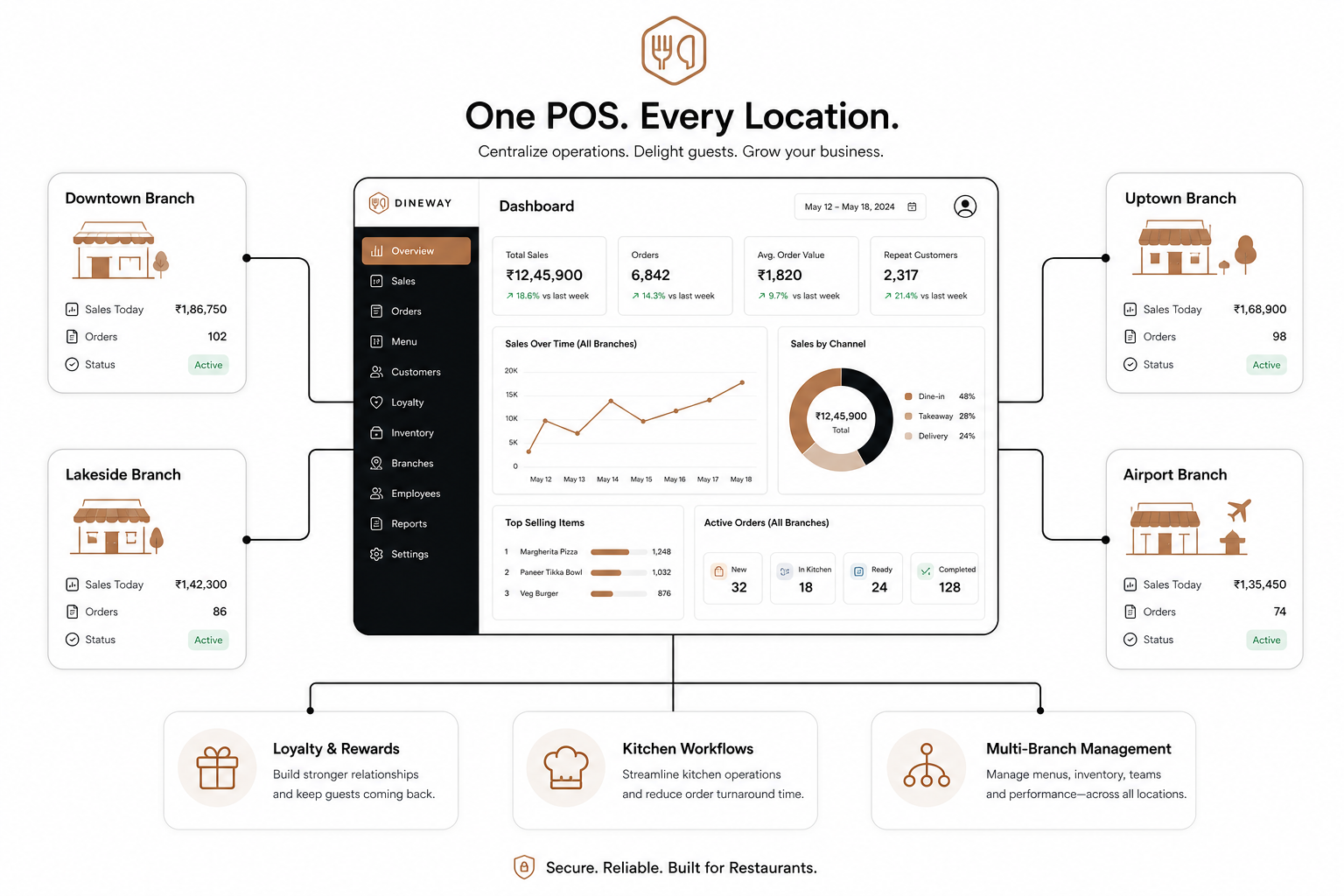
Managing a single restaurant is about passion. Managing a multi-location restaurant group is about systems.
When you expand to five, ten, or fifty locations, your biggest challenge is maintaining a cohesive brand. Customers expect the exact same flavor, service speed, and rewards whether they walk into your downtown bistro or your suburban drive-thru.
Unfortunately, execution is often fragmented. Salesforce research shows that 79% of customers expect consistent interactions across a brand's departments, yet 55% feel like they are communicating with completely separate businesses.
For multi-unit restaurant operators, bridging this gap requires centralizing customer loyalty and standardizing kitchen workflows. Today, forward-thinking operators are leveraging AI-powered POS tools to manage these complex pieces from a single, centralized interface.
Why loyalty and consistency are your primary growth levers
Customer acquisition is expensive. Customer retention is where your profitability hides.
According to the National Restaurant Association, 78% of customers are more likely to visit a restaurant where they can earn reward points, even if it is less convenient to get there. Furthermore, 96% of loyalty customers view these reward programs as a smart way to get more "bang for their buck."
But a loyalty program only works if your operational execution is flawless. If a guest dines at your Dallas location, receives a perfect medium-rare steak, and earns loyalty points, they expect the same high-quality meal when redeeming those points in Houston.
If the Houston kitchen misses the mark, the loyalty points lose their value. Consistent omnichannel experiences build trust. Inconsistent experiences destroy it.
Standard operating procedures (SOPs) act as the backbone of multi-unit consistency because they define exactly how tasks should be performed across every kitchen line and shift. When you scale, you must scale with standard operating procedures to keep your prime costs in check and your dishes uniform.
The multi-location operational bottleneck
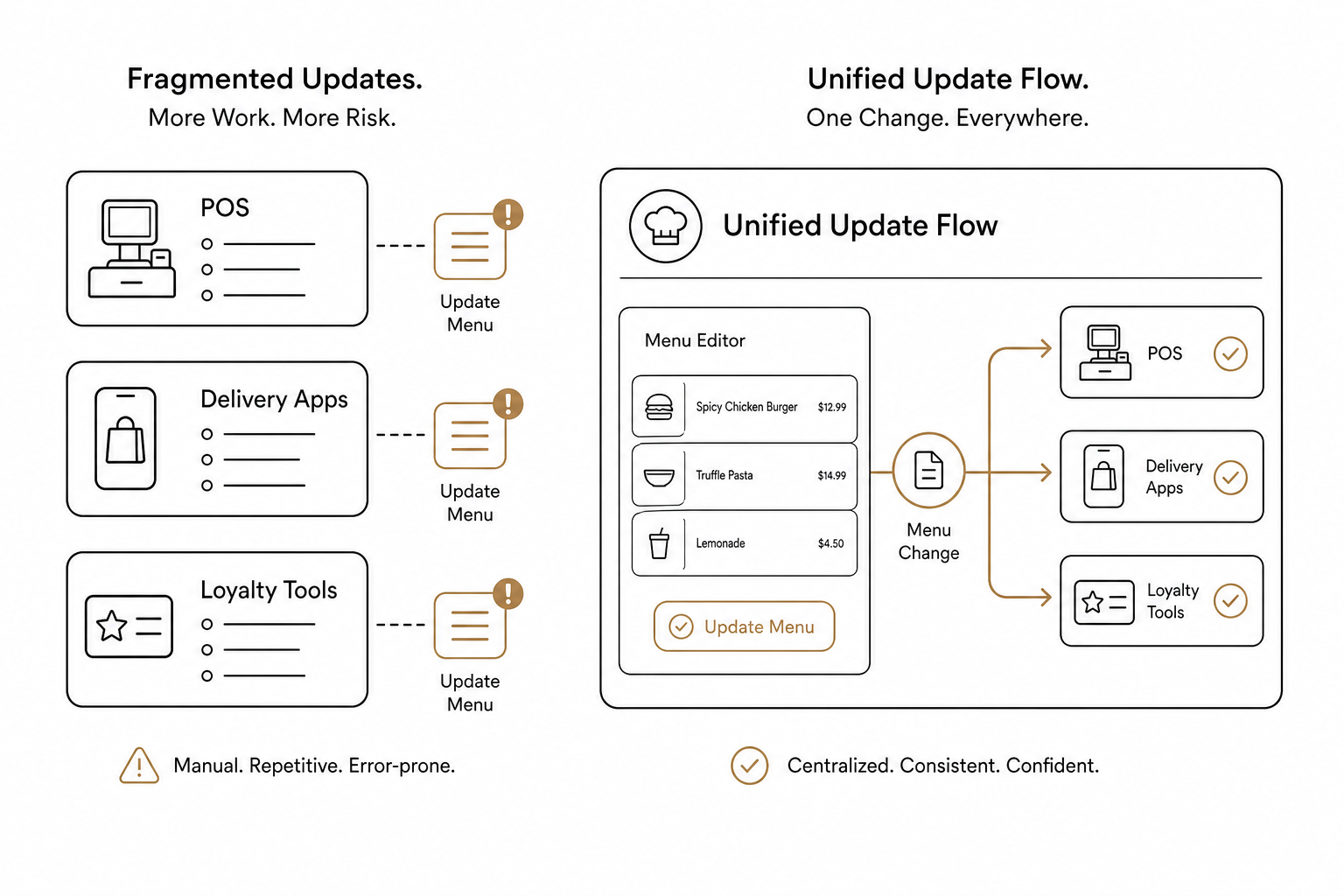
Historically, managing menu updates, loyalty campaigns, and standard processes across multiple locations meant logging into different, disconnected back-office dashboards.
If you wanted to launch a new seasonal menu, you had to:
- Manually update pricing and modifiers on each local POS terminal.
- Re-key those menu items into third-party delivery apps like DoorDash and UberEats.
- Train staff across multiple states on the new plating guidelines.
- Set up the promotional loyalty triggers in an external marketing platform.
This manual approach is slow, error-prone, and exhausting. It is why launching a new menu is often cited as a massive operational headache. To do this efficiently, you need to centralize your POS updates so a single change propagates everywhere instantly.
This is where modern POS platforms like Spindl step in. Spindl acts like the iPhone of restaurant systems – integrating order-taking, delivery, and loyalty into a single device, whereas legacy POS systems feel more like an outdated Nokia 3310.
Centralizing loyalty programs with AI-powered POS tools
A 2025 survey by Toast revealed that 86% of restaurant operators are comfortable using AI, with many planning to expand its use for marketing and menu optimization. Additionally, Deloitte found that 63% of restaurant executives use AI daily to enhance the customer experience.
By connecting an AI agent to your centralized POS, you can run sophisticated loyalty programs without wasting hours on administrative setup.
Automated guest segmentation
AI agents can continuously analyze guest transaction history, visit frequency, and average order value across all of your branches. Instead of your marketing team manually pulling spreadsheets, an AI tool can automatically segment your guests.
For example, the system can identify "lapsed high-value guests" – diners who typically spend a lot but haven't visited in 60 days – and automatically text them a personalized offer for their favorite dish. To learn more about this approach, read our guide on AI-driven customer segmentation.
Intelligent, localized promotions
Not every location has the same guest demographics or inventory levels. An AI agent can track local inventory levels and automatically roll out loyalty double-point promotions on items that need to be sold quickly before they spoil, protecting your margins in real time.
Enforcing brand consistency with AI agents
In a traditional restaurant group, if a kitchen runs out of avocados, a manager has to manually "86" avocado-based dishes on the in-store terminal, their online ordering site, and every delivery app. If they forget even one platform, a customer orders an item that cannot be fulfilled, leading to a poor review and a refunded order.
AI-powered POS integrations solve this by turning complex back-office adjustments into a simple conversation.
Using an AI agent for restaurant management allows you to control your systems via natural language. Instead of clicking through multi-layered dashboards, an operator can type a single message to their AI assistant:
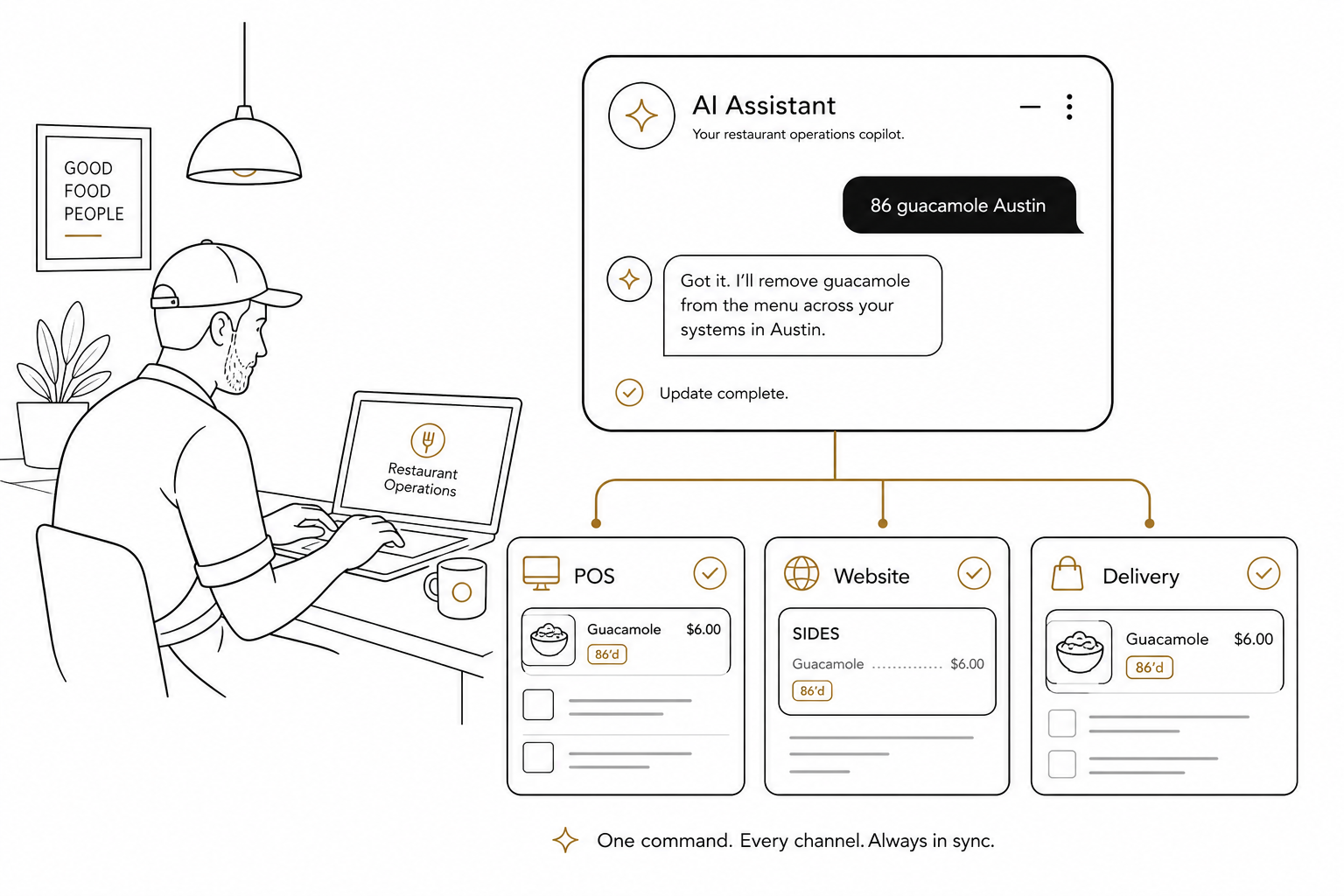
"We are out of avocados at the Austin location. 86 the guacamole across all channels, and set an automatic reminder to reactivate it tomorrow morning."
The AI agent interprets the command and updates your POS, your website, and your third-party delivery channels instantly.
[Operator Message]
  │
  ▼
[AI Agent / MCP Server]
  │
  ├───► POS Terminal (86s Item)
  ├───► Online Ordering App (Disables Item)
  └───► DoorDash & UberEats (Updates Menu)
This level of automation drastically reduces administrative friction and protects the customer experience. You can see how this works in practice by reading our restaurant workflow automation guide.
Selecting the right system for your brand
If you want to transition from manual, disjointed operations to streamlined, AI-driven management, you need a solid technical foundation.
- The POS Foundation: You need an all-in-one platform like Spindl that natively integrates loyalty, ordering, and delivery into a single data stream.
- The Integration Layer: Webhooks and open APIs are essential. They function as the nervous system of your business, pushing transaction data where it needs to go instantly. For a deeper dive, check out our piece on how POS webhooks sync data in real time.
- The AI Interface: This is where AgenticPOS fits in. It acts as an open protocol (an MCP server) that connects your existing POS software to AI models like Claude or ChatGPT. It translates complex database updates into simple chat commands.
Before choosing your tech stack, review our restaurant group POS system comparison to weigh your options.
Security and guardrails are non-negotiable
Allowing AI to execute menu updates or run campaigns requires strict operational boundaries. When implementing agentic POS technology, ensure your system includes:
- Custom spending caps: Prevent the AI from launching promotions that exceed a specified discount budget.
- Approval workflows: Require a human manager to approve any menu-wide price change before it goes live.
- Full audit logs: Maintain a clear record of every change made by the AI, with the ability to roll back actions with a single command.
Standardize your operations today
Consistency at scale is not about working harder; it is about building smarter infrastructure. By centralizing your loyalty data and automating menu management through conversational AI, you can free your managers to focus on what truly matters: hospitality.
Are you ready to see how AI can streamline your multi-unit operations? Explore AgenticPOS to learn how you can run your restaurant group's menus, pricing, and analytics by talking directly to Claude or ChatGPT.