How to connect ChatGPT to your restaurant POS system
Learn how to connect ChatGPT to your restaurant POS via function calling, webhooks, and MCP to automate scheduling, menu syncs, and inventory management.
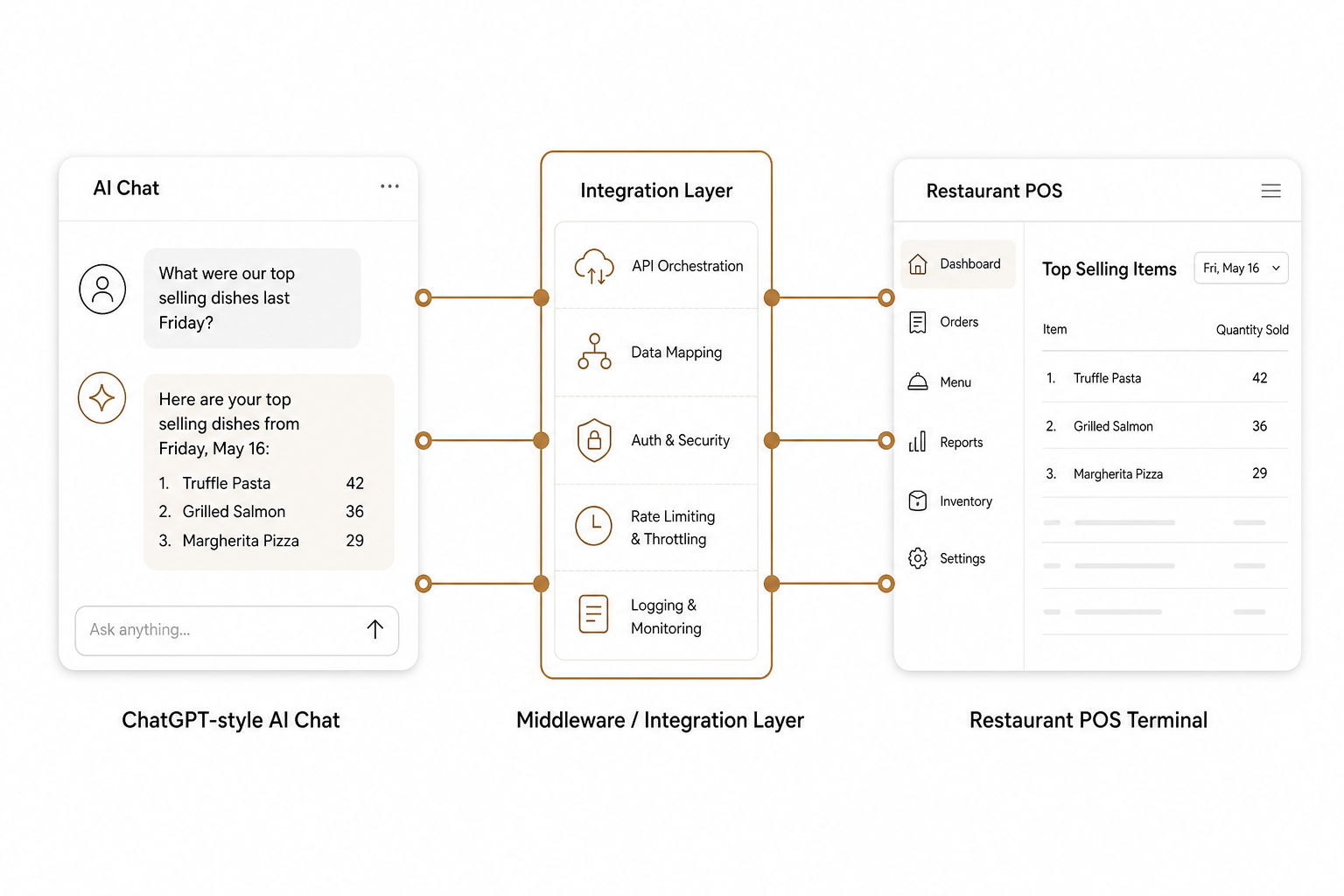
Running a restaurant shouldn't feel like wrestling with dozens of mismatched software dashboards. Yet, many operators find themselves trapped in "tablet hell" as they manage delivery apps, staff schedules, and inventory across separate interfaces. According to the National Restaurant Association’s State of the Restaurant Industry 2026 report, 26% of restaurant operators are already using artificial intelligence–related tools in their daily workflows. Instead of clicking through complex tabs, forward-thinking managers are connecting natural language models like ChatGPT directly to their point-of-sale (POS) systems.
To bridge the gap between AI text prompts and physical kitchen printers, you need a workflow that translates conversational dialogue into secure database commands.
The architecture: how ChatGPT talks to your POS
ChatGPT cannot natively access your restaurant’s physical hardware or local servers. Establishing a connection requires middleware or an integration layer that interprets the AI's intent and executes structured commands.
This connection is achieved through three primary methods:
Function calling (tool use)
Function calling is a native capability built into modern Large Language Models (LLMs). According to OpenAI's function calling guide, this developer flow allows the model to act as a bridge between natural language and structured code.
When you type a request into ChatGPT, the system uses a JSON schema to define the tools available to the model. The model identifies the correct tool, generates formatted arguments, and returns them to your application to execute. If you use Structured Outputs (enabling strict: true in your code), the model's output is guaranteed to match your exact schema, preventing syntax errors. To understand how this differs from other integration frameworks, you can read our comparison of MCP vs. function calling.
POS webhooks
To keep data flowing in real time, your integration relies on webhooks. While traditional APIs require your system to constantly poll the server for updates, webhooks use a push model.
For example, when a customer places an order, your POS instantly fires an HTTP POST request to your AI middleware. This event-driven mechanism keeps your system updated without lag. To set this up properly, see our guide on how POS webhooks sync your restaurant data in real time.
Model Context Protocol (MCP)
The newest paradigm in AI-to-POS integration is the Model Context Protocol (MCP), an open-source standard introduced by Anthropic. Think of MCP as a standardized "USB-C port" for AI tools.
Instead of writing a custom API integration for every single task, you run an MCP server that securely exposes your restaurant's data – like menus, pricing, shifts, and inventory – directly to any compatible AI agent. You can read more about this in our deep-dive on the Model Context Protocol (MCP).
Technical limitations of legacy POS APIs
When planning your integration, be aware of the limitations present in legacy systems. For example, Square's Orders API can record items, calculate totals, and track order progress.
However, developer documentation shows that Square for Restaurants and the standard Square app do not trigger order webhooks for unpaid in-person restaurant orders; only fully paid orders trigger payment webhooks. Furthermore, many specialized restaurant-only features and configurations are not fully exposed through standard APIs, which can severely limit your AI's capabilities.
This is why modern, unified platforms like Spindl are critical. Spindl acts as an all-in-one platform that consolidates order-taking, delivery, POS, and loyalty systems into one cohesive device. This eliminates the fragmentation of legacy integrations and provides a clean, unified data stream for AI agents to interact with.
What can you actually automate?
Once ChatGPT is securely integrated with a modern POS like Spindl via AgenticPOS, you can transform back-office work into simple conversation.
Automated order injection and menu sync
Off-premises dining (delivery, takeout, and drive-thru) accounts for nearly 75% of restaurant traffic in the United States, with 37% of adults ordering restaurant delivery at least once a week.
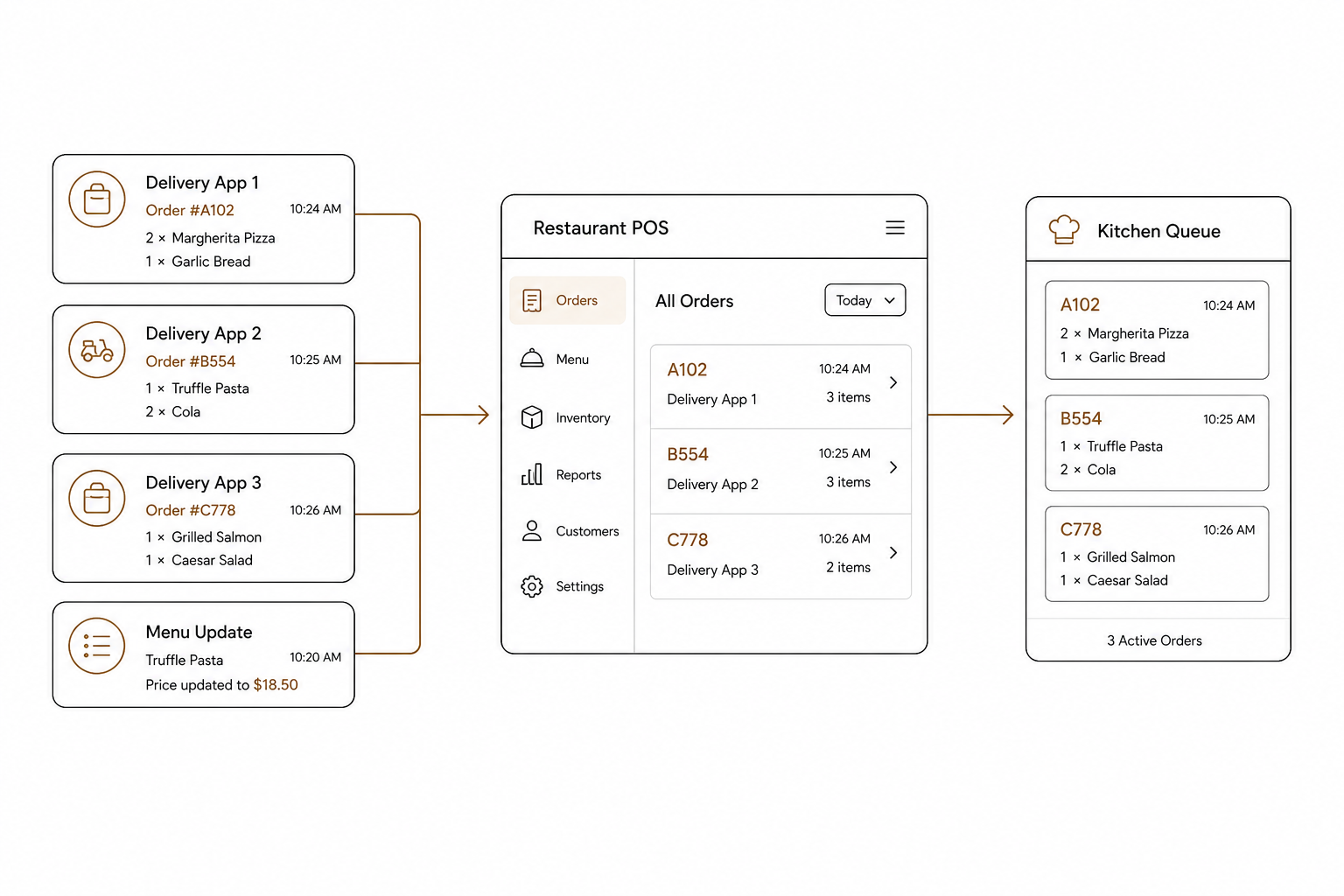
Instead of manually updating menus on every delivery app, your AI agent can coordinate changes instantly. When a customer orders, the system bypasses human delay and injects the order straight into the kitchen queue. Learn the step-by-step setup in our guide on syncing your POS with online ordering.
Hands-free shift scheduling
Managing staff shifts on spreadsheets is slow and prone to errors. With an agentic POS framework, you can update your labor calendar using plain English: "Adjust the Saturday night shift schedule to add one extra line cook because of the local festival." The AI handles the logistics. Check out our workflow automation guide to learn how to streamline scheduling.
Real-time inventory and analytics
AI agents can monitor inventory depletion rates in real time, forecast demand based on historical trends, and draft purchase orders before you run out of key ingredients. Instead of pulling CSVs and analyzing pivot tables, you can ask ChatGPT: "Which menu items had the highest margin squeeze last week?" Find out how to put this to work with an AI agent for restaurant management.
Crucial security and compliance standards
Allowing an AI model to interface with a live business system requires strict guardrails. You must protect both your operational data and your customers' financial information.
                    +-----------------------------+
                    |        User Prompt          |
                    +--------------+--------------+
                                   |
                                   v
                    +--------------+--------------+
                    |        AI Agent             |
                    +--------------+--------------+
                                   |
                                   | (Proposes Action)
                                   v
                    +--------------+--------------+
                    |   Human-in-the-Loop (HITL)  | <--- Manager Approval Required
                    +--------------+--------------+
                                   |
                                   | (Authorized)
                                   v
                    +--------------+--------------+
                    |  AgenticPOS MCP Server      |
                    +--------------+--------------+
                                   |
                                   | (Executes Change)
                                   v
                    +--------------+--------------+
                    |     Spindl Unified POS      |
                    +-----------------------------+
Adherence to the NIST AI Risk Management Framework
When developing or deploying AI integrations, align your practices with the NIST AI Risk Management Framework. This voluntary framework helps organizations build trustworthy AI systems through four core functions:
- Govern: Establish a culture of active risk management, accountability, and clear organizational policies.
- Map: Identify and document the context, boundaries, and unique risks of your AI integration.
- Measure: Regularly analyze and monitor AI system performance, accuracy, and outputs using quantitative and qualitative tools.
- Manage: Prioritize resources to mitigate mapped risks, maintain logs, and establish incident response plans.
PCI DSS payment compliance
The PCI Security Standards Council mandates strict technical and operational requirements for any business that processes payment cards. Key compliance obligations include:
- Zero Retention: Sensitive authentication data (magnetic stripe data, CVV, or PINs) must never be stored after authorization.
- Access Control: Access to payment systems must be strictly limited to authorized personnel using role-based permissions.
- Third-Party Vendor Management: Under PCI DSS Requirement 12.8, you must maintain a list of all Third-Party Service Providers (TPSPs), establish a rigorous due-diligence onboarding process, and verify their PCI compliance annually. Remember: outsourcing a PCI function to an AI vendor does not outsource your liability. The merchant remains fully accountable.
Human-in-the-Loop (HITL) safety systems
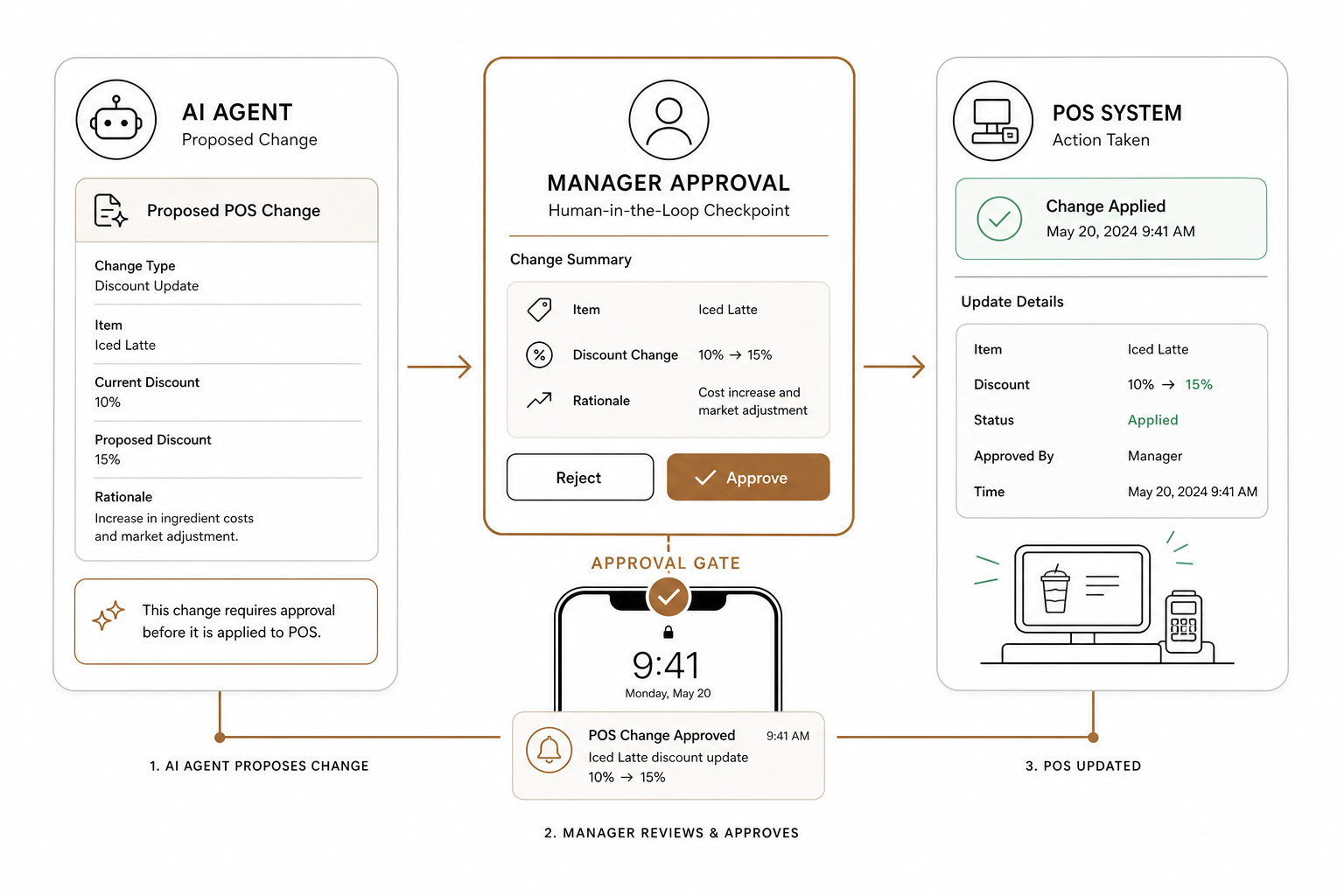
For any action that changes state – such as altering menu prices on Spindl, executing payments, or modifying employee shifts – do not give the AI complete autonomy. The AI should write the proposal, but require a manager's physical approval (via a Slack ping, SMS confirmation, or terminal prompt) before executing the database change. This guarantees operational security while drastically reducing manual labor.
Run your restaurant by talking to it
Building custom AI-to-POS pipelines from scratch requires thousands of lines of code and extensive security audits.
AgenticPOS simplifies this process. It acts as an out-of-the-box MCP server that connects your unified Spindl POS platform directly to Claude, ChatGPT, or your internal tools. This setup exposes over 140 agentic tools – covering shift schedules, pricing, inventory, and promotions – without sacrificing security.
Ready to reclaim your administrative hours? Start your 14-day free AgenticPOS trial today.