How to securely grant AI agents access to your software
Learn how to securely grant AI agents access to your software using OAuth 2.0, Zero Trust, and MCP. Protect your operations with robust security guardrails.
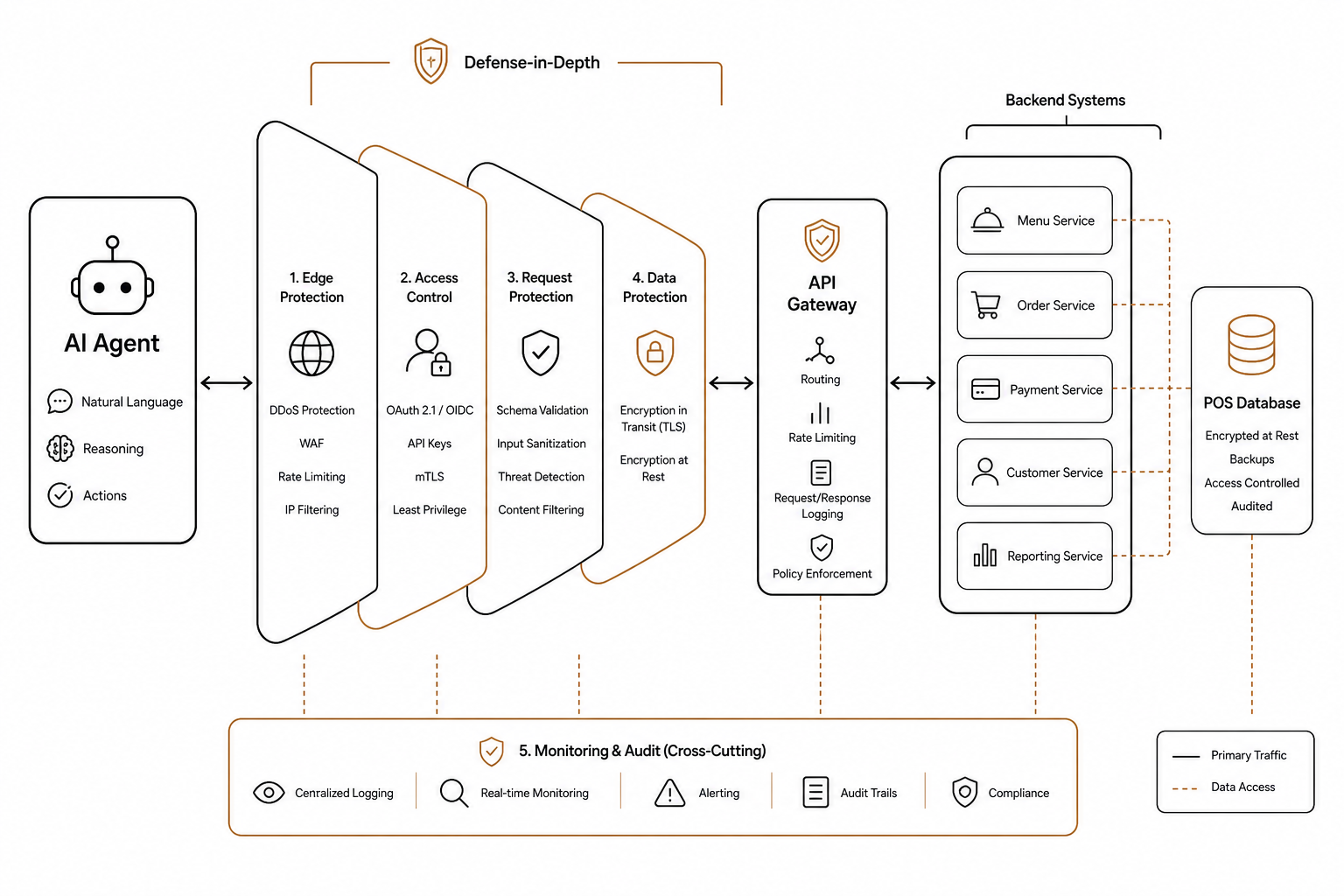
Modern hospitality brands are deploying AI agents for restaurant management to bypass administrative friction and streamline complex back-office workflows. However, transitioning from simple search queries to active operational systems introduces severe architectural challenges. Allowing an AI agent to read and modify live databases without the correct security controls is a massive business risk.
To safely leverage autonomous AI capabilities, technical managers and operators must build a defense-in-depth model around their core software. This guide covers the architectural frameworks, authentication protocols, and compliance guardrails required to connect AI systems safely to your physical operations.
Architectural patterns: how agents talk to your software
To grant an autonomous system access to your business platforms, you need a highly responsive translation layer between natural language and structured backend code.
APIs and event-driven sync
A standard API layer acts as your system's core backbone, but static pulling is too slow for fast-paced environments. Real-time operations require event-driven data flow. Implementing POS webhooks allows backend systems to push transaction updates and stock fluctuations directly to your agent's event receiver. This immediately bypasses the heavy server overhead and latency of continuous API polling.
Standardized protocols vs. custom tool building
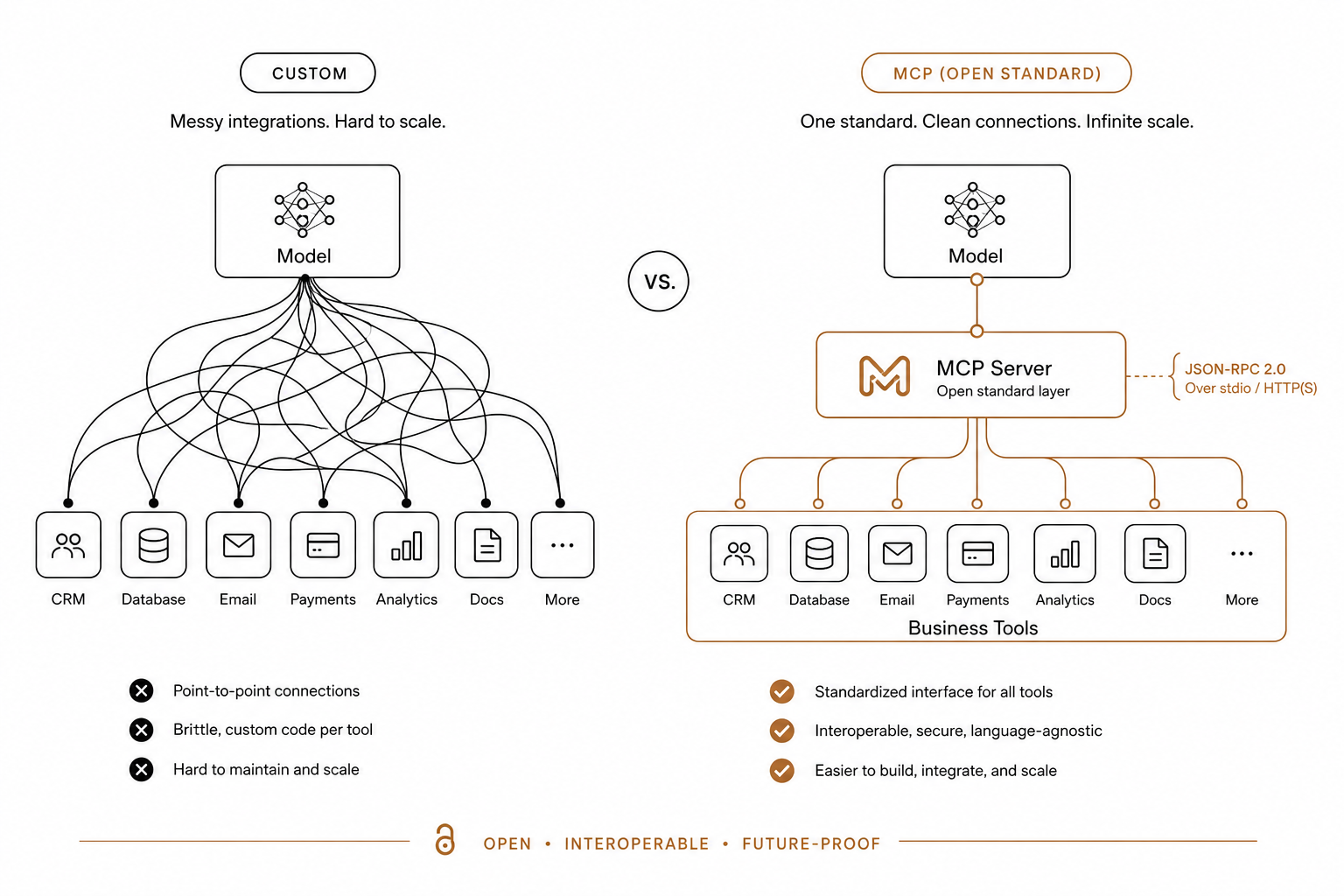
Historically, developers had to write custom tool-calling schemas for every individual endpoint. Maintaining these custom configurations across fragmented, multi-vendor systems is highly inefficient.
This integration challenge is why the industry is rapidly shifting toward open standards. Anthropic's what is Model Context Protocol (MCP) establishes an open-source, client-server framework over JSON-RPC 2.0 to solve this exact problem. When evaluating MCP vs function calling, the primary advantage of MCP is that it decouples your integration layer from the model's core logic. This clean division provides your engineering team with superior scalability, centralized security controls, and long-term maintainability.
Authentication: treat your AI agent as a non-human identity
Never hardcode permanent root API keys inside your AI system's codebase. A single compromise would expose your entire digital infrastructure.
Instead, treat every AI agent, custom integration, or automated background service as a unique non-human identity. Each agent must go through standard provisioning, lifecycle auditing, credential rotation, and clean deprovisioning paths, just like a human employee.
OAuth 2.0 and scoped access
Your infrastructure should use the OAuth 2.0 framework to manage authorization. Under this framework, agents do not operate with master administrative keys. They use short-lived access tokens configured with strictly limited scopes.
For example, an agent tasked with monitoring labor schedules should only receive an access token containing a shifts:read scope. It must never possess a write scope like pricing:write. Additionally, OAuth 2.0 refresh tokens must be kept highly confidential in transit and storage, enabling the system to renew short-lived credentials without exposing persistent authorization.
Federated assertions
For agentic systems that operate across distributed microservices, secure authentication can utilize cryptographically signed assertions. Following NIST SP 800-63C guidelines, an Identity Provider (IdP) generates a cryptographically signed assertion containing specific attributes about the agent. The receiving application validates this digital signature and enforces strict expiration times, ensuring that assertions cannot be intercepted and replayed.
Authorization: the zero trust framework
Rule number one of agentic architecture: never delegate access control to the GenAI model itself. An LLM cannot be trusted to self-police its own permissions, as it remains inherently susceptible to prompt injection and jailbreaks.
You must build all authorization and access control logic directly into the surrounding downstream systems.
┌─────────────────┐      ┌─────────────┐      ┌──────────────────────────┐
│  AI Agent / LLM  │ ───> │ API Gateway │ ───> │  Downstream App / POS   │
│  (Untrusted)    │      │ (Auth/TLS)  │      │ (Zero Trust / HITL Check)│
└─────────────────┘      └─────────────┘      └──────────────────────────┘
Zero trust principles
Applying NIST SP 800-207 standards guarantees that access to your core business systems remains secure through several essential practices:
- Every single resource request is authenticated, authorized, and evaluated dynamically on a per-session basis.
- Your API gateway enforces a strict default-deny policy, rejecting all requests unless they explicitly match a validated claim.
- All agent activities are executed within the specific security context of the active human user, preventing privilege escalation.
Tool isolation
Keep a strict division between read-capable and write-capable toolsets. Start by provisioning agents with read-only tools, such as viewing historical menus or pull-reporting databases. Only grant write access to tools – such as database updates or transactional capabilities – when a highly scoped task explicitly requires it.
Critical guardrails: mitigating excessive agency
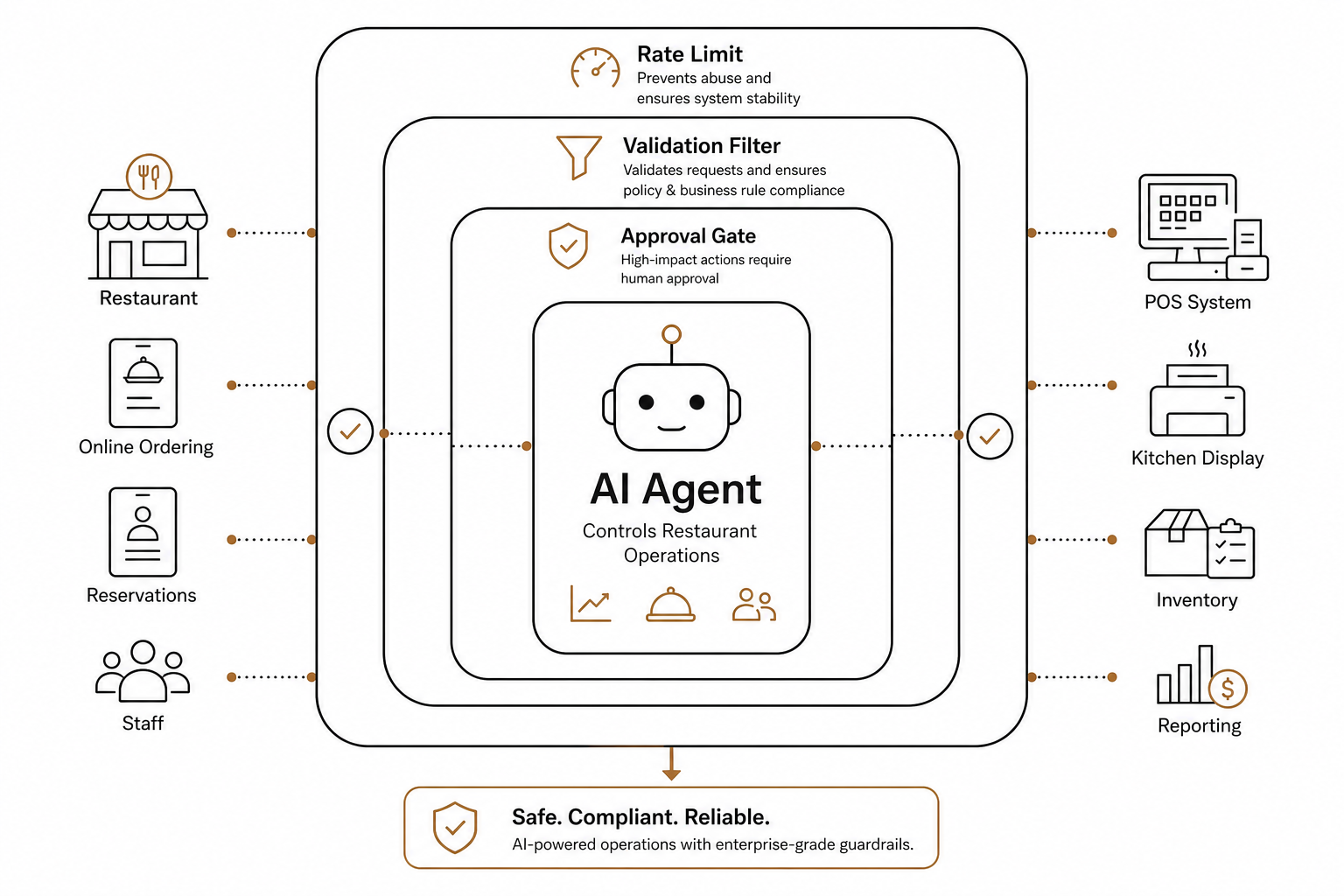
When conversational interfaces connect to physical restaurant hardware, an unvalidated model instruction can cause real-world damage. You must implement robust, multi-layered guardrails to prevent your agent from exceeding its intended operational boundaries.
Human-in-the-loop validation
High-impact, costly, or irreversible actions must require manual approval from an authorized manager. For example, updating menu layouts on your unified Spindl platform, issuing customer refunds, or dispatching inventory orders should follow a strict review cycle. The AI agent generates the data payload and stages the transaction, but it cannot execute the final command without a physical human click.
Input sanitization
Treat every output generated by an LLM as untrusted user input. Before passing the agent's output to downstream POS databases, pass it through strict schema validation and sanitization gates. This prevents injection attacks and structural errors from corrupting your core databases.
Rate limiting and throttling
AI systems can occasionally enter recursive loops, generating hundreds of API calls in a matter of seconds. Configure strict rate limits and throttling at the API gateway layer. This prevents runaway agent execution from racking up massive API compute bills or launching an unintended denial-of-service (DoS) attack against your internal servers.
Compliance: PCI DSS v4.0 and security auditing
If your agentic systems interact with platforms that touch customer payment card data, you must maintain PCI DSS compliance. Outsourcing payment management to third-party providers does not remove your compliance responsibilities.
Multi-factor authentication
According to the PCI SSC guidance for connected service providers, establishing strict account boundaries is critical. Under PCI DSS v4.0, multi-factor authentication (MFA) is required for all access into the Cardholder Data Environment (CDE). For remote technical access, follow NIST SP 800-63B standards by implementing phishing-resistant MFA authenticators (AAL2) to secure administrative channels.
Comprehensive audit trails
To satisfy security and compliance requirements, you must log and monitor every step of the agent's lifecycle. Your audit pipeline must capture:
- The user's initial natural language prompt.
- The LLM's raw reasoning steps and AI agent memory and state management changes.
- The specific tools and schemas invoked.
- The exact downstream API payload, headers, and system responses.
Streamlining secure agent access
Building these rigorous authentication, authorization, and audit layers from scratch is a massive software development challenge. Your engineering team has to manage model context windows, build secure gateway proxies, and coordinate real-time APIs simultaneously.
If you want to bring the efficiency of conversational AI to your operations safely, AgenticPOS offers an enterprise-ready solution. Operating as an open-standard MCP server, AgenticPOS connects directly to your point-of-sale – including unified platforms like Spindl – to establish a highly secure agentic POS framework.
With over 140 pre-built operational tools, integrated role-based permissions, automated human-in-the-loop approval gates, and total audit trail transparency, AgenticPOS handles the complex security architecture for you. Explore how AgenticPOS can securely transform your business operations today.