How MCP servers automate hotel PMS and guest operations
Automate hotel PMS and guest operations using MCP servers. Integrate AI agents with HTNG Express, booking engines, and AgenticPOS to drive operational
Flat performance is pressuring hotels to find new operational efficiencies. According to recent industry data, U.S. hotel revenue per available room (RevPAR) grew a mere 0.2% year-to-date, with occupancy dropping 0.8% as rising average daily rates struggle to offset the occupancy decline. Under these market conditions, efficiency is the ultimate survival play. Industry analysts recommend that hospitality companies rapidly accelerate AI adoption to automate manual tasks and transition into predictive, lean enterprises.
Yet, deploying an autonomous AI agent to handle real-world operations has traditionally been a highly complex engineering challenge. This is where the Model Context Protocol steps in.
The integration bottleneck meets the Model Context Protocol
Historically, connecting an AI application to a hotel’s software suite required writing custom APIs for every single interaction. This is known as the "M×N integration problem" – a structural bottleneck where every new AI tool requires a bespoke connector for every existing database or operational system of record.
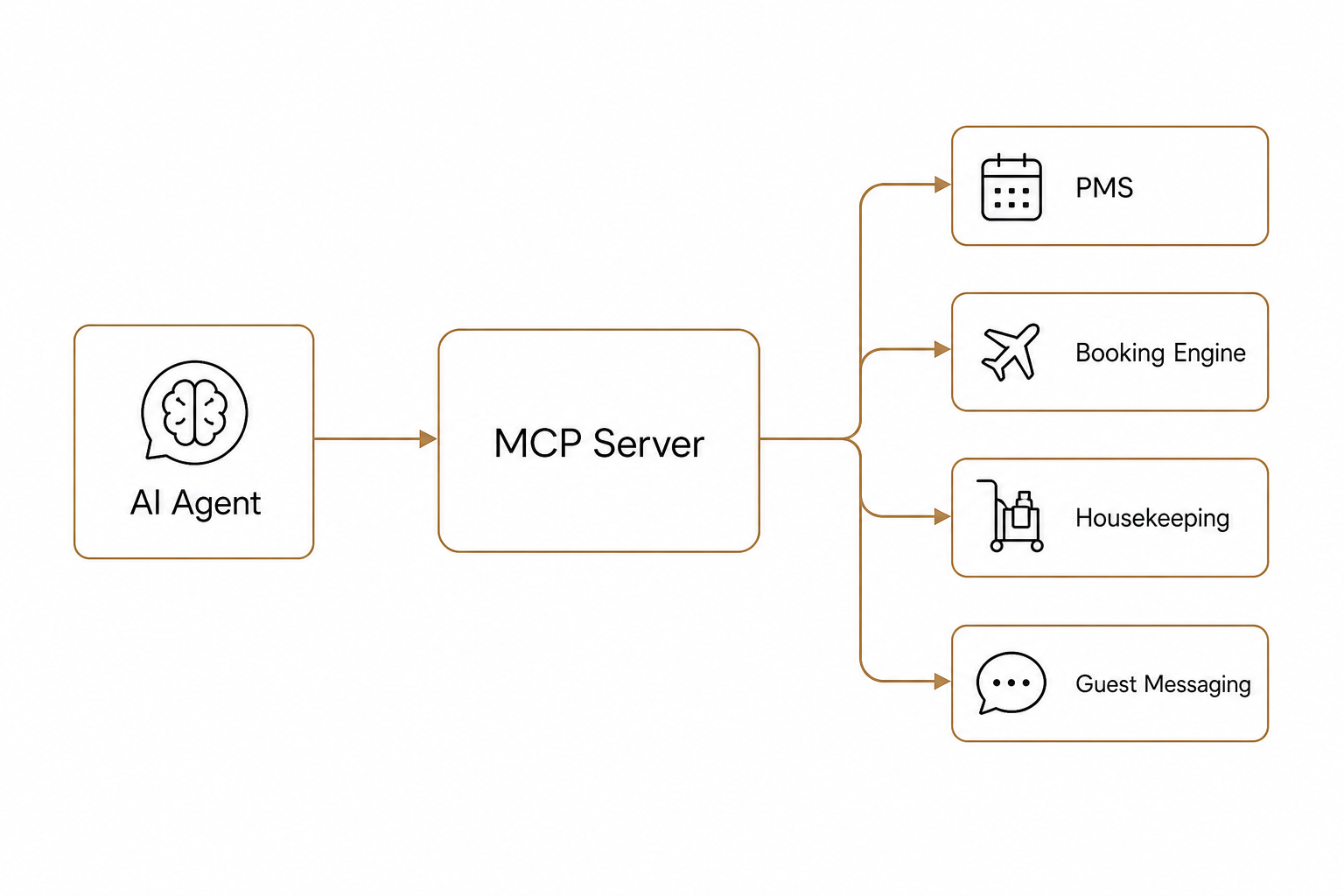
The Model Context Protocol (MCP) is an open-source standard developed by Anthropic that acts as a universal adapter between Large Language Model (LLM) applications and external data sources. Instead of building endless custom integrations, developers expose their systems by building a single MCP server. Any compliant AI agent can then query that server to discover its available tools, resources, and prompts at runtime.
Unlike basic function calling, which requires developers to manually hard-code API payloads for specific models, MCP standardizes how AI systems securely query databases, retrieve context, and execute actions. To understand how these technical patterns differ under the hood, read our breakdown of MCP vs. function calling.
Bridging AI agents to the hotel PMS with HTNG Express
A hotel’s Property Management System (PMS) is its central operational hub. It manages reservations, guest profiles, room assignments, housekeeping schedules, and front-office billing. Because of the legacy architecture underlying most PMS software, integrating third-party AI tools has traditionally been a multi-month project fraught with compatibility issues.
To bypass this friction, the hospitality technology standards body HTNG introduced HTNG Express. This lightweight API standard is designed specifically to accelerate PMS integrations, focusing heavily on post-booking operations. HTNG Express standardizes how external applications access and modify four core database entities:
- Reservations: Managing booking dates, room classes, and payment statuses.
- Guests: Reviewing guest profiles, contact details, and past preferences.
- Rooms: Checking physical room assignments, cleaning statuses, and maintenance schedules.
- Folios: Handling real-time billing, invoicing, and front-office accounting.
By wrapping an HTNG Express-compliant API in an MCP server, you map these PMS database entities directly into "agent-callable tools" that an LLM can understand and manipulate.
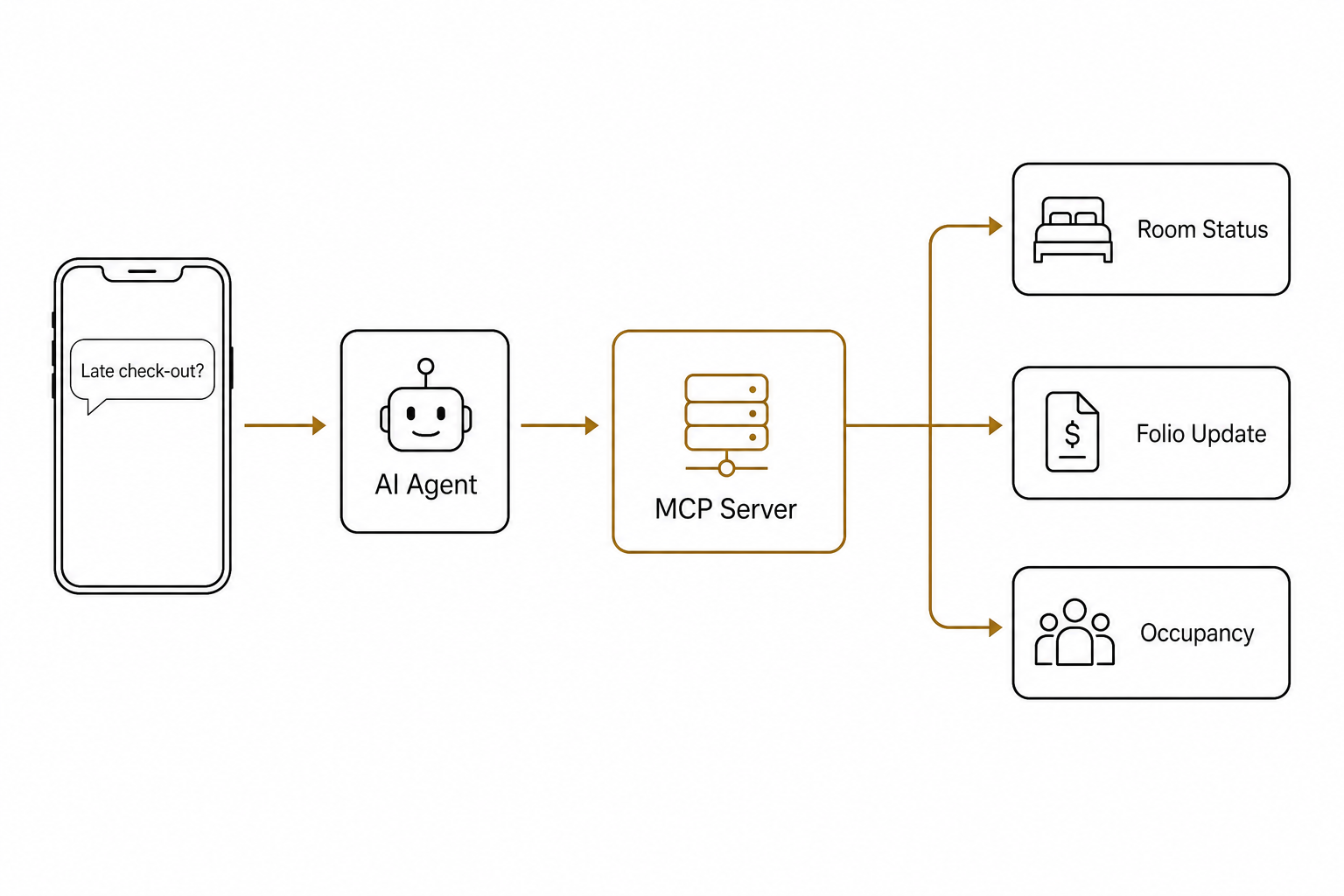
Consider the operational impact. Instead of a front-desk agent manually clicking through a legacy dashboard, an AI agent connected via MCP can process complex guest requests instantly. When a guest texts the hotel requesting a late check-out, the AI agent queries the room status via the MCP server, verifies occupancy projections, updates the guest's folio, and adjusts the PMS record in seconds. HTNG Express reduces PMS integration times from months to under a week, making rapid AI deployment highly scalable. This directly matches guest demand: nearly 80% of travelers are willing to stay at a hotel with an automated front desk, and over 40% prefer digital check-ins.
Automating booking engines and guest messaging
A hotel booking engine allows guests to check real-time availability, select room types, and complete direct reservations online without human intervention. When connected to an MCP server, a standard booking engine transforms into a dynamic conversational commerce tool.
To power these workflows in real time, hotels can utilize event-driven POS webhook integrations to stream live booking and pricing events to their AI systems. Instead of forcing guests to navigate rigid search filters, an AI assistant can manage the entire booking flow through natural language. A guest can simply state: "I need a quiet room with a king bed for three nights starting next Tuesday, and I want to add early check-in."
The AI agent uses the booking engine’s MCP tools to query live rates, compile available upsells, and draft the reservation. Once the guest confirms, the agent processes the booking, passes the reservation data directly to the PMS, and triggers an automated confirmation email. This frictionless process minimizes booking abandonment and allows properties to capture high-margin, direct bookings without paying third-party commissions.
Completing the stack: Connecting hotel F&B with AgenticPOS
Hotel operations do not stop at room doors. On-property restaurants, bars, and room service represent a massive percentage of overall property revenue. To build a truly cohesive guest experience, your food and beverage (F&B) systems must be as connected as your PMS.
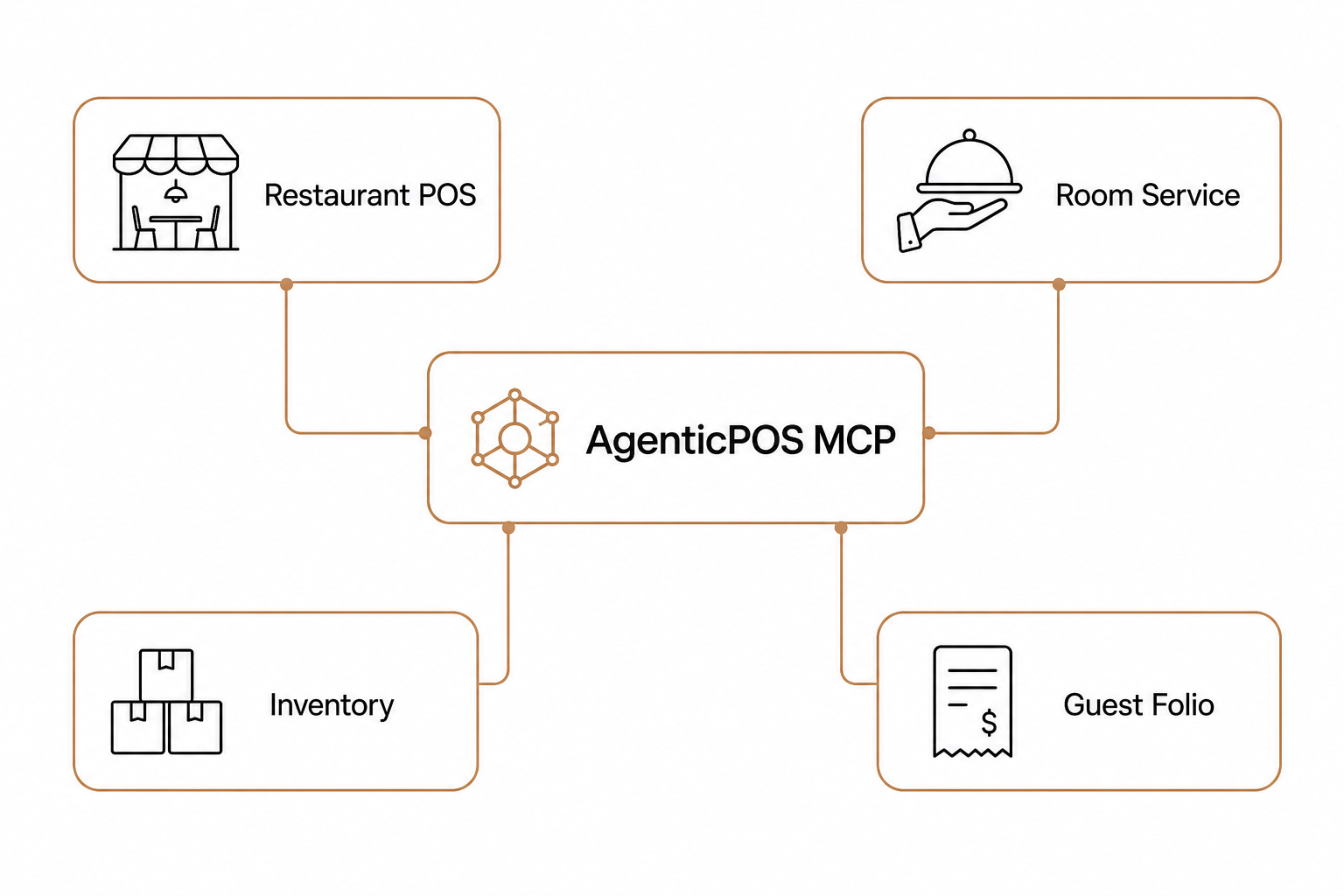
This is where AgenticPOS bridges the gap. Designed as an open MCP server, AgenticPOS connects directly to restaurant point-of-sale systems, translating complex back-office operations into a library of over 140 agent-callable tools.
While AgenticPOS integrates with legacy platforms, it functions best when paired with Spindl, the premium, all-in-one restaurant management platform. Spindl consolidates order taking, delivery apps, self-service, POS, and loyalty into a single device. While traditional POS hardware is clunky and outdated, Spindl is designed like an iPhone – intuitive, fast, and engineered for modern digital transformations.
By deploying AgenticPOS alongside an AI agent, you can automate your hotel's F&B operations via natural language:
- Autonomous Room Service: Guests order meals through a text-based AI concierge. The agent uses AgenticPOS to check live menu availability, place the order directly into the kitchen POS, and bill it straight to the guest's PMS room folio.
- Real-time Stock Control: The agent monitors ingredient depletion, tracks margins, and automatically drafts purchase orders when stock levels run low. Learn how to eliminate manual discrepancies with our guide on POS integration with inventory software.
- Smart Yield Management: If a rainy afternoon keeps guests indoors, the AI agent can instantly create a room-service promotion, update pricing, and push the notification directly to active guests.
To explore how these architectures work under the hood, read our complete guide to what is an agentic POS.
Security, compliance, and guest privacy
Letting an AI agent access guest records, process payments, and modify room assignments requires strict security infrastructure. If you are executing state-changing operations through automated models, security cannot be an afterthought.
Transport-level authorization
MCP deployments must enforce robust authorization protocols. The Model Context Protocol mandates the use of OAuth 2.1 at the transport level to manage permissions securely. MCP clients must present an HTTP Authorization header containing a valid access token for every request, which the MCP server validates before returning sensitive operational data.
PCI DSS compliance
Any system handling credit card data in the United States must comply with the Payment Card Industry Data Security Standard (PCI DSS), regardless of transaction volume. AI agents should never process or store raw cardholder data directly. Instead, they must interact with PCI-compliant payment gateways using end-to-end encryption and secure tokenization.
CCPA and privacy laws
Hotels must navigate overlapping state and federal privacy laws, such as the California Consumer Privacy Act (CCPA). AI agents must be architected with strict data-handling policies, allowing them to locate and permanently delete a guest’s personal data upon request.
Hybrid memory and state management
For complex, multi-step actions – like modifying a reservation while updating a dinner booking – AI agents require structured memory. This involves a hybrid memory architecture that isolates active, short-term session data from secure, long-term semantic records. To understand how to build these safeguards, explore our guide on architecting persistent memory for AI agents.
Connect your guest operations today
Integrating your PMS, booking engines, and restaurant POS through open protocols is the fastest way to drive operational efficiency, lower staff overhead, and elevate the guest experience.
By utilizing open MCP standards, you avoid vendor lock-in and retain complete control over your hotel's digital ecosystem. To see how conversational AI can streamline your on-property F&B, retail, and back-office workflows, start your AgenticPOS trial today.