Run your restaurant with natural-language commands
Streamline restaurant operations with natural-language commands. Use AI agents to automate menu updates, inventory, and scheduling to reclaim manager time.
Restaurant operators face a persistent, exhausting margin squeeze. According to data from the National Restaurant Association, labor costs have surged 35% since 2019, deeply impacting overall profitability. In 2024, salaries and wages devoured a median of 36.5% of sales for full-service restaurants, and 31.7% for limited-service concepts, as analyzed in the National Restaurant Association labor report. With persistent inflation and rising food costs, margins are razor-thin, and many operators reported their restaurants were unprofitable last year.
Despite these pressures, valuable manager hours are regularly wasted on manual administrative work. Managers spend significant portions of their shifts clicking through tedious point-of-sale dashboards, adjusting menus, and updating spreadsheets.
There is a more efficient approach. Instead of navigating dozens of nested drop-down menus, forward-thinking operators are starting to control their entire back-of-house operations using natural-language commands. By transforming your restaurant management system from a series of manual inputs into a simple conversation, you can reclaim your team's time and protect your bottom line.
What are natural-language commands in restaurant tech?
For decades, software required humans to adapt to its strict terminology. You had to learn where specific buttons were hidden, export CSV files, and input structured data into precise fields.
Natural-language commands completely invert this dynamic. Instead of you adapting to the machine, the software understands your natural speech.
Leading technology providers define this capability through the lens of artificial intelligence. According to IBM's AI agent definition and AWS's overview of AI systems, an AI agent is a software program that uses advanced natural language processing to comprehend user inputs, generate human-like responses, and autonomously perform multi-step tasks to achieve a predetermined goal.
In a restaurant context, deploying an AI agent for restaurant management is like hiring an autonomous virtual assistant. When you type or say a command, the agent translates your plain English into a digital action. The agent accesses your database, compiles the metrics, and delivers the answer. By utilizing what is an AI agent at its core – a language model linked to operational tools – you bypass the administrative friction of legacy software.
Practical use cases for restaurant operators
Managing a restaurant with text commands is no longer a futuristic concept. By integrating conversational tools with your existing systems, you can streamline several core workflows.
Instant menu and price adjustments
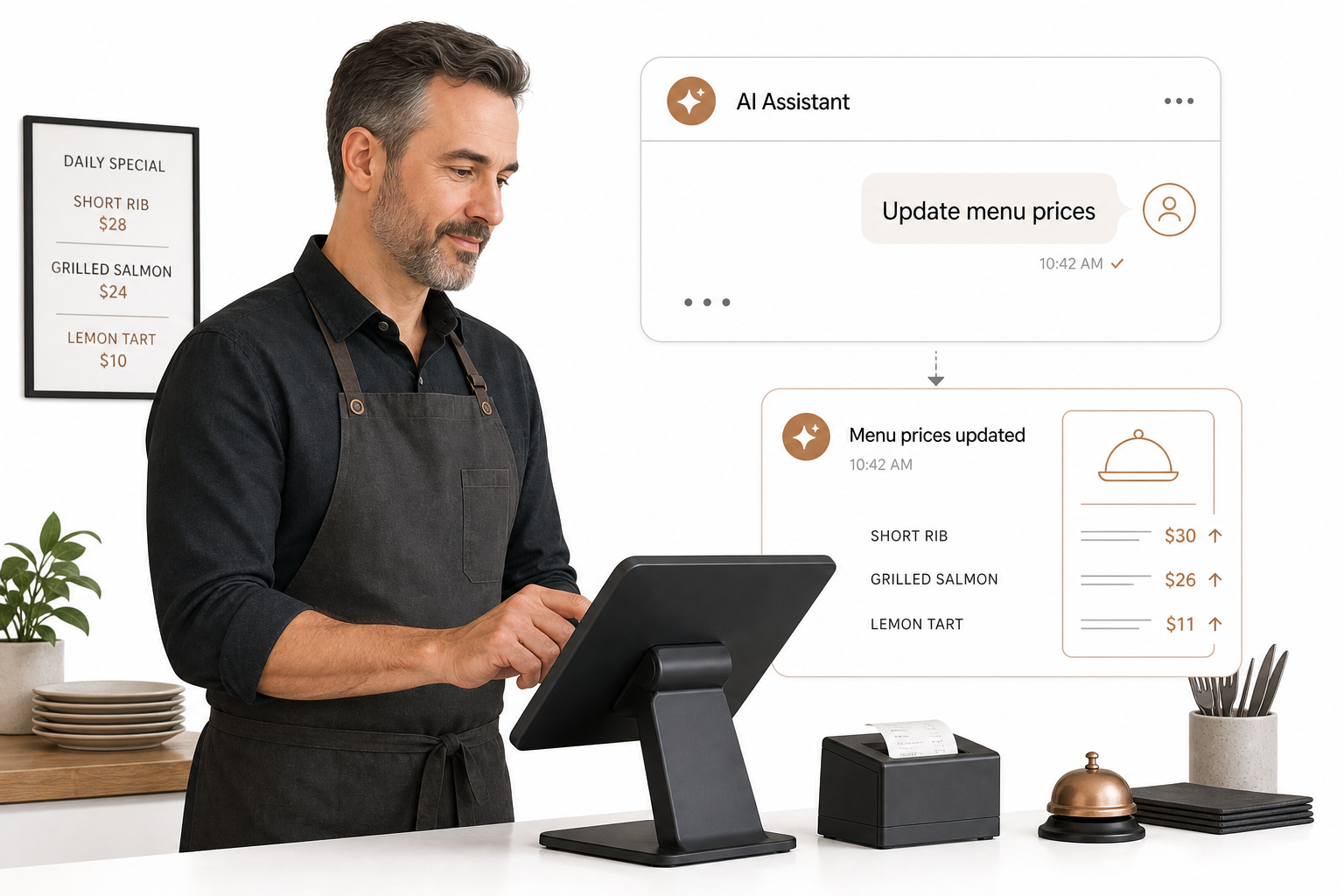
Manually updating menu prices across physical terminals and multiple third-party delivery channels is a notoriously slow, error-prone task. With natural-language commands, you can learn how to do a menu price increase in POS systems instantly:
- The command: "Raise the price of all draft beers by $0.50 across all channels starting Friday."
- The action: The agent accesses your menu configuration, updates the pricing tiers, and schedules the change to go live simultaneously on your register and delivery apps.
Real-time inventory and 86ing items
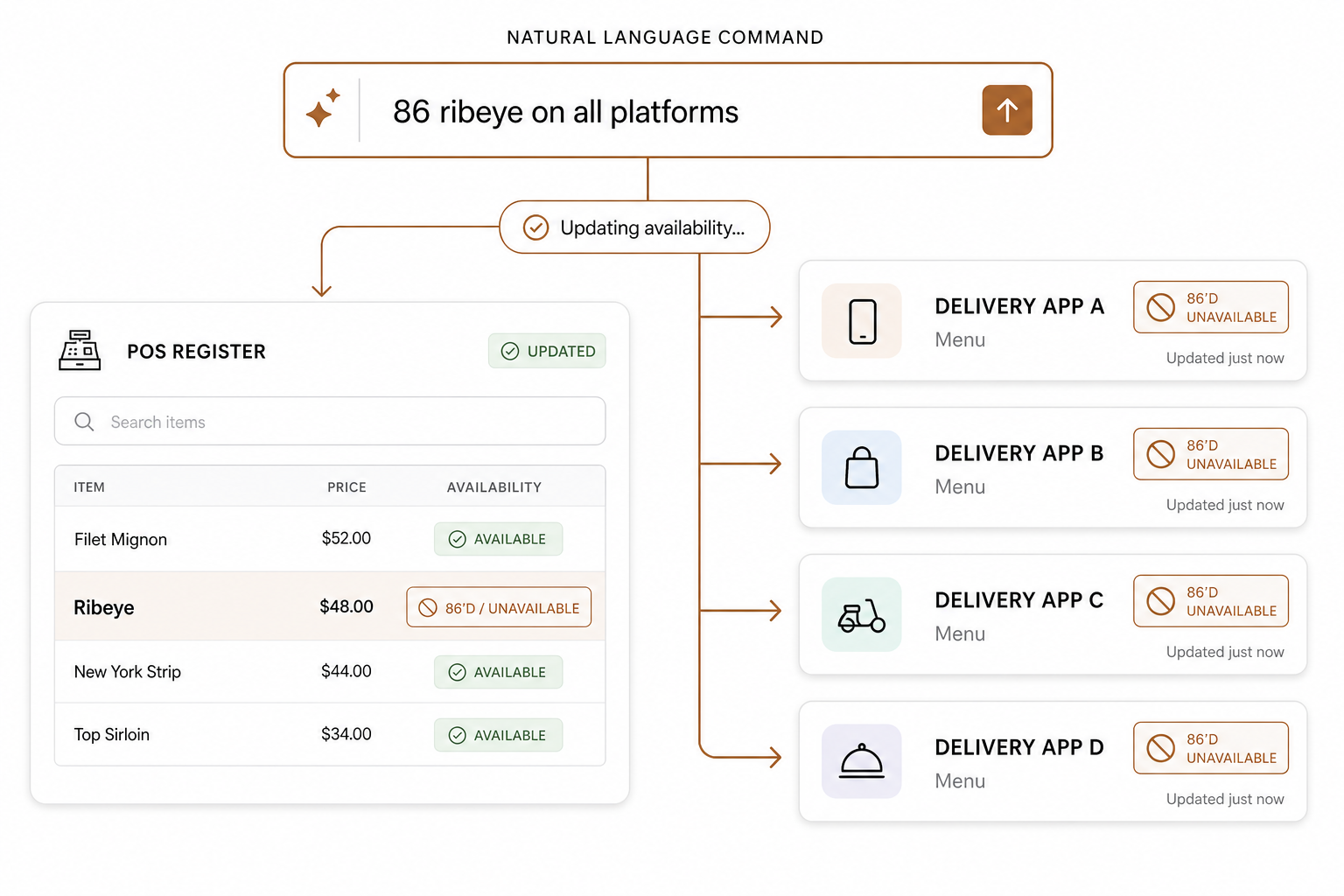
When an ingredient runs out mid-service, a manager has to log into multiple delivery tablets to "86" the affected dishes. If they miss even one platform, a customer orders an unavailable item, leading to a cancelled order, a bad review, and lost revenue.
Modern, highly integrated point-of-sale platforms like Spindl – which acts as an all-in-one platform to run order taking, delivery, and self-service from a single device – solve this complexity. When backed by AI tools, handling outages becomes instantaneous:
- The command: "We are out of ribeye. 86 the ribeye steak on all platforms."
- The action: The agent immediately marks the item unavailable on your Spindl register, DoorDash, UberEats, and Grubhub.
Automated inventory and margin alerts
Inventory is where your cash gets trapped. Manual stock counts on clipboards are slow, inaccurate, and instantly out of date. By deploying restaurant automation software, you can manage vendor orders and monitor margins using conversation:
- The command: "Draft a purchase order for our weekly produce based on our sales forecast for this weekend."
- The action: The agent reviews historical sales trends, checks current stock levels, calculates the required ingredients, and creates a purchase order draft. It can also run POS system integration with inventory software to automatically flag margin leaks or price discrepancies before you approve the order.
Rapid scheduling and shift updates
Managing shifts on spreadsheets is a recipe for miscommunication. When unexpected events occur, updating schedules is a headache. You can easily manage these changes via a chat interface, as detailed in our restaurant workflow automation guide:
- The command: "Add an extra server to the Friday night shift to cover the local concert crowd."
- The action: The agent checks staff availability, assigns an eligible employee, and sends a notification directly to their phone.
How the technology works under the hood
The ability to run your restaurant via text relies on a secure, standardized connection between your language model and your live database.
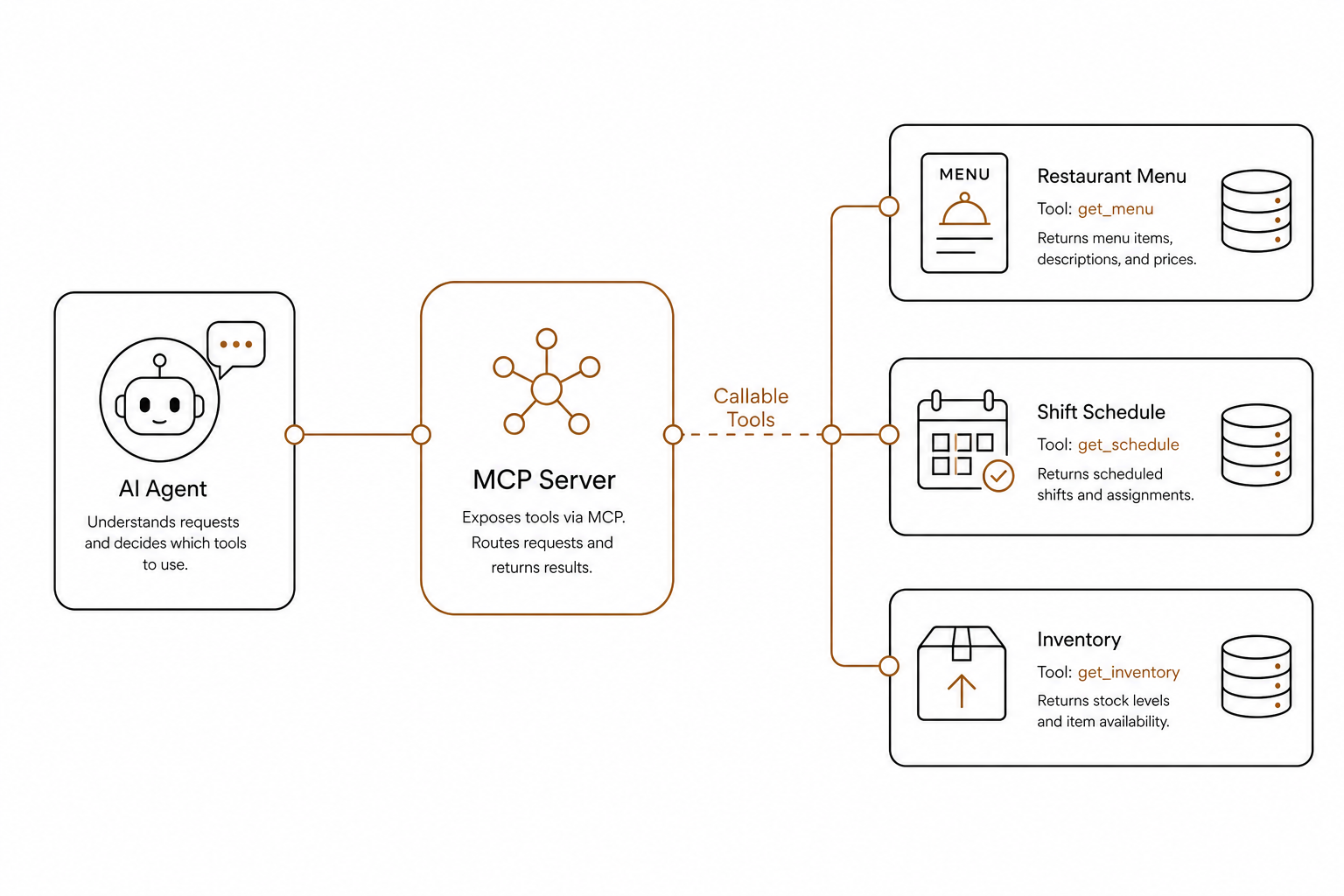
This connection is built on the Model Context Protocol (MCP), an open-source standard introduced by Anthropic. Think of MCP as a universal "USB-C port" for AI. It allows large language models (like Claude or ChatGPT) to securely read data and execute actions inside your physical systems.
By installing an MCP server on top of your point-of-sale system, your menus, shifts, and inventory databases are mapped into "agent-callable tools." Instead of a human navigating a complex UI, the AI agent uses these tools to retrieve context and complete your requested tasks. To maintain continuity over multiple operational requests, developers are architecting persistent memory for AI agents to store previous context and preferences. This turns your restaurant's tech stack into a true agentic POS that understands the unique state of your store at any given minute.
Ensuring security and operator control
Entrusting an AI agent with live business data requires strict security guardrails. You should never give an autonomous system free rein over your financials, vendor agreements, or menu pricing without oversight.
Industry best practices, including the NIST AI Risk Management Framework and Microsoft's AI agent governance guidance, emphasize several non-negotiable risk controls for business environments:
- Human-in-the-loop (HITL): Major operational actions – such as sending a wire transfer, changing vendor agreements, or executing a sitewide price hike – must require explicit confirmation from a human manager before they are executed.
- Detailed decision traces: The system must maintain detailed, auditable logs of every action, tool call, and reasoning step the agent takes.
- Least-privilege access: AI agents should only be granted access to the specific software tools and databases necessary to complete their assigned functions.
- Reversibility: If an agent executes an incorrect update, the operator must have the ability to roll back the changes with a single click.
The outlook for conversational restaurant tech
The appetite for digital transformation is growing rapidly. According to the National Restaurant Association’s Restaurant Technology Landscape Report, 73% of restaurant operators increased their investments in technology last year.
Furthermore, 52% plan to incorporate technology into back-office functions, and 37% intend to adopt automated labor management or scheduling systems. While only 16% of operators have actively deployed dedicated AI solutions, those who do are gaining a massive competitive edge by freeing their managers from administrative friction.
Technology integration is designed to augment human labor, not replace it. By using natural-language commands to run your back-of-house, you can take your managers out of the office and put them back on the floor where they can focus on what actually matters: your guests and your food.
Turn your POS into a conversation
Ready to see how conversational commands can simplify your daily workflows?
At AgenticPOS, we build the MCP infrastructure that connects existing POS systems – including ultra-modern, all-in-one platforms like Spindl – directly to AI agents. Our system exposes over 140 agent-callable tools across menu management, scheduling, inventory, and real-time reporting, all protected by strict operator controls and rollbacks.
Explore our AgenticPOS blog to learn more about the future of agentic POS architecture, or contact our team today to find out how you can start running your restaurant using plain text.